EN
EN

One Month to Go: EU New Battery Law August 18 Deadline — How Car Jump Starter Importers Can Avoid Delisting Risks
Europe’s automotive jump starter market is entering a dual window of “compliance reshuffling” and “peak-season stocking.” Companies that move early on compliance are more likely to secure shelf space and traffic, while late movers may face product delisting and customs-clearance delays.
If you are a European importer, brand owner or procurement manager of automotive jump starters, the next thirty days may determine whether your products can reach shelves for the peak season and whether your Amazon listings can remain active. Regulation (EU) 2023/1542 has replaced the former battery directive and introduced a unified regulatory framework across the EU. For portable batteries, the industry is preparing for the August 18 compliance milestone covering labelling, capacity information and related documentation.
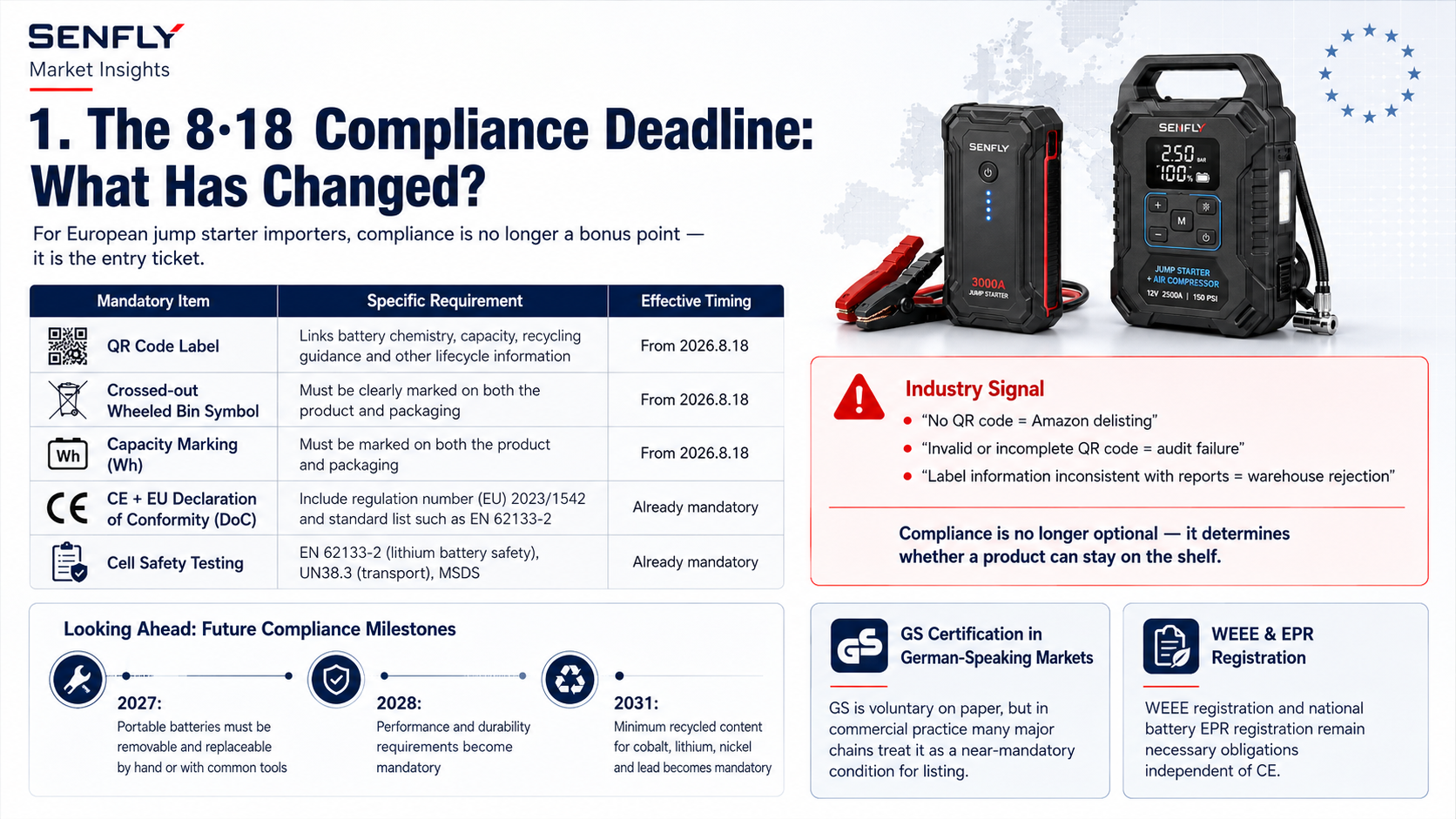
Key compliance changes, future milestones, GS expectations and WEEE/EPR obligations.
1. The August 18 Compliance Deadline: What Has Changed?
Portable automotive jump starters generally fall within the “portable battery” category, as their battery capacity is usually limited to several dozen watt-hours. Importers therefore need to prepare the following items at product and packaging level:
| Mandatory Item | Specific Requirement | Implementation Timing |
|---|---|---|
| QR code label | Links to battery chemistry, capacity, recycling guidance and other lifecycle information. | From August 18, 2026, according to the source article. |
| Crossed-out wheeled-bin symbol | Clearly displayed on the product and packaging. | From August 18, 2026, according to the source article. |
| Capacity marking in Wh | Capacity must be shown on both the product and packaging. | From August 18, 2026, according to the source article. |
| CE marking and EU Declaration of Conformity | The DoC should reference Regulation (EU) 2023/1542 and list the applicable standards, such as EN 62133-2. | Already mandatory. |
| Cell safety documentation | EN 62133-2 for lithium battery safety, UN38.3 for transport and MSDS documentation. | Already mandatory. |
Importers should also plan for later milestones. From 2027, portable batteries are expected to become removable and replaceable by hand or with commonly available tools. From 2028, performance and durability requirements — including rated capacity, cycle life and self-discharge — will become more important. From 2031, minimum recycled-content requirements for cobalt, lithium, nickel and lead will enter the mandatory phase.
For German-speaking markets, GS certification remains voluntary in legal terms, but large chains such as OBI, Bauhaus and Hornbach often treat it as a practical prerequisite for listing. WEEE registration and national battery EPR registration are separate obligations and should not be treated as substitutes for CE compliance.
Market Practice Reference
The completeness of compliance documentation is becoming a core criterion when European importers screen suppliers. Senfly’s main product range is supported by CE documentation and IEC/EN 62133-2 battery safety reports. The factory also operates under IATF 16949 and ISO 9001 management systems and maintains a CNAS-accredited laboratory, enabling test data and traceability documents to be prepared at batch level rather than added only after shipment.
For brands preparing for the August deadline, confirming whether an upstream supplier can deliver model-specific labels, declarations and technical files is far more reliable than trying to repair missing documentation after a marketplace audit has already failed.
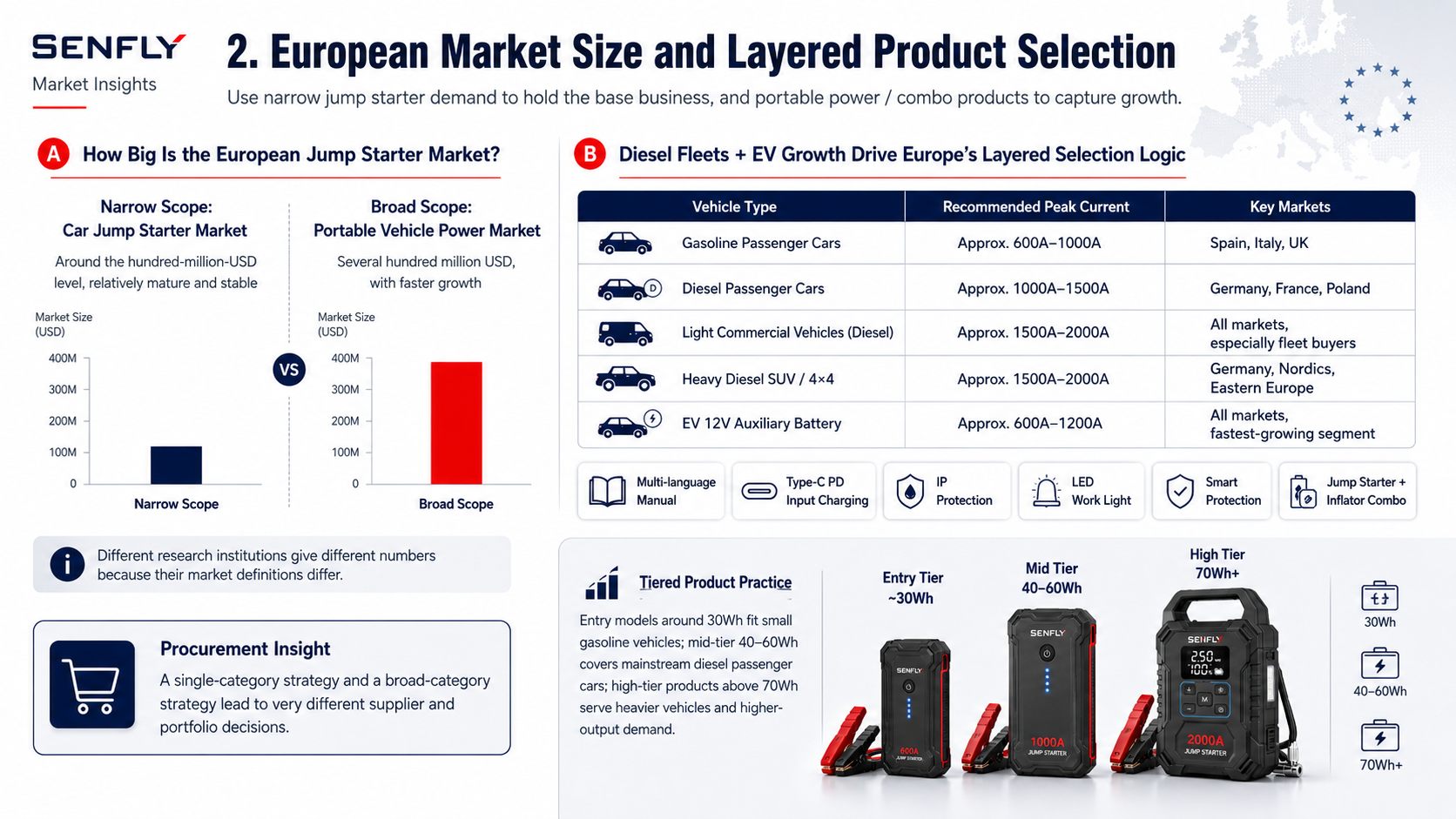
Market-size interpretation and a layered product-selection logic for petrol, diesel, LCV and EV auxiliary-battery applications.
2. How Large Is the European Jump Starter Market?
Market-size estimates vary substantially among research institutions. The main reason is the difference in category definition. Under a narrow definition, the automotive jump starter market is a mature category at roughly the hundred-million-US-dollar level. When portable vehicle-power equipment, combination units and portable power stations are included, the addressable market expands to several hundred million dollars and shows stronger growth.
For procurement teams, the practical interpretation is straightforward: use conventional jump starters to secure the core business and use portable power and multifunction combination products to capture incremental growth. A single-category strategy and a broad-category strategy lead to very different supplier-selection and portfolio decisions.
Product-Line Coverage in Practice
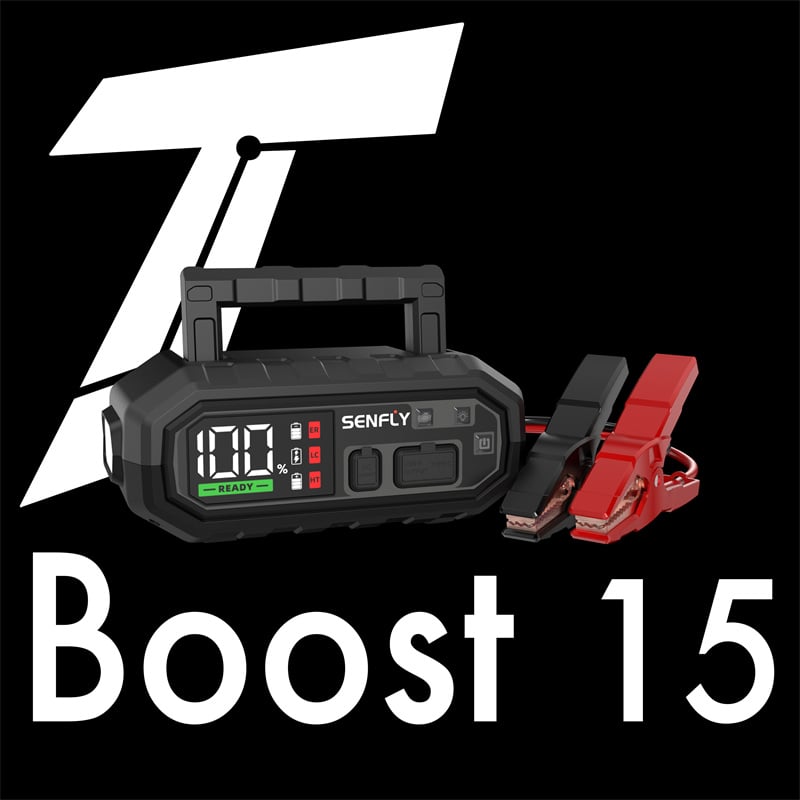
Manufacturers capable of offering pure jump starters, jump-starter-and-inflator combination units and higher-capacity portable power products under one platform remain relatively limited. Senfly’s portfolio includes pure jump starter models such as T11, T13-A and G32L, as well as combination products including T25, T38, T39, T53 and T67. For importers that want to cover multiple European channel tiers with several SKUs, using one supplier across multiple categories can reduce compliance-management and supply-chain coordination costs.
3. Diesel Fleets and EVs: Europe’s Layered Product-Selection Logic
Europe combines a relatively high share of diesel passenger cars, a large light-commercial-vehicle base and one of the world’s fastest-growing EV fleets. This vehicle structure creates product preferences that differ from those in the United States.
| Vehicle Type | Recommended Peak Current | Key Markets |
|---|---|---|
| Gasoline passenger cars | Approx. 600A–1000A | Spain, Italy, United Kingdom |
| Diesel passenger cars | Approx. 1000A–1500A | Germany, France, Poland |
| Light commercial vehicles, diesel | Approx. 1500A–2000A | Across Europe, particularly fleet buyers |
| Heavy diesel SUVs and 4×4 vehicles | Approx. 1500A–2000A | Germany, the Nordics and Eastern Europe |
| EV 12V auxiliary battery | Approx. 600A–1200A | All markets; one of the fastest-growing use cases |
A “one SKU for all of Europe” strategy is becoming less realistic. Diesel-dominant markets need higher-output models; entry-level units can cover many southern European petrol vehicles; and EV auxiliary-battery support is emerging as a distinct segment. Layered stocking is more consistent with real channel demand than relying on a single hero product.
European distributors also frequently request multilingual manuals — at minimum English, German and French, ideally with Dutch, Polish, Spanish and Italian — together with USB-C PD input charging, a meaningful level of environmental protection, integrated LED work lights, intelligent reverse-polarity, overcharge and short-circuit protection, and jump-starter-plus-inflator combination products. The combination category is gaining particular attention in Germany and France.
Tiered Product Practice
For Europe’s diverse vehicle mix, some suppliers have built a complete ladder from entry to high output. Within Senfly’s T-series combination portfolio, entry models around 30Wh can serve smaller petrol vehicles, mid-tier 40–60Wh products address mainstream diesel passenger-car requirements, and higher-tier products above 70Wh provide stronger output for demanding applications. This allows importers to complete several power tiers with one supplier rather than managing a different factory for every performance level.
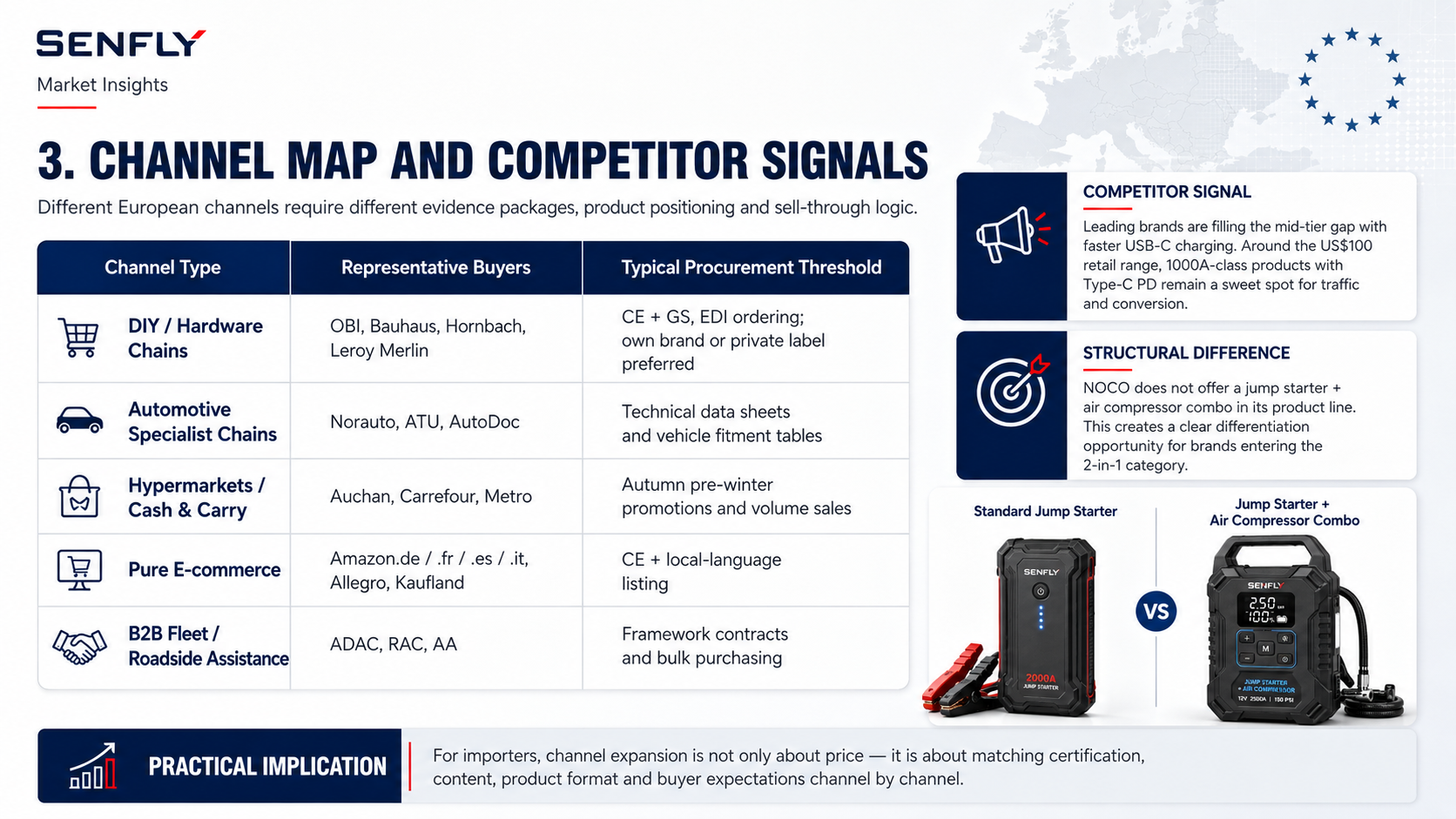
Channel requirements, representative buyers and differentiation opportunities in the European jump starter market.
4. Channel Map and Competitor Signals
| Channel Type | Representative Buyers | Typical Procurement Threshold |
|---|---|---|
| DIY and hardware chains | OBI, Bauhaus, Hornbach, Leroy Merlin | CE and often GS, EDI ordering, private-label or white-label capability |
| Automotive specialist chains | Norauto, ATU, AutoDoc | Technical data sheets and vehicle-fitment tables |
| Hypermarkets and cash-and-carry | Auchan, Carrefour, Metro | High-volume autumn promotions before winter |
| Pure e-commerce | Amazon.de, Amazon.fr, Amazon.es, Amazon.it, Allegro, Kaufland | CE documentation and localized listings |
| B2B fleet and roadside assistance | ADAC, RAC, AA | Framework contracts and bulk purchasing |
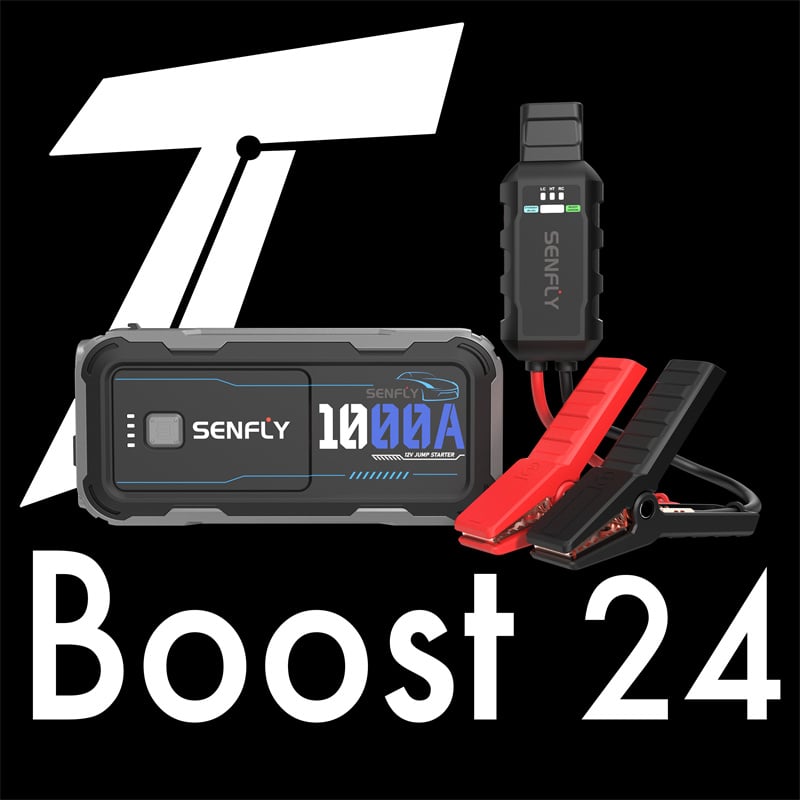
Competitor activity indicates that leading brands are filling the middle of the market with faster USB-C charging and approximately US$100 retail positioning. Products in the 1000A class with Type-C PD charging therefore remain a strong traffic and conversion zone between low-priced entry units and premium models.
Structural Difference
The source article highlights that NOCO does not currently offer a jump starter plus air compressor combination model in its main product line. This creates an opportunity for brands entering the two-in-one category to establish a clearer position instead of competing only on conventional peak-current claims.
Senfly’s combination range covers capacity levels from approximately 30Wh to nearly 90Wh. For importers building differentiated Amazon or offline assortments, the “two functions in one product” proposition is often easier for consumers to understand than a purely specification-driven comparison.
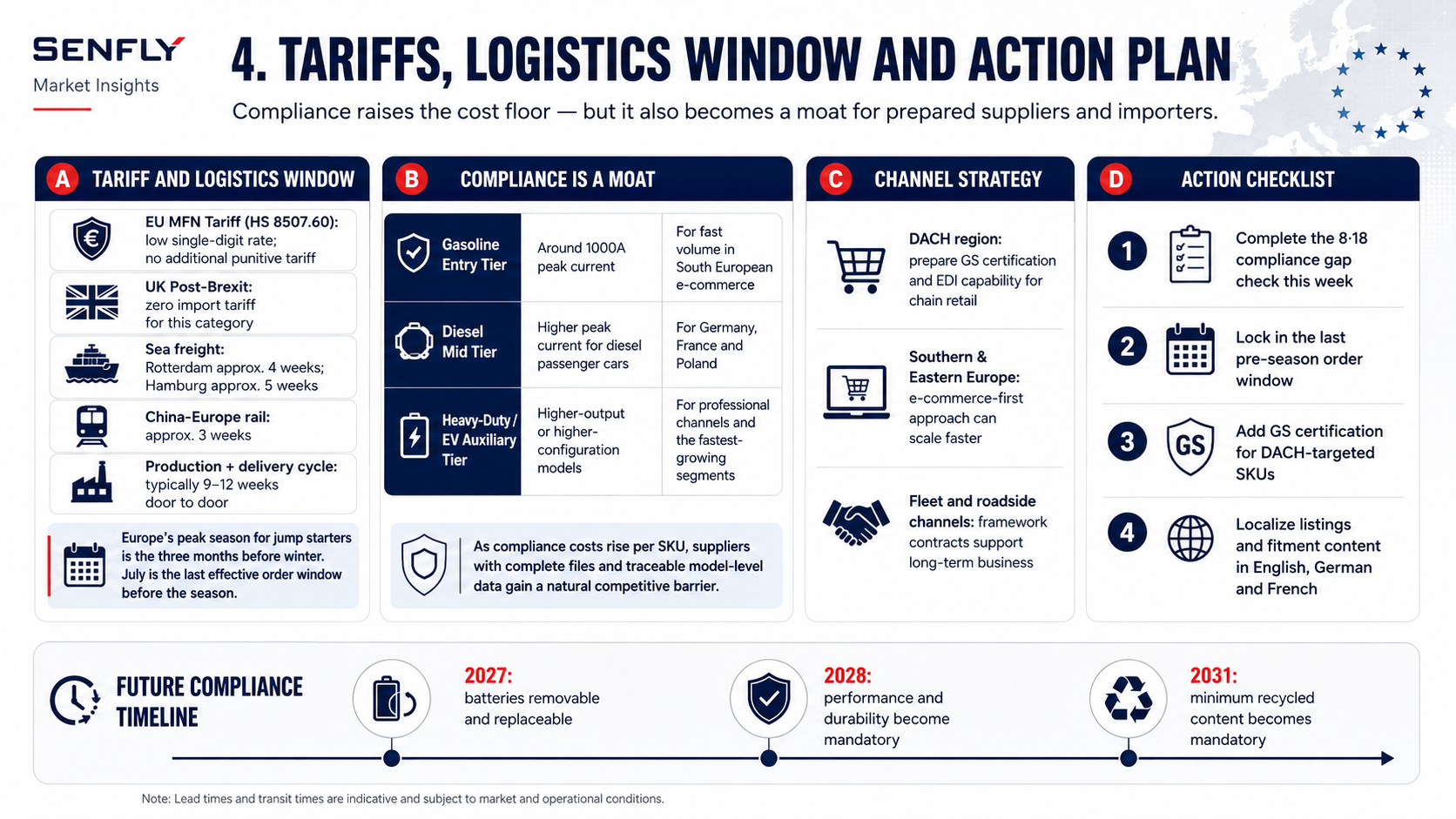
Tariff and logistics reference, compliance moat, channel strategy and immediate action checklist.
5. Tariffs and the Logistics Window
European importers generally face a more favourable tariff environment than their US counterparts. According to the source article, the EU’s basic most-favoured-nation tariff for automotive jump starters under HS 8507.60 is at a low single-digit level, without an additional punitive tariff. The United Kingdom applies zero import duty to this category after Brexit.
Typical lead times cited in the source article are approximately four weeks by sea to Rotterdam, five weeks to Hamburg and three weeks by China–Europe rail. With a production cycle of around four weeks, the total order-to-delivery period is usually nine to twelve weeks.
The three months before winter form the main seasonal sales window. To reach the market before peak demand, July is presented as the last effective ordering window. After that point, importers may need to rely on rail or air freight, while lithium-battery air transport involves higher cost and tighter restrictions.
6. Compliance as a Moat: Product Strategy and Actions
The new battery framework is reshaping competition. QR-code preparation, declarations, safety reports, multilingual manuals and EPR obligations all raise the fixed compliance cost of every active SKU. At the same time, this threshold can become a compliance moat: suppliers and brands with complete documentation are more likely to take the shelf space and listings left by non-compliant competitors.
A three-tier product matrix can cover the main needs:
- Gasoline entry tier: approximately 1000A-class peak current for rapid growth through southern European e-commerce.
- Diesel mid tier: higher-output products for Germany, France and Poland.
- Heavy-duty and EV auxiliary tier: higher-configuration products for professional channels and faster-growing specialist segments.
For channel development, German-speaking retail chains often require GS certification and EDI capability. Southern and Eastern European e-commerce can usually scale more quickly. Fleet and roadside channels are better suited to framework contracts and stable long-term orders.
Upstream Supplier Evaluation
When assessing a supplier’s compliance-delivery capability, importers should ask whether model-specific IEC 62133-2 reports can be provided, whether technical files — including BOMs, circuit diagrams and traceability data — are complete, and whether packaging and label artwork can be switched before the relevant regulatory milestone.
Senfly’s standard OEM/ODM delivery package includes model-level certification files, component procurement traceability, production-batch records and a pre-shipment compliance review. For European importers seeking a supplier that can support the certification side of the project, this level of coordination can translate directly into greater certainty during market entry.
7. Future Timeline
| Time | Requirement |
|---|---|
| February 18, 2027 | Portable batteries become removable and replaceable by hand or with commonly available tools. |
| August 18, 2028 | Performance and durability requirements, including rated capacity, cycle life and self-discharge, become mandatory. |
| August 18, 2031 | Minimum recycled-content requirements for cobalt, lead, lithium and nickel become mandatory. |
Compliance is therefore not a one-time investment but a continuing upgrade process. A supply-chain partner with systematic compliance capability and sustained certification investment can create long-term value well beyond passing one audit.
Action Recommendations
- Complete the August compliance gap check this week. Review all active SKUs for QR-code preparation, capacity marking, the wheeled-bin symbol, CE and DoC documentation referencing Regulation (EU) 2023/1542, and EN 62133-2 reports.
- Secure the final peak-season order window. If autumn and winter inventory has not yet been ordered, confirm the order immediately and consider China–Europe rail where the ocean-freight window is too tight.
- Add GS certification for the German-speaking market. Start the process for SKUs targeting OBI, Bauhaus, ATU and similar channels.
- Localize content and fitment information. Prepare English, German and French listings and vehicle-fitment tables, with structured presentation of peak current, battery type, supported engine size and certification references.
About Senfly
Senfly Technology Co., Ltd., founded in 2011, is an integrated automotive aftermarket mobile-energy enterprise covering R&D, design, manufacturing and sales. The company operates an 8,000-square-metre factory with monthly capacity of approximately 100,000 units and more than 50 R&D personnel. It holds IATF 16949, ISO 9001, ISO 14001 and BSCI system certifications, maintains a CNAS-accredited laboratory and owns 82 patents worldwide. Its portfolio includes automotive jump starters, tyre inflators, jump-starter-and-inflator combination products and portable outdoor power products.
The data and statements in this article are translated from the supplied Chinese source and reflect the source information dated July 18, 2026. This material does not constitute legal or compliance advice. Specific obligations should be confirmed against official EU publications and qualified testing or compliance organisations.




 Hot News