A market brief for Korean brand owners, importers, channel partners and purchasing managers — from an experienced Chinese OEM/ODM supplier.
On a winter-solstice morning in Seoul, temperatures can drop to around -10°C. A Hyundai Grandeur sitting powerless in an apartment garage because its 12V battery has failed is not an unusual story—it is a recurring winter problem for Korean drivers. From our perspective as a Chinese OEM manufacturer serving the Korean market, the structural opportunity is clear: demand for jump starters is resilient; the Korea–China FTA keeps the effective tariff at only 3–5%; and the combination of mandatory KC certification, a local certificate holder and a Korean-language user experience creates a high entry barrier that blocks much of the low-quality white-label supply. The result is a long-standing shortage in the mid-tier “trust sweet spot.”
This brief looks at the market from a supplier’s perspective and explains where Senfly can support Korean brands, importers and purchasing teams as a reliable OEM/ODM partner.
| Indicator | Source Article Figure |
|---|---|
| Korea jump starter market (2025) | Approx. USD 2.67 million; CAGR 2.38% for 2026–2034 |
| Broader portable lithium-power market (from 2026) | Approx. USD 1.2–1.5 billion, including power stations and emergency power products |
| Import dependence | 80–90% of unit volume is imported; China accounts for 75–85% and Vietnam 10–15% |
| Effective tariff under the Korea–China FTA | Only 3–5% with the required FTA origin documentation; 5–8% without FTA treatment |
| EV new-car penetration | 18–20% by mid-2025, led by Hyundai IONIQ and Kia EV models |
| Older vehicle base | 38.4% of vehicles were more than 10 years old as of May 2026, a record high |
| Online retail share | 55–65%, with Coupang and Naver as the dominant platforms |
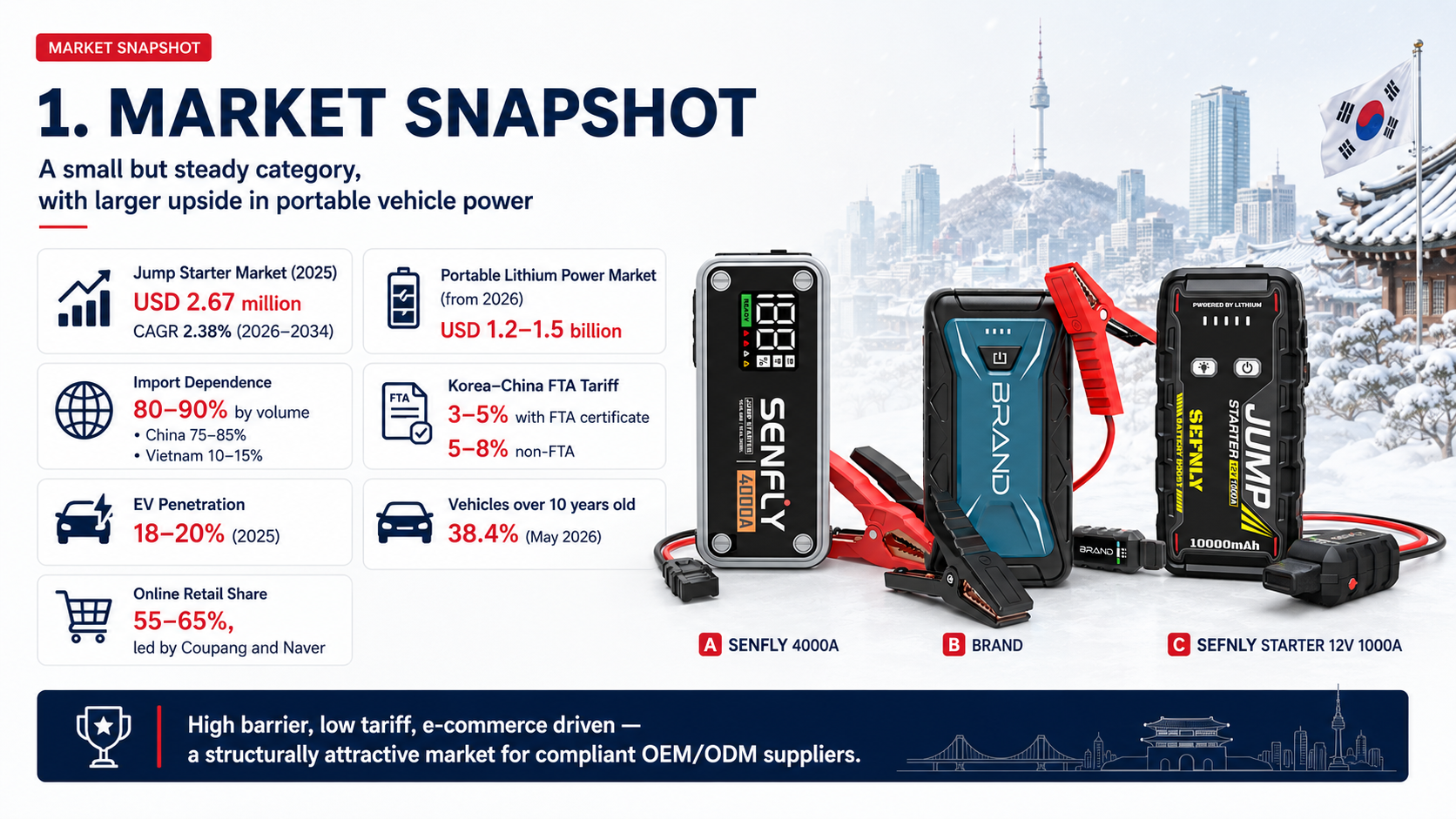
In one sentence: the standalone jump-starter category is small but stable, while portable vehicle power is the larger growth pool. Korea combines resilient demand, low tariffs, strict certification and an online-first retail structure. For an OEM partner that can clear the KC barrier, it is a classic high-barrier, low-tariff opportunity.
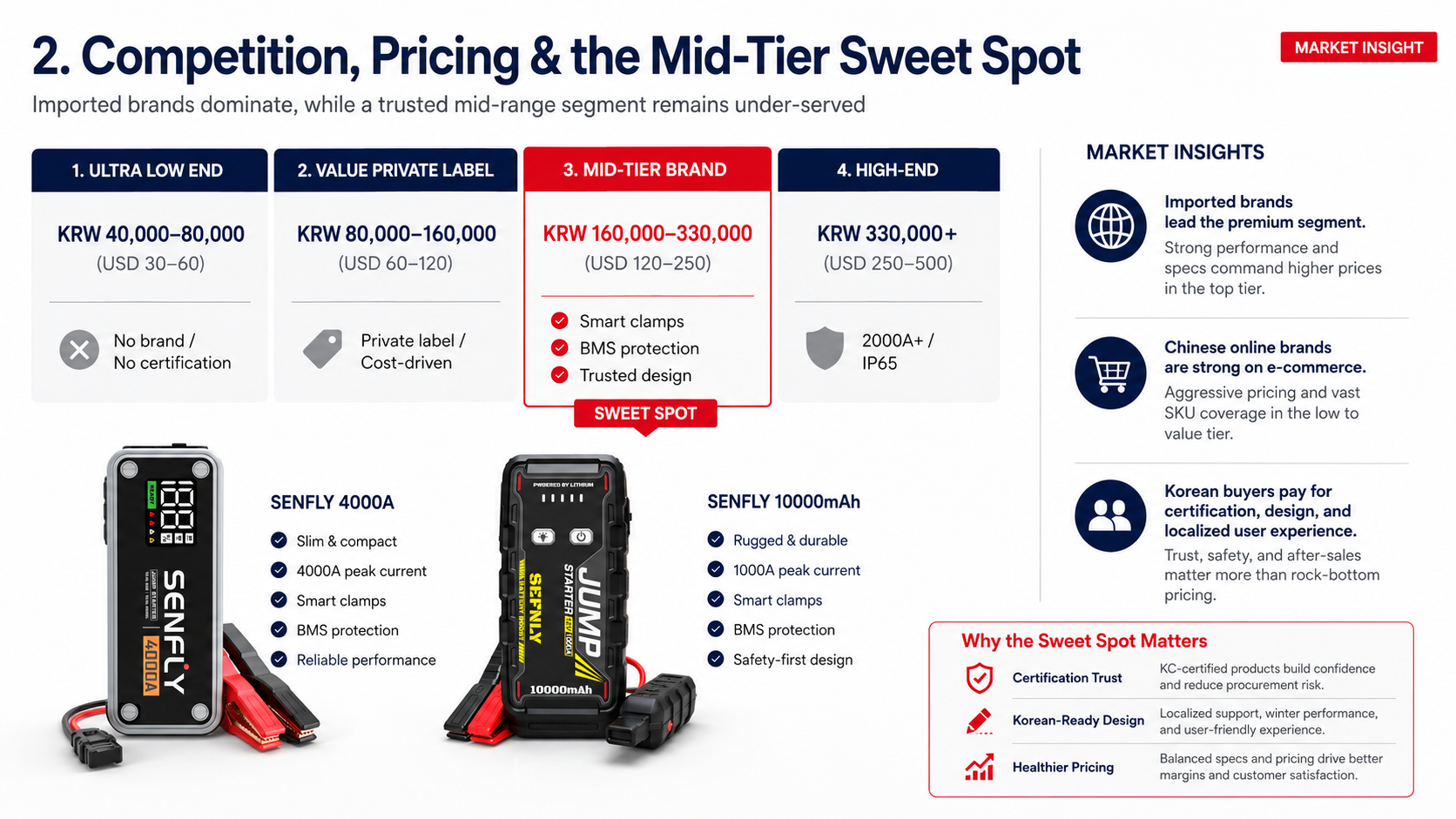
NOCO has established a position at the premium end of the Korean market through the GB40 and GBX series. Chinese e-commerce brands such as GOOLOO, DBPOWER and Beatit are widely sold through Coupang, while private labels from E-Mart, Lotte Mart and other retailers account for roughly 25–35% of unit volume. LG Energy Solution and Samsung SDI supply cells but do not operate as major finished jump-starter brands. That leaves room for Korean brands to build or extend a mid-tier product line using a KC-ready OEM/ODM platform.
The USD 120–250 mid-tier is the most attractive “trust sweet spot.” Korean buyers are willing to pay for certification, industrial design and a Korean-language experience—areas in which a compliant OEM can create a real moat.
KC safety certification costs are estimated at KRW 5–15 million per model, which helps keep poor-quality imports out. Korean-language manuals, Korean UI and voice prompts have moved from optional extras to basic requirements. Senfly can complete Korean packaging, manuals and Korean-style visual design before shipment, reducing secondary repacking costs.
KC certification is mandatory for portable lithium products under Korea’s Electrical Appliances and Consumer Products Safety Control framework. The core standard is KC 62133-2:2020, equivalent to IEC 62133-2. Models with wireless or Bluetooth functions also require KCC electromagnetic-compatibility certification. Portable power stations above 500Wh fall under KC 62619:2023. Senfly can work with the buyer’s designated Korean certificate holder and provide test samples, technical files and mass-production consistency support.
Korea is not a market won by peak-current claims alone. The winning formula is KC compliance + Korean user experience + mid-tier design + e-commerce reputation.
| Channel | Main Players | Entry Requirements | Commercial Role |
|---|---|---|---|
| Comprehensive e-commerce | Coupang (Rocket Delivery), Naver Shopping | KC-compliant listing, Korean content and Rocket-warehouse readiness | Coupang accounts for around 30–40% of online sales; Naver is a major traffic source |
| Open marketplaces | Gmarket, 11st, SSG.com, Kakao | Korean product page and review management | Naver-led discovery and comparison remain important |
| Hypermarkets / mass retail | E-Mart, Lotte Mart, Homeplus | Private-label negotiation and KC-compliant packaging | Private labels account for roughly 25–35% of unit volume |
| Auto-parts / electronics chains | Autobell, Hi-Mart, Midopa | Technical data and vehicle-fitment information | Important for immediate need and older consumers |
| B2B fleets | Ride-hailing, logistics fleets and corporate buyers | Framework contracts and volume supply | Safety certification and warranty support are essential |
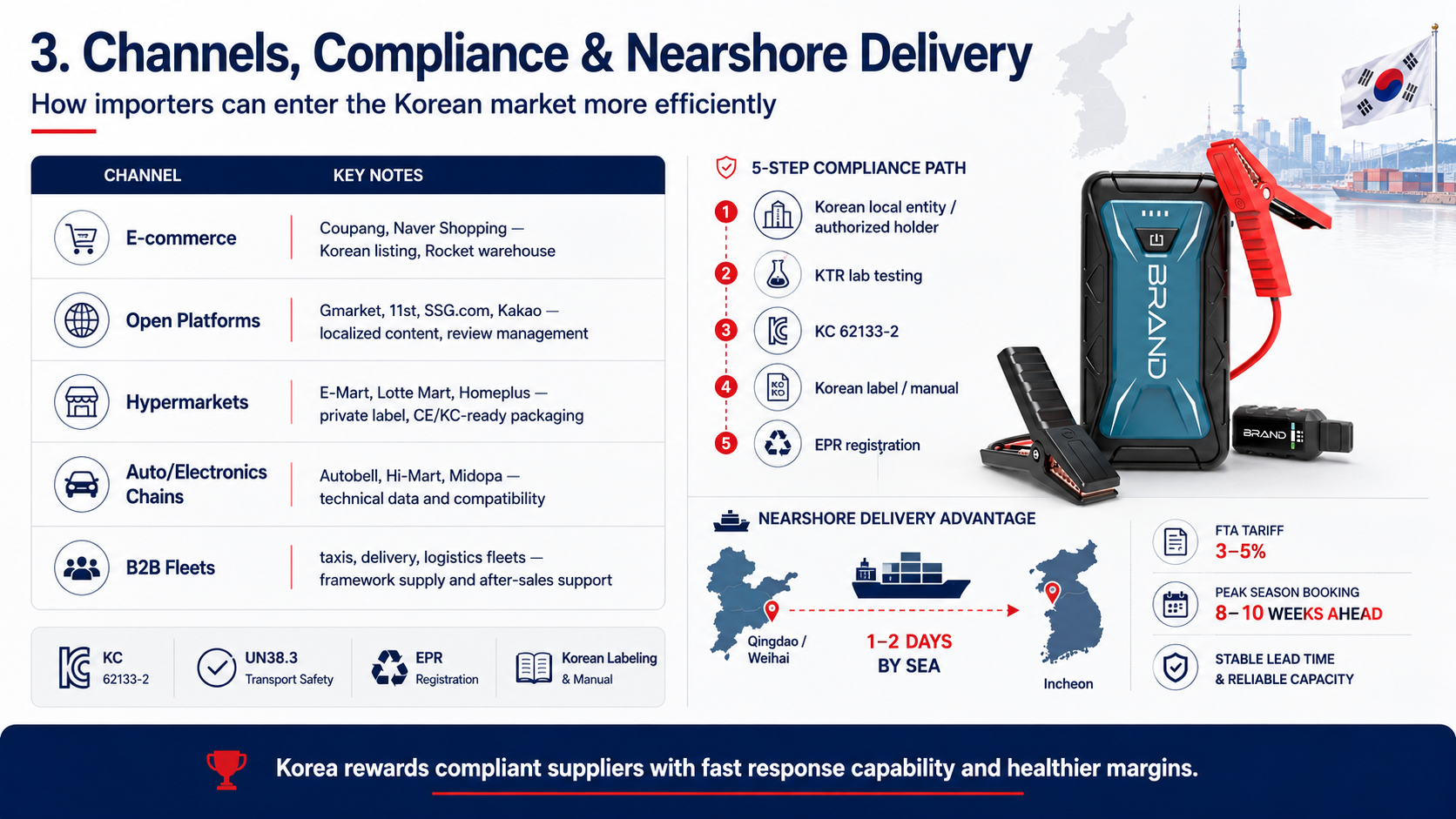
The Korea–China FTA reduces the tariff to 3–5% with the appropriate origin certificate. Sea freight from Qingdao or Weihai to Incheon can take only one to two days, with even shorter airfreight transit. This supports a nearshore fast-response model: small trial orders followed by locked volume eight to ten weeks before the winter peak. Low tariffs and short routes can become a meaningful cash-flow and replenishment advantage.
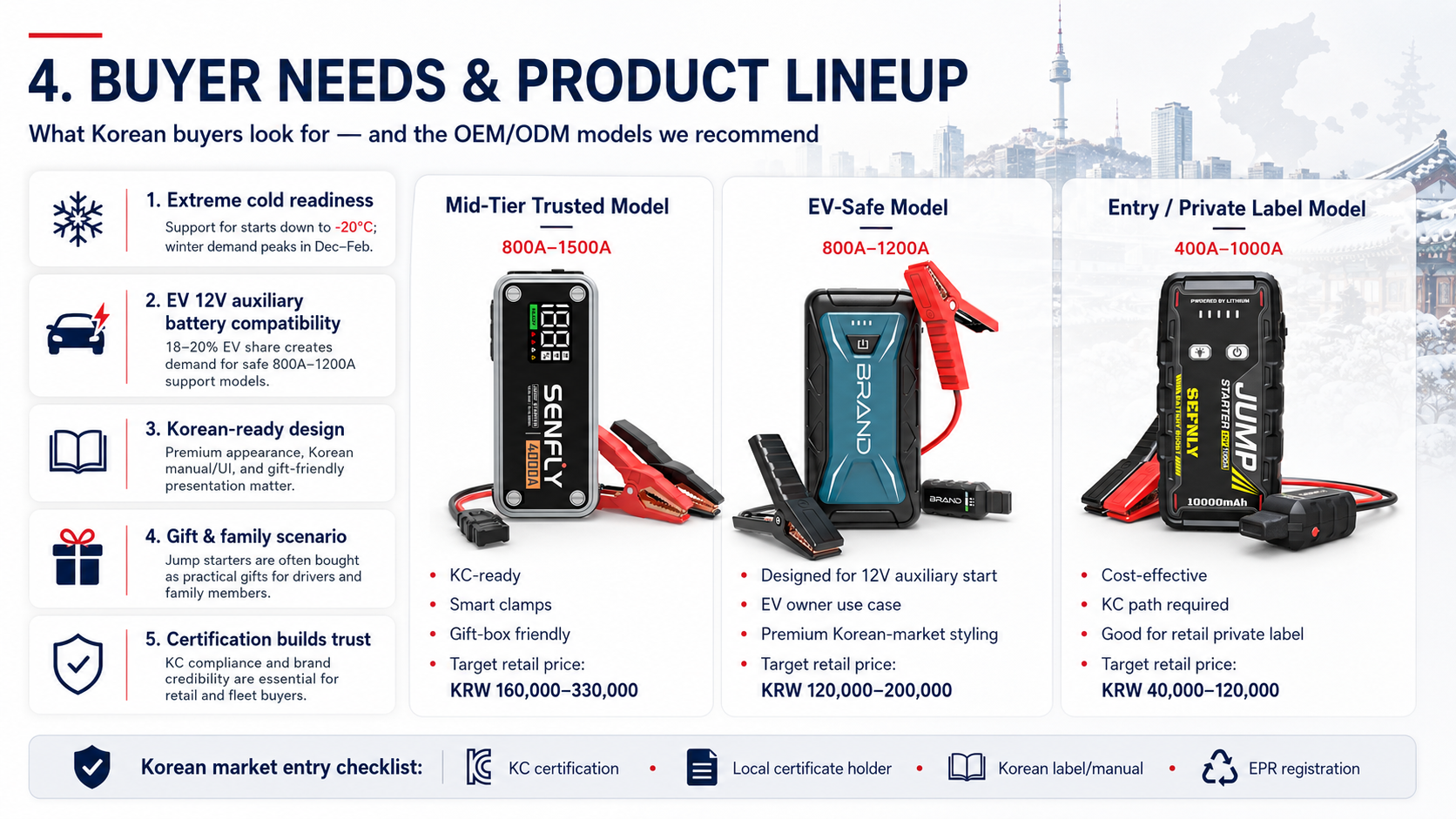
For any SKU entering Korea, four requirements are non-negotiable: KC certification, a local certificate holder, Korean labels/manuals and EPR registration.
| Market Change | Commercial Impact | Recommended OEM / ODM Response |
|---|---|---|
| Mandatory KC certification + local holder | Companies without a Korean entity cannot hold the certificate; low-quality products are filtered out. | Provide KC pre-testing, complete technical documentation and samples for KTR or another authorized laboratory; work with the buyer’s Korean certificate-holding entity. |
| 3–5% Korea–China FTA tariff | Cost is materially lower than in the United States, while short-haul delivery supports fast replenishment. | Position compliant products as high-value mid-tier solutions rather than low-price white labels. |
| Winter peak from December to February | Missing the stocking window can mean losing 35–45% of annual category sales. | Back-plan 8–10 weeks, lock Q3 orders and ensure arrival before winter. |
| EV 12V auxiliary-battery demand | Conventional messaging often fails to address 12V battery failure beside the high-voltage EV system. | Develop EV-Safe models and market them around Hyundai and Kia EV-owner rescue scenarios. |
| Private labels at 25–35% of volume | Retailers pressure price while securing volume. | Use flexible OEM/private-label capacity for E-Mart, Lotte and other retail programs. |
| EPR expansion in 2026 | Failure to register recycling obligations can lead to delisting or penalties. | Reserve packaging space for recycling marks and support the importer’s EPR registration. |
| E-commerce reviews drive sell-through | Coupang reviews strongly influence ramp-up. | Provide Korean-language real-start test content and avoid misleading peak-current claims. |
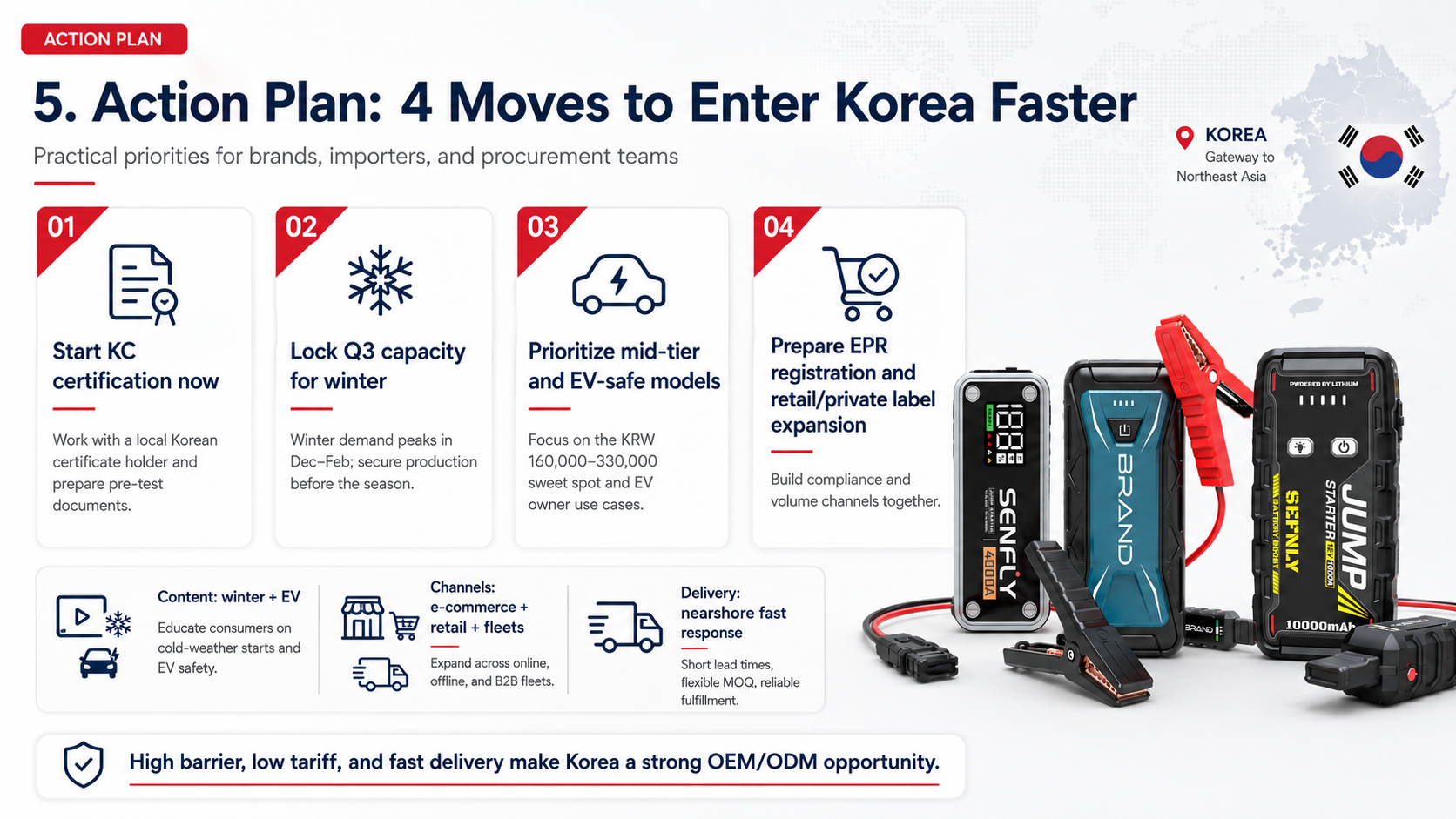
The certificate holder must be a Korean local entity, and testing must be completed through a Korean authorized laboratory. Senfly can provide KC 62133-2 pre-test samples and technical documentation to shorten the path and reduce the risk of missing the winter season.
Winter represents 35–45% of annual sales. Even with short-haul delivery from China, orders and production should be confirmed before September. We recommend a mid-tier trust model as the main volume driver, supported by an EV-focused model as the growth line.
Avoid the low-price white-label red ocean. Use KC compliance, Korean-language experience and industrial design to anchor the USD 120–250 trust sweet spot, while developing 12V EV auxiliary-battery rescue scenarios for Hyundai and Kia owners.
Importers must register recycling obligations under the expanded EPR system. Senfly can reserve the required packaging space and support compliant flexible private-label programs for mass retail.
 Hot News
 EN
EN