Market Observation — July 2026
The UK automotive jump starter market has not lost its relevance as new energy vehicle adoption grows. On the contrary, with the average vehicle age rising and consumer demand expanding into roadside emergency response, tyre maintenance, and mobile power supply, this category is evolving from a single-purpose “car starting tool” into a more complete portable vehicle power solution.
For brands, importers, and procurement managers planning to enter the UK market or refresh existing product lines, the next phase of competition will no longer hinge solely on higher peak current ratings. Real, reliable starting performance, safer user experience, more complete feature combinations, and verifiable compliance evidence for channel audits will define the winners.

As of 2026, approximately 36.68 million passenger cars are on UK roads, with petrol and diesel vehicles still accounting for about 87.8% of the total. Meanwhile, the average age of UK passenger cars has risen to 9.7 years, and 45.7% of vehicles have been in use for over a decade. (SMMT)
This trend has direct implications for the jump starter market. The longer a vehicle stays on the road, the more likely its 12V battery will degrade, the vehicle will sit idle long enough to drain, or cold-weather starts will become difficult. For UK auto parts brands and retail channels, jump starters remain a product with a clear use case and sustained demand, not a transitional category being rapidly phased out by electrification.
The used car market in the UK remains active as well. Q1 2026 saw over 2.01 million used car transactions, with pure EV transactions up 32% year-over-year. (SMMT) This means future product descriptions cannot focus solely on traditional ICE vehicles. Even though BEVs do not rely on jump starters to power their high-voltage drivetrains, they still carry a 12V auxiliary battery. Brands developing product content need to accurately define their product’s scope of application and avoid misleading claims such as “can start electric vehicles.”
Senfly, a Guangzhou-headquartered manufacturer with 15 years of industry experience and an 8,000 m² production base in Dongguan, supplies products that cover the full 12V system range from 29.6Wh entry-level models to 288.8Wh high-capacity configurations. Its product line is engineered for the real-world UK fleet composition—primarily petrol and diesel, with auxiliary 12V battery compatibility clearly documented. With an installed customer base that includes Walmart, GEELY, Baseus, Energizer, and GOOD YEAR, Senfly has delivered over a decade of volume production for global brands addressing precisely this vehicle demographic.
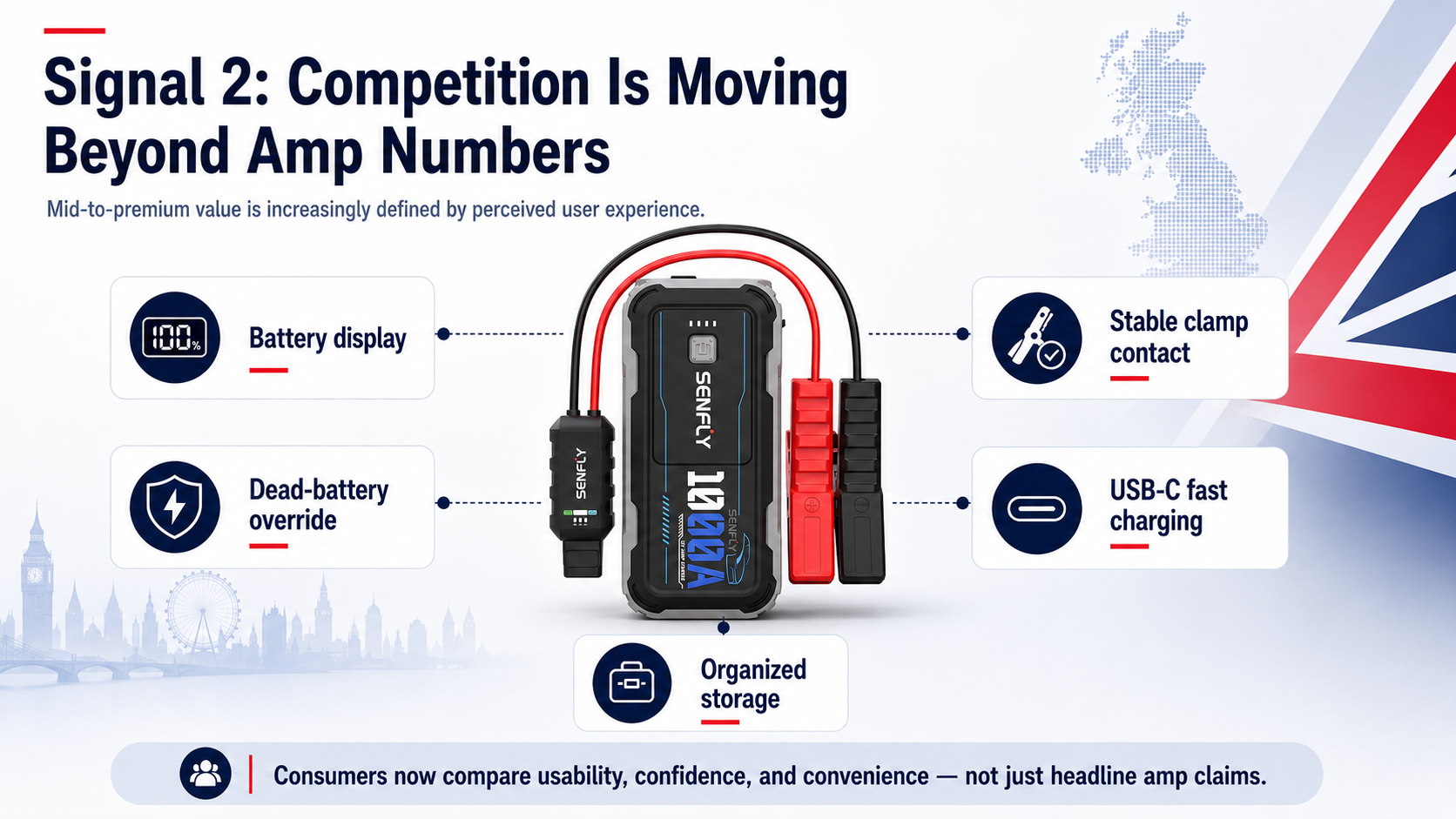
For years, jump starter marketing focused primarily on peak current figures—1,000A, 1,500A, 2,000A and beyond. But looking at the product direction of mainstream UK brands, features that consumers can directly perceive are becoming more important.
Ring’s ULTRABOOST 1500, beyond covering up to 6L petrol and 3L diesel engines, includes a large LCD battery gauge, a dead-battery override function, reverse-polarity and spark-proof protection, longer clamp cables, 60W bi-directional USB-C fast charging, and a storage case with two USB-C cables. (Ring Automotive)
This configuration tells us that the UK market’s evaluation criteria for mid-to-premium jump starters have moved beyond “will it start a car” to questions like:
Peak current remains an important packaging claim, but it is increasingly difficult to stand on alone. A more valuable product strategy combines engine size compatibility, safety protection, real-world starting capability, and ease of use into a proposition consumers can understand at a glance.
Products that integrate digital battery percentage displays, clear fault codes, USB-C fast charging, and organised storage cases—such as Senfly’s T series all-in-one range—align with this evolving expectation. The brand’s 25-cylinder air pump models (T53, T39) additionally address the user need for rapid tyre inflation without compromising the starting function.
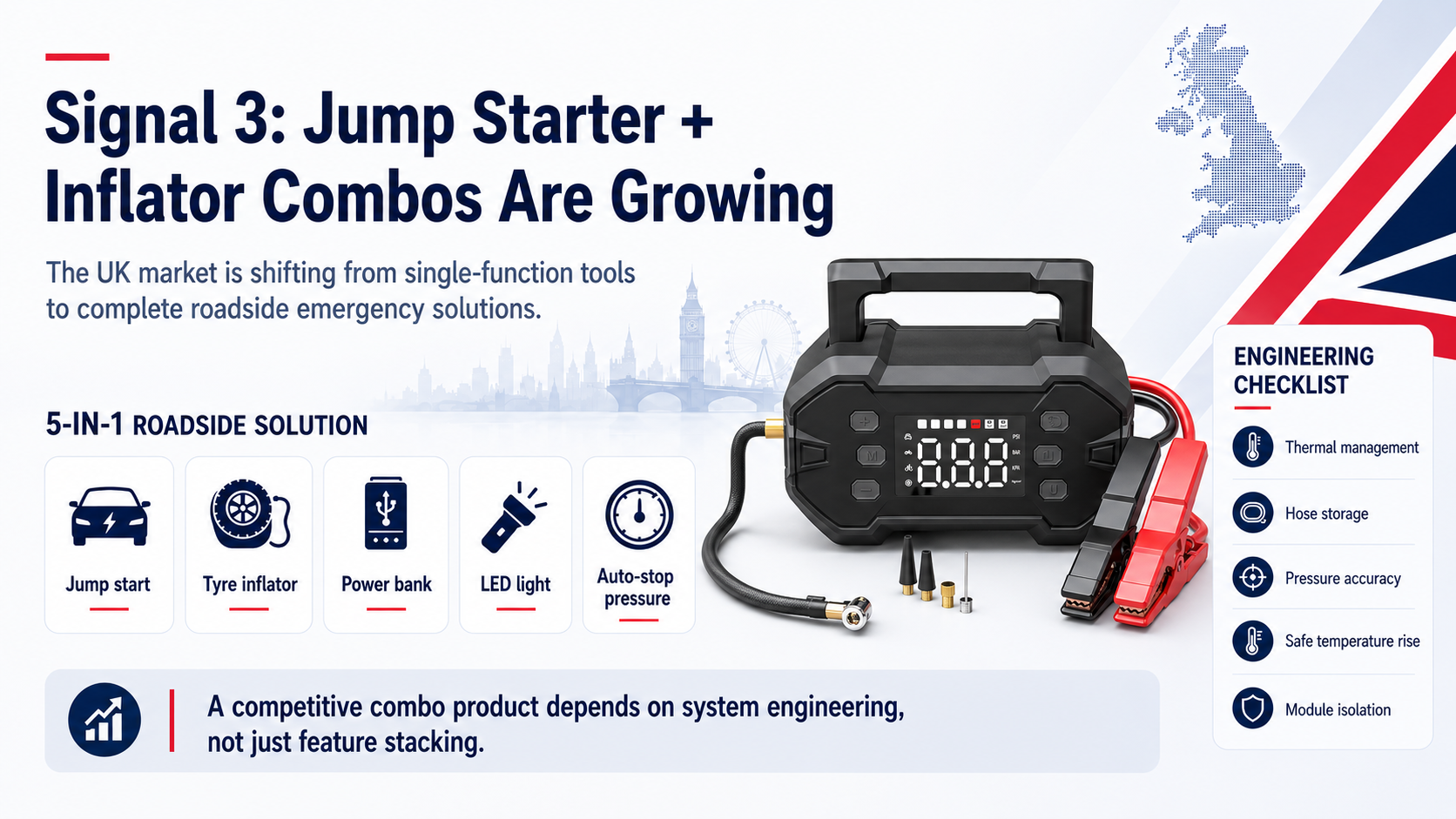
Another clear signal from the UK market is the accelerating convergence of jump starting and tyre inflation in a single product.
Ring’s 5-in-1 product combines jump start, cordless inflator with digital pressure display and auto-stop, lighting, power bank, and auxiliary device power, covering up to 5L petrol and 3L diesel engines. (Ring Automotive)
OSRAM’s BATTERYjumpstart 1000TI, also available through UK channels, uses a similar all-in-one design with digital pressure display, auto-stop, USB power bank, lighting, and a dead-battery override. Its published specs distinguish between 1,000A peak current and 300A start current. (OSRAM)
These developments reflect two shifts worth noting. First, channels are moving from selling single-function tools towards selling “complete roadside emergency solutions.” Second, competitors are beginning to differentiate between peak current and actual start current—raising the bar for supplier test data.
However, an all-in-one product is not simply about adding more features. The inflator module introduces additional heat, noise, structural space, and durability requirements. Brands developing such products should verify:
A truly competitive all-in-one is not two products in one shell. It is the result of structural engineering and system-level thermal management that reduces the risk of multi-function use.
Senfly has been engineering integrated jump starter and inflator products since 2022 and now offers eight all-in-one models spanning entry-level (T67, T27) through mid-range (T25, T38, T66, T68) to performance-oriented (T53, T39) configurations. This dedicated focus on the combo category—with 25-cylinder pumps, intelligent thermal fan control, custom pressure presets, and dual USB QC fast charging across different models—stems from a decade of volume production experience. Senfly’s R&D team of 50+ engineers and in-house CNAS laboratory enable validation of thermal, structural, and electrical interactions within each combo design before production ramp-up.
Notably, the industry benchmark brand NOCO does not offer a single all-in-one jump starter and inflator product. This means that brands and importers entering this segment through a dedicated combo supplier can establish a differentiated position without directly competing on the same product grid.
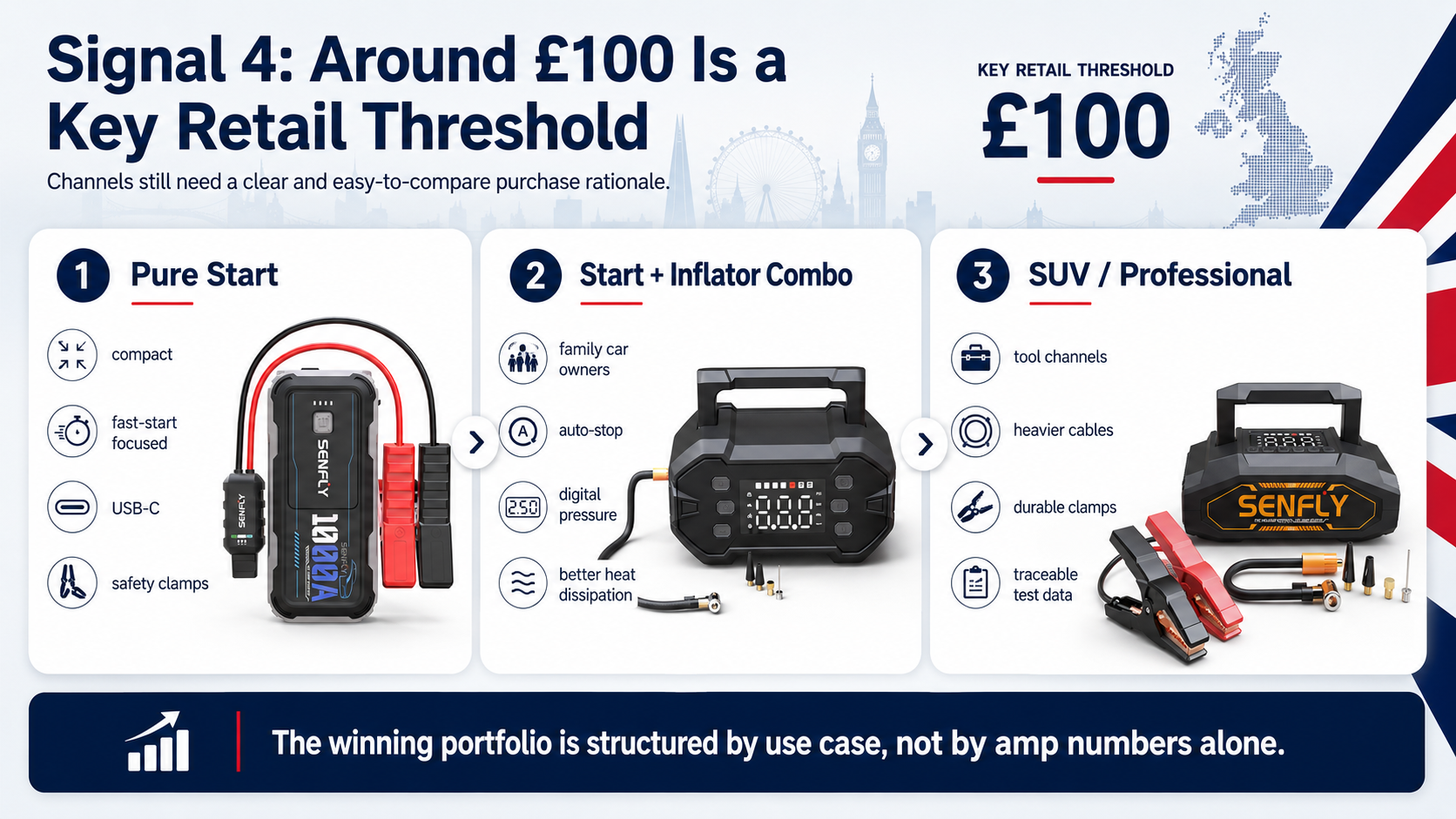
Halfords currently sells its own-brand 6-in-1 jump starter at £99.99, supporting up to 2L petrol and diesel engines with integrated inflator, LED lighting, inverter output, and a 12V port. The product has accumulated 937 reviews with a 4.5-star average rating. (Halfords UK)
This confirms that UK consumers accept multi-function automotive emergency products at around £100, but channels need a clear, easy-to-compare purchase rationale.
For brands targeting this price band, simply increasing battery capacity or peak current is usually not enough. A more effective product structure would include:
| Tier | Positioning | Key Specs |
|---|---|---|
| Pure Start | Compact, fast-start focused | USB-C fast charging, digital battery gauge, safety clamps, dead-battery override, hard case |
| Start + Inflator Combo | Family car owners, campers, long-distance drivers | Digital tyre pressure with auto-stop, independent hose storage, optimised heat dissipation |
| SUV / LCV / Professional | Tool channels, fleets, service shops, trade customers | Heavier gauge cables, durable clamps, continuous start capability, traceable test data |
Senfly’s product lineup maps directly to this three-tier structure. The pure-start category includes models like G32 and T13-A; the combo tier covers the bulk of the T series with inflator integration at multiple price points; and the professional tier is served by high-capacity configurations such as the T25-88.8Wh configuration with 2,000A peak current, suitable for large-displacement and diesel vehicles in fleet and trade applications. This tiered approach helps brands avoid a lineup where different models differ only by amp numbers, making it easier for retailers to build a clear price ladder.
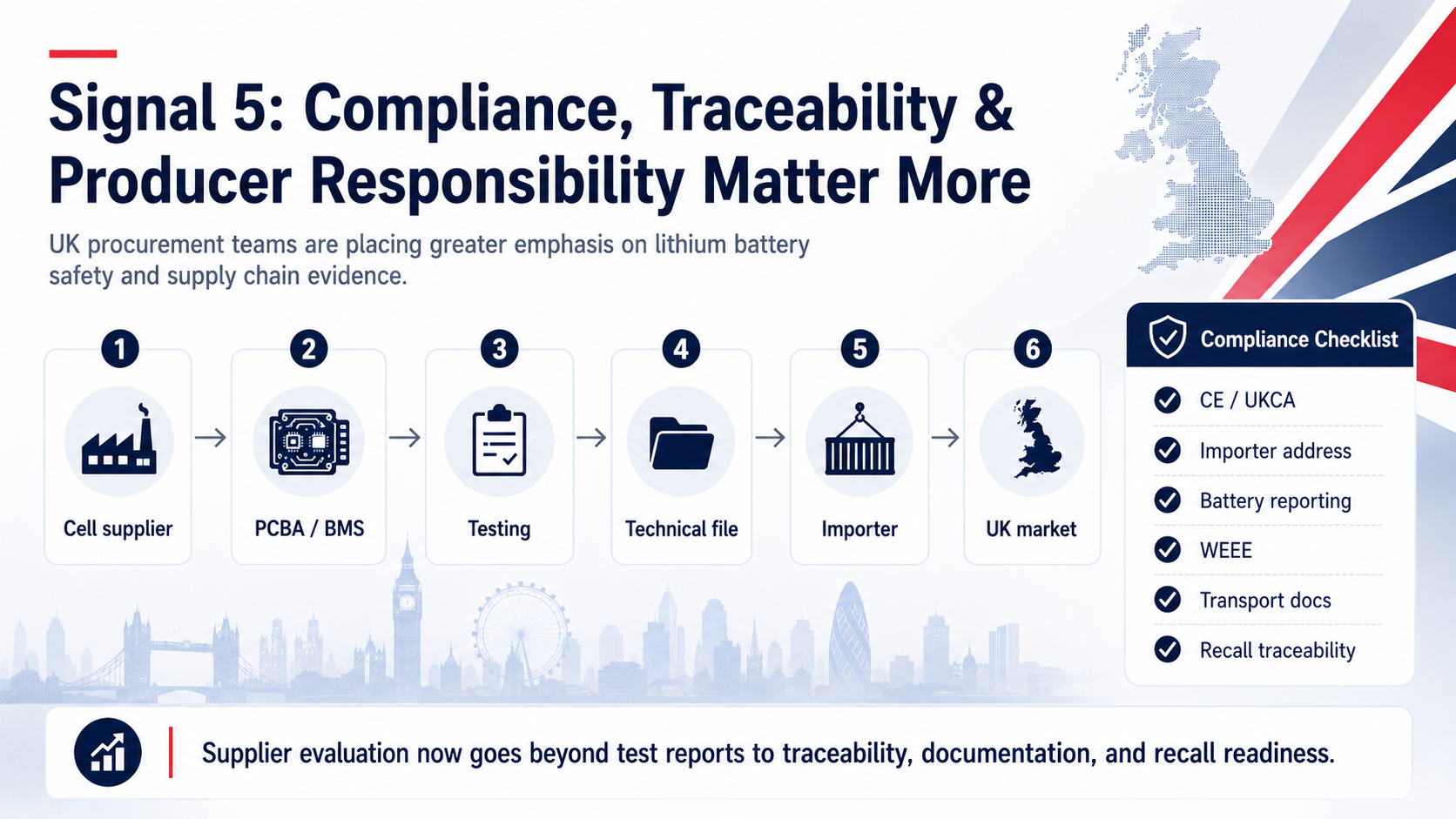
The UK currently continues to accept CE marking for most applicable products placed on the Great Britain market, alongside the UKCA marking. UK importers must provide their business name and postal address on the product, and confirm that the manufacturer has completed the applicable conformity assessment, labelling, and technical documentation. When selling products under an importer’s own brand, the importer may also assume manufacturer-level obligations. (GOV.UK)
For jump starters containing lithium batteries, importers must also consider waste battery and WEEE obligations. Businesses placing more than one tonne of portable batteries on the UK market per year must join a battery compliance scheme; even those placing less than one tonne must register and declare battery weight and chemistry. The equipment weight and battery weight of battery-containing electronics must be reported separately. (GOV.UK)
The UK is advancing a new product safety framework. A 2026 consultation specifically addresses lithium-ion battery risks, online sales responsibilities, complaint handling, and supply chain traceability, proposing that manufacturers, importers, retailers, e-commerce businesses, and platforms bear more proactive safety responsibilities. While these are still at the consultation and proposed reform stage, they clearly signal the direction of future regulation. (GOV.UK)
Additionally, the UK plans to launch a further consultation on battery producer responsibility reform in autumn 2026. (Defra)
For UK importers, supplier evaluation should therefore go beyond reviewing CE reports. Key checks include:
Senfly holds full certification coverage across its product range, including UL, FCC, CE, PSE, and RoHS, with IATF 16949, ISO 9001, ISO 14001, and BSCI management system certifications. Its CNAS-accredited in-house laboratory supports batch-level testing for cell, BMS, and clamp traceability. With 82 global patents, 30+ granted patents across 20+ countries and regions, and zero major quality incidents in 13½ years of factory operation, Senfly maintains batch identification and recall-ready traceability as standard practice for its OEM and ODM programmes. For UK importers, the availability of model-level technical files, component BOMs, test data, batch traceability, and packaging artwork pre-production means compliance documentation does not become a post-shipment scramble.
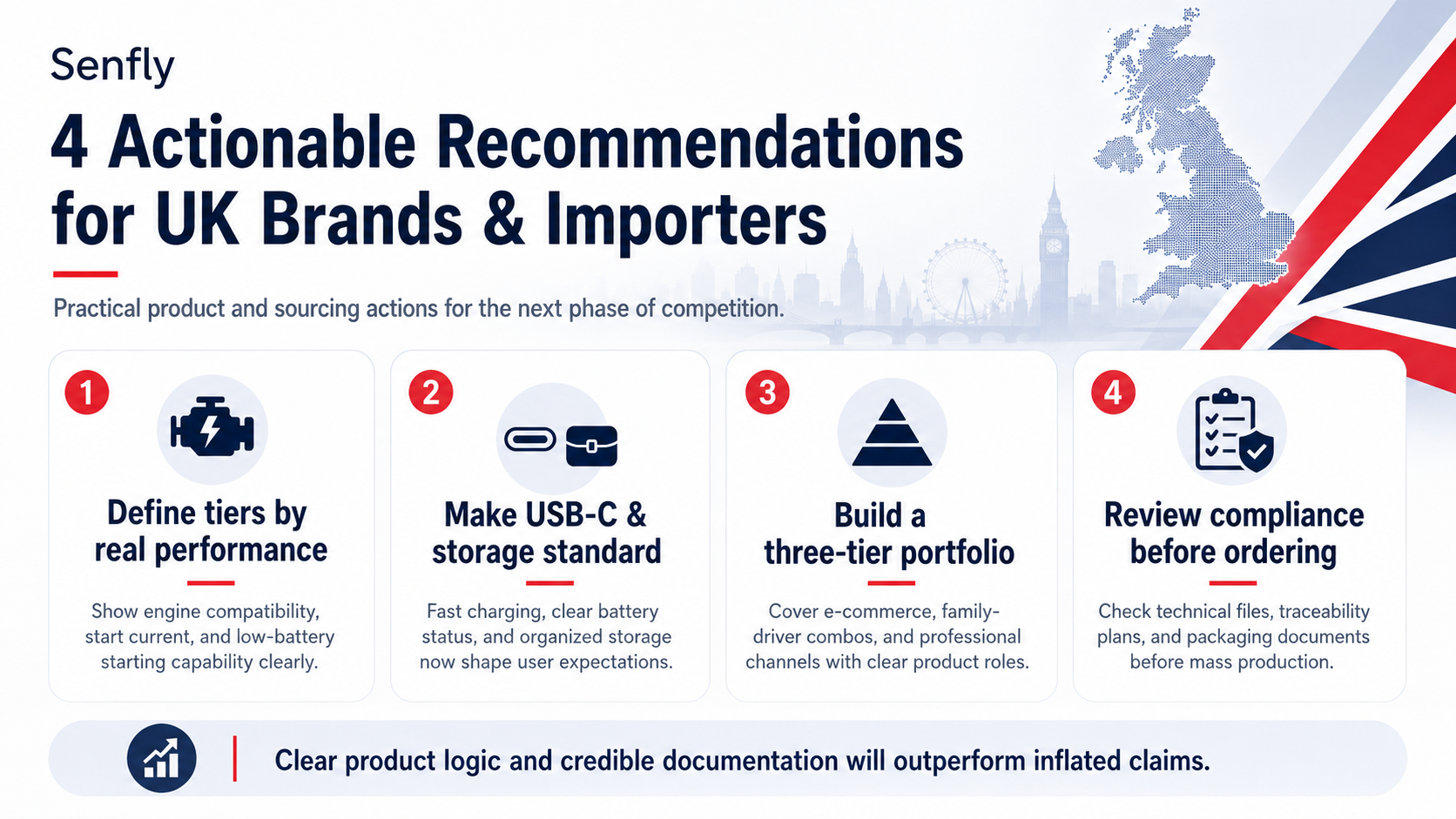
Present engine size compatibility, start current, low-battery starting capability, and dead-battery override method clearly to both consumers and channels. The more verifiable the product parameters, the lower the procurement doubt and after-sales disputes.
Senfly publishes engine displacement coverage per configuration (e.g., up to 8.0L petrol or diesel on the 88.8Wh configuration), distinguishing start current from peak current, and documents the dead-battery override procedure for each model.
60W bi-directional USB-C, clear battery level indication, sufficiently long clamp cables, and a complete storage case are becoming essential components of the mid-to-premium product experience in the UK, not optional accessories.
Across the Senfly lineup, USB-C or QC fast-charge input is standard from the mid-range upwards, and all models ship with organised storage cases designed for long-term vehicle storage.
Pure-start models suit e-commerce and auto parts retail; combos suit family and outdoor scenarios; professional models suit tool channels, service shops, and trade customers. A clear product hierarchy is more likely to gain channel support than a large number of similarly specified SKUs.
Senfly’s 15-year manufacturing track record, with an installed base spanning Walmart to independent e-commerce sellers, demonstrates the capability to support this tiered strategy at volume while maintaining individual model-level certification and separation.
Procurement teams should request model-level technical files, critical component lists, test data, batch traceability plans, and packaging artwork drafts from suppliers before mass production—not wait until goods arrive at port.
Senfly’s standard OEM/ODM handover package includes model-specific certification documentation, component sourcing records, production batch traceability, and pre-shipment compliance review as a routine part of the process, not an upsell.
The UK jump starter market is not entering a phase of pure price competition. It is evolving towards more mature product competition.
An aging vehicle fleet provides stable underlying demand. The convergence of jump starting and tyre inflation opens new growth opportunities. And lithium battery safety combined with producer responsibility reform raises the bar for supply chain capability that brands and importers must meet.
For companies planning their UK automotive emergency product strategy, the competitive edge of the next generation of products will not be a higher amp number. It will be:
 Hot News
 EN
EN