Procurement Principle: A jump starter that perfectly cranks a 2.0L petrol sedan in Tokyo will fail catastrophically on a 12L diesel truck in Oslo — not because the product is defective, but because the selection criteria ignored three non-negotiable variables: voltage architecture, engine displacement, and climate stress. This article provides the checklist-driven methodology procurement teams need to eliminate that risk before it reaches the supply chain.
 The Cost of Incorrect Fleet Spec Selection
When a European logistics fleet operator purchases 500 jump starters under a single SKU, the assumption is that "one model covers everything." The reality in the maintenance bay tells a different story:
UK Fleet Failure Data Point: In March 2023, the UK Office for Product Safety and Standards issued recall 2303-0111 for the Ring RPPL360 Fast Charge Lithium Jump Starter — a manufacturing defect where a PCB solder pin damaged internal cable sleeving, creating a fire risk. The root cause was a single-point design failure that escaped quality inspection. For fleet procurement managers, this is the nightmare scenario: a defect discovered after deployment across hundreds of vehicles.
The solution is not to "buy a bigger jump starter." It is to build a data-driven selection protocol with three input variables and one structured output matrix. Below is the checklist that makes this repeatable.
Voltage is the non-negotiable first filter. Apply this before evaluating any current rating or battery chemistry.
| Region | Passenger/Light Vehicle | Commercial/Heavy Vehicle | Mixed Fleet Risk |
|---|---|---|---|
| North America | 12V (universal) | 12V (light-duty); 24V (Class 7–8 heavy trucks) | Low (heavy truck 24V is niche) |
| Northern & Western Europe | 12V (standard) | 24V (mandatory for trucks >3.5T, buses, coaches) | High — logistics fleets commonly run 12V vans + 24V heavy trucks |
| Southern Europe | 12V | 24V (trucks >3.5T) | High — same mixed-fleet profile |
| Middle East (GCC) | 12V (passenger/SUV) | 24V (heavy trucks, buses) | Moderate to High |
| Japan | 12V (uniform) | 12V light trucks dominate; 24V only for large trucks/buses | Low — predominantly 12V |
| Southeast Asia | 12V | 24V (heavy trucks); 12V (light/medium commercial) | High in logistics hubs |
| Australia/NZ | 12V | 24V (mining trucks, road trains, heavy transport) | High in mining/agriculture |
IF fleet contains ANY vehicle with a 24V electrical system
→ Procurement MUST include 12V/24V dual-voltage capable models
→ 12V-only models are restricted to 12V-only fleet segments
→ Crossing this line = equipment destruction, not performance degradation
Senfly Product Voltage Mapping:
| Voltage Requirement | Compatible Senfly Models | Platform |
|---|---|---|
| 12V only | T11, T11L, T13, T15, T25, T27, T53, G32,T47,T55 | 4S LiCoO₂ |
| 12V/24V dual (auto-detect) | T37 (7S, 155.4Wh, 2.0–26V wide-range detection), T40 (8S, 142Wh, 1,000A start / 2,000A peak) | 7S/8S LiCoO₂ with dynamic series-parallel switching |
Critical Boundary: 12V/24V dynamic series-parallel switching applies only to T37 and T40. Pure 12V models must never be described as dual-voltage capable. A procurement manager who misreads this specification will deploy incompatible hardware into a 24V fleet environment — a compliance and safety liability.
Peak amps alone are an insufficient selection criterion. The jump starter's sustained cranking capability — its ability to deliver high current for 2–5 seconds during cold or high-compression diesel starts — determines real-world reliability.
| Engine Type | Displacement Range | Minimum Peak Current Recommendation | Sustained Current Requirement | Notes |
|---|---|---|---|---|
| Petrol (gasoline) — compact | 1.0L–2.5L | 600A–1,200A | 300A–500A | Kei cars (Japan 0.66L), compact sedans |
| Petrol — mid/full-size | 2.5L–5.7L | 1,200A–1,800A | 500A–800A | SUV/V8 markets (Middle East, North America) |
| Diesel — light | 1.5L–3.0L | 1,000A–1,500A | 500A–700A | Common in European fleet vans, SE Asian pickups |
| Diesel — medium/heavy | 6.0L–10.0L | 1,500A–2,000A | 700A–1,000A | European/SE Asian truck fleets |
| Diesel — extreme heavy | 12.0L–16.0L | 2,000A+ | 1,000A+ | Mining trucks, road trains (Australia, Middle East, Scandinavia) |
| 24V truck/bus (all displacements) | 7.0L+ | 2,000A minimum | Verify with manufacturer | 24V systems require dedicated dual-voltage models |
Source: Engine-to-current ranges are based on manufacturer technical literature and SAE J537 CCA testing methodology.
| Senfly Model | Start Current | Peak Current | Battery Capacity | Recommended Max Diesel | Recommended Max Petrol |
|---|---|---|---|---|---|
| T53 (29.6Wh) | 300A–800A | 600A–1,600A | 29.6–59.2Wh | 2.0L–4.0L | 3.0L–5.0L |
| T11/T13 (71.04Wh) | 700A–800A | 1,400A–1,600A | 59.2–71.04Wh | 4.0L–6.0L | 5.0L–7.0L |
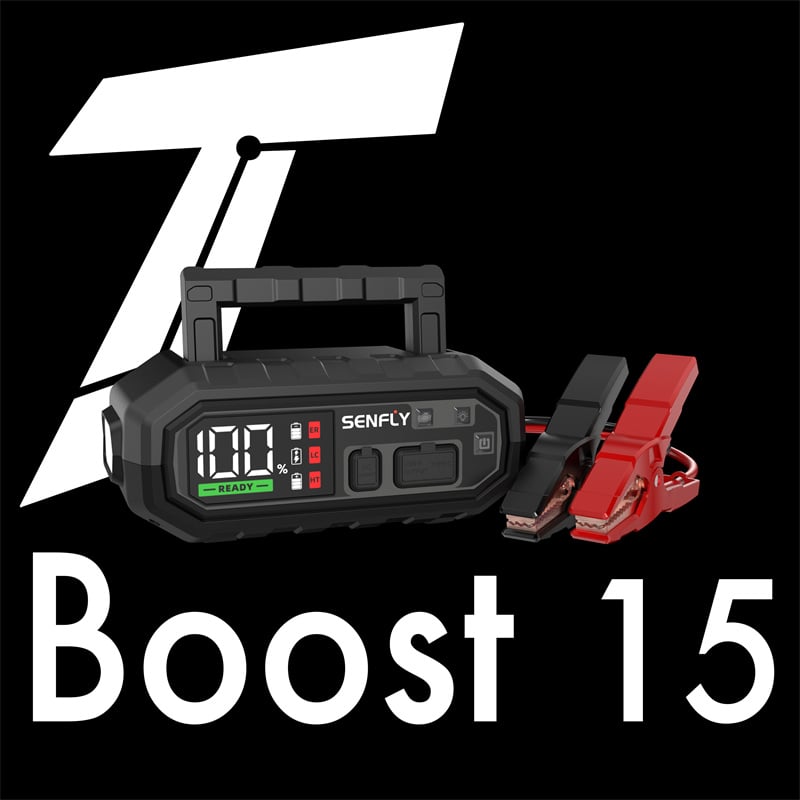
| T15 (88.8Wh) | 1,000A | 2,000A | 88.8Wh | 6.0L–8.0L | 7.0L–9.0L |
| T25 (88.8Wh max) | 500A–1,000A | 1,000A–2,000A | 44.4–88.8Wh | 5.0L–8.0L | 6.0L–9.0L |
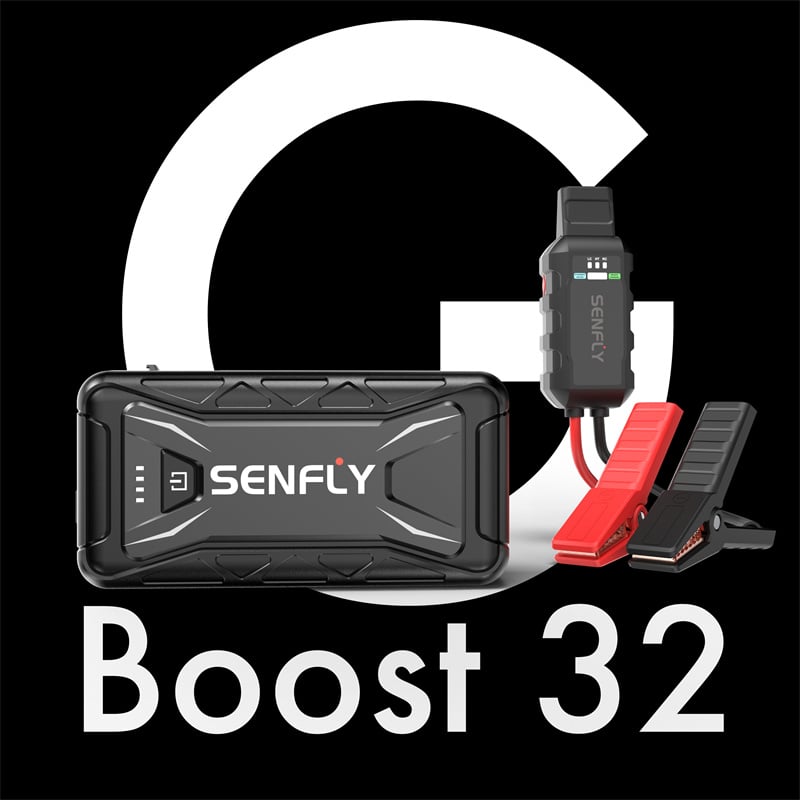
| G32 (59.2Wh) | 800A | 1,500A | 59.2Wh | 5.0L–7.0L | 6.0L–8.0L |
For 24V applications: T37 (155.4Wh, integrated clamp control module, peak current not separately specified) and T40 (142Wh, 1,000A start / 2,000A peak) are the dual-voltage options.
Diesel Derating Rule: For every 10°C drop below 0°C, estimate a 10–15% reduction in available cranking current from the jump starter's lithium cells. A unit rated for 8.0L diesel at 25°C may only effectively crank a 5.0L diesel at −20°C. The procurement buffer is not "buy the next model up" — it is verify the cold-soak test data at the fleet's minimum operating temperature.
All Senfly T-series and G-series jump starters currently use LiCoO₂ (Lithium Cobalt Oxide) chemistry. The operating temperature envelope — −20°C to +60°C discharge, 0°C to +45°C charge — aligns with IEEE industry data and MDPI Energies journal derating guidelines.
| Chemistry | Discharge Floor | Thermal Runaway Threshold | Cycle Life | Cold Performance Strategy |
|---|---|---|---|---|
| LiCoO₂ (LCO) (current Senfly chemistry) | −20°C | \~150°C | 500–1,000 cycles | Capacity reserve (higher Wh per model) |
| LiFePO₄ (LFP) | −20°C | \~270°C | 2,000+ cycles | Thermal stability, cycle durability |
Key Procurement Insight: Both chemistries share the same −20°C discharge floor. LiFePO₄'s fleet advantage is thermal safety margin (higher runaway threshold) and cycle longevity, not superior cold-cranking performance. For Arctic-condition fleets, the practical mitigation is battery capacity reserves (specify 88.8Wh over 59.2Wh) and pre-warming protocols — not chemistry switching alone.
| Climate Type | Example Regions | Primary Risk | Mitigation Strategy |
|---|---|---|---|
| Arctic winter (−25°C to −35°C) | Scandinavia, Northern Canada, Russia | Capacity loss in lithium cells; internal resistance spike | Specify maximum Wh per model; verify cold-soak test data; implement device pre-warming in heated cab storage |
| Temperate cold (−10°C to −20°C) | UK, Germany, Northern Japan | Moderate capacity reduction | Standard Wh models (71.04Wh+) adequate with derating buffer |
| Extreme heat (+40°C to +50°C) | GCC, Australian Outback, Arizona | BMS over-temperature auto-shutdown during repeated jump attempts | Verify BMS recovery time specification; consider models with thermal management headroom; avoid leaving devices in direct sun in vehicle cabs |
| Hot + humid (+35°C, monsoon) | Southeast Asia, coastal India | Connector corrosion; charging port moisture ingress | Specify sealed connector designs; evaluate Type-C port cycle-life rating; integrated clamp models preferred |
Customs Compliance Warning: A jump starter left in an unheated vehicle cabin overnight in Kiruna, Sweden at −30°C has already exceeded its rated discharge floor before the operator attempts a start. The device hasn't failed — the selection criteria failed when procurement didn't mandate cold-temperature validation data.
Certification is model-specific and market-required, not brand-universal. Senfly products are engineered to meet the technical testing standards and product quality demands of diverse regional certification regimes—covering UN 38.3, CE, FCC, PSE, and more. However, in OEM/ODM procurement contexts, certifications are typically obtained under the buyer’s own brand and company identity, not under Senfly’s entity.
To support this process, Senfly offers additional certification services at a separate cost, including:
This approach ensures that your branded product meets every target-market requirement without last-minute gaps, while maintaining full compliance with local regulations.
 Certification Support Framework
| Certification | Markets Where Required | Senfly Support Capabilities |
|---|---|---|
| UN 38.3 | All — transport safety | Products designed to comply; coordination with approved laboratories for your project's transport safety certification. |
| CE‑EMC / CE Safety | EU — mandatory | Technical compliance to IEC 62133‑2; assistance compiling the technical file and coordinating with EU-recognized bodies for your Declaration of Conformity. |
| UKCA | UK — mandatory (post‑Brexit) | Technical-compatibility support for UKCA marking under your brand; coordination with UK-approved bodies available. |
| FCC‑SDoC | USA — mandatory | EMC compliance support; assistance with SDoC documentation under FCC Part 15 for your U.S. distribution. |
| RoHS | EU — mandatory | All products are RoHS‑compliant; substance‑restriction documentation provided for your certification records. |
| UL | USA — differentiating | Support for UL evaluation on applicable models; coordination with UL‑certified labs for your project. |
| IATF 16949 | Automotive supply chain — differentiating | Senfly’s manufacturing facility operates under IATF 16949‑certified quality systems—a baseline for OEM/ODM supply contracts. |
| PSE | Japan — mandatory | Products meet PSE technical standards; coordination with Japan‑approved labs for your certification. |
By leveraging Senfly’s support, OEM buyers avoid navigating complex certification processes alone and ensure their branded product arrives market-ready.
EU Regulatory Update (2024–2027): EU Battery Regulation 2023/1542 entered into force February 2024. By 2027, portable batteries (<5kg) must be "readily removable" by end-users, and economic operators face due diligence obligations for supply chain traceability. Fleet procurement managers placing multi-year orders should verify that supplier compliance roadmaps address these phased requirements.
| Region | Dominant Fleet Voltage | Typical Engine Range | Climate Challenge | Recommended Voltage Platform | Minimum Peak Current | Recommended Senfly Platform (12V) | Recommended Senfly Platform (24V) |
|---|---|---|---|---|---|---|---|
| Japan | 12V | 0.66L–2.5L petrol | −10°C (Hokkaido) | 12V | 600A–1,200A | T11, T13,T47 | Not required |
| North America | 12V + 24V mixed | 2.0L–6.7L diesel/petrol | −30°C (northern states) | Dual-voltage required | 1,000A–2,000A | T15, T25 | Rarely required |
| Northern Europe | 12V + 24V mixed | 2.0L diesel vans + 10–13L truck diesels | −25°C (Scandinavia) | Dual-voltage required | 1,500A–2,000A (12V) / 2,000A+ (24V) | T15 | T40 |
| Southern Europe | 12V | 1.6L–3.0L diesel + 7–12L trucks | +40°C summers | 12V | 1,000A–1,500A (12V) | T47/T55 | Rarely required |
| Middle East (GCC) | 12V + 24V mixed | 3.0L–5.7L petrol SUVs + 8–15L diesel trucks | +50°C extreme heat | Dual-voltage for logistics | 1,500A–2,000A (12V) / 2,000A+ (24V) | T15 | T40 |
| Southeast Asia | 12V | 1.5L–3.0L diesel pickups | +35°C, humid/monsoon | 12V | 500A–1,000A (12V) | T47/T13A | Rarely required |
| Australia/NZ | 12V + 24V mixed | 2.0L–4.5L diesel 4WDs + 12–16L mining trucks | +45°C outback, remote | Dual-voltage | 1,500A–2,000A (12V) / 2,000A+ (24V) | T15 | T40 |
How to Use This Matrix: Start with the fleet's operating region. Identify voltage mix — if any 24V vehicles exist in the fleet, procure dual-voltage models for that segment. Map the largest engine displacement in the fleet to the peak current recommendation. Apply climate buffer: cold-weather fleets should select the higher Wh configuration within the recommended model line.
 Conclusion: The Specification Audit Before the Purchase Order
Procurement Integration Principle: A fleet jump starter procurement decision made without a regional voltage × engine displacement × climate matrix is not a decision — it is a gamble. The cost of being wrong is not a warranty claim. It is a truck that doesn't start at a loading dock, a maintenance crew that loses confidence in the equipment, and a supply chain disruption that traces back to a specification error made months earlier.
The four-step checklist in this article — confirm voltage standards, match engine displacement to sustained current, assess climate derating, plan certification path — transforms jump starter selection from an experience-based guess into a repeatable procurement protocol. When combined with Senfly's T-series product architecture (T11–T15 covering 12V segments from 600A to 2,000A peak; T37 and T40 handling 24V commercial applications and built to meet diverse market certification requirements), the methodology supports fleet operations across every continent and climate zone.
Next Step for Procurement Teams: Compile your fleet's vehicle roster by country, voltage, engine displacement, and minimum operating temperature. Contact Senfly's technical support team with this data to receive a customized Regional Fleet Specification Matrix — a structured spec-matching document that maps each fleet segment to the appropriate model, Wh configuration, and certification support plan. OEM and ODM customization for branding, packaging, manuals, and accessories is supported — confirm scope during project review.
Senfly — Secure The Unknown, Never Stop.
 Hot News
 EN
EN