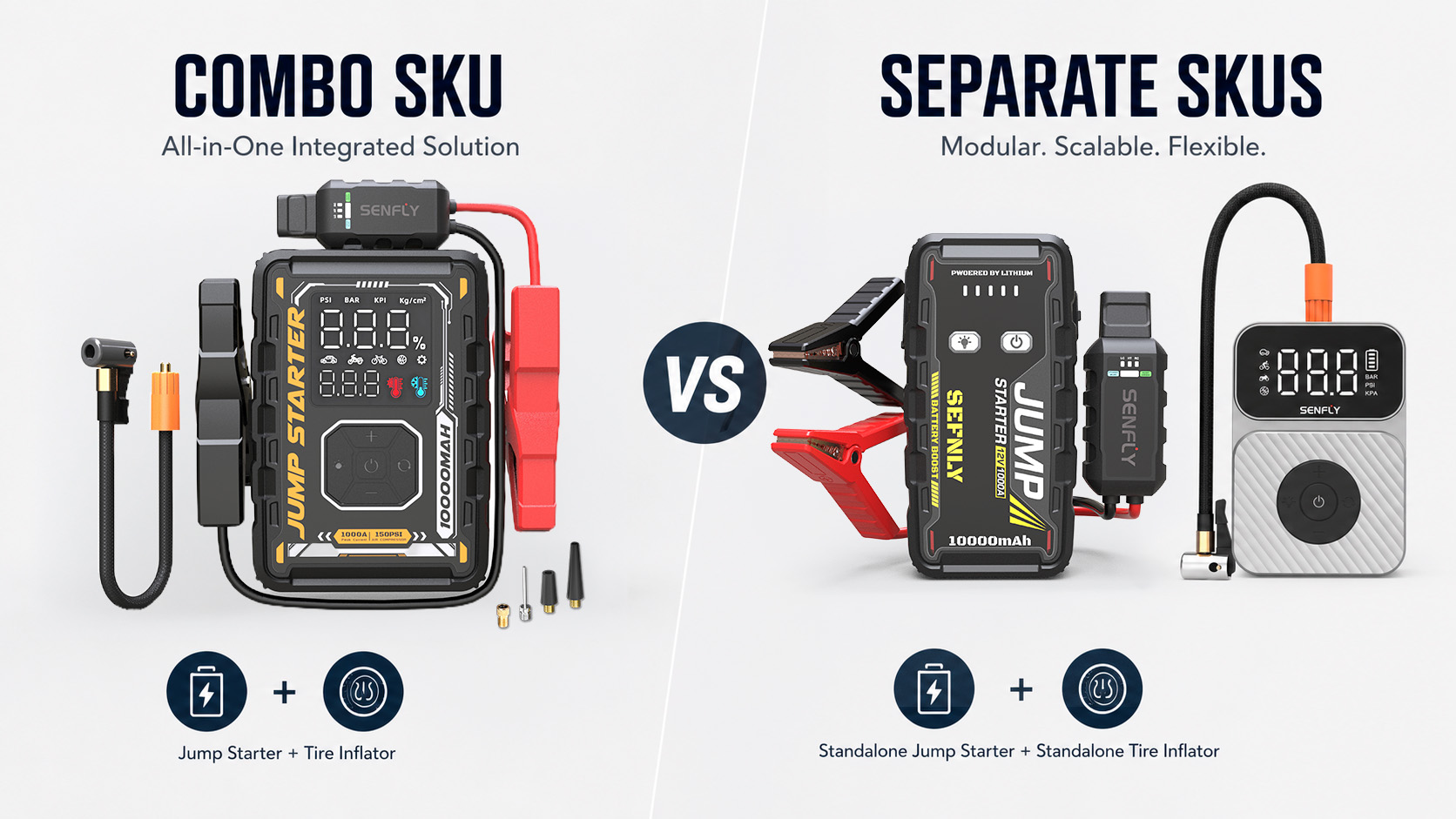
For an automotive accessories brand, the decision to launch a jump starter + tire inflator combo or keep two separate SKUs is not only a product feature question. It affects tooling risk, inventory planning, certification scope, after-sales handling, and the way your brand is positioned in front of distributors and retail buyers.
The practical question is this: do you want one integrated hero SKU that simplifies the catalog, or a modular product line that gives buyers more flexibility and isolates risk?
Both strategies can work. The stronger choice depends on your channel, target buyer, warranty tolerance, and whether your product roadmap needs speed, flexibility, or a more differentiated shelf story.
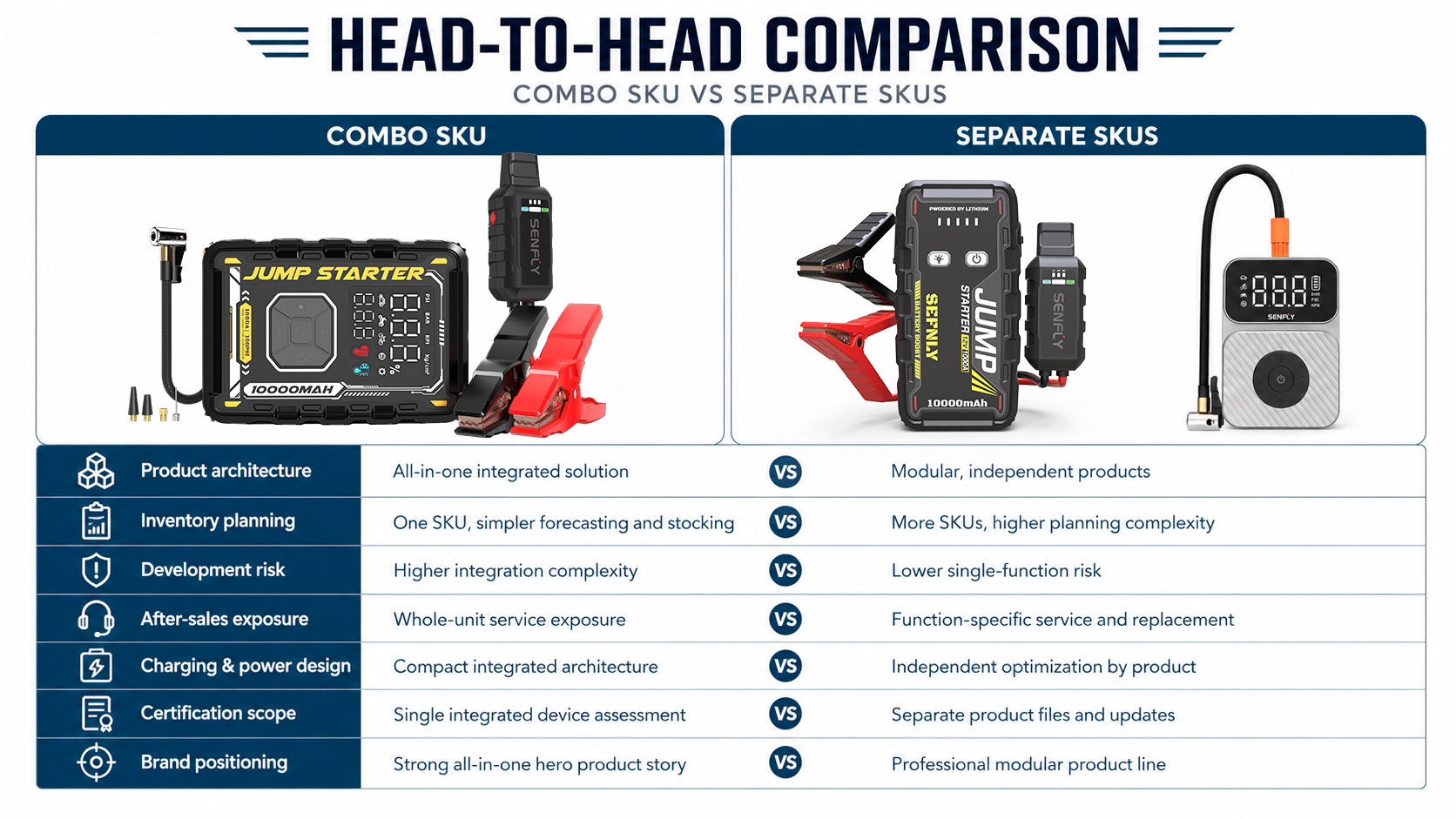
| Decision Dimension | Combo SKU | Separate SKUs |
|---|---|---|
| Product architecture | One housing integrates the lithium jump starter, BMS, pump motor, display, charging circuit, hose, and accessories. | A standalone jump starter and standalone tire inflator are managed as independent products. |
| Inventory planning | One SKU is easier to forecast, stock, ship, and promote. | Two SKUs create more planning work, but each product can be adjusted independently. |
| Development risk | Higher integration risk because thermal design, EMC, pump layout, and battery protection sit in one enclosure. | Lower integration risk because each product can rely on a more mature, single-function platform. |
| After-sales exposure | A pump, hose, battery, clamp, or BMS issue may require servicing the whole unit. | A failure in one product does not automatically affect the other product. |
| Charging and power design | Current combo platforms often prioritize compact integration over high-power charging. | Standalone performance models can support stronger charging architectures, such as PD 65 W on selected jump starter platforms. |
| Certification scope | One integrated product must be assessed as a combined device. Battery transport and EMC remain central. | Each product can be documented separately, which can simplify changes to one SKU without reopening the full bundle. |
| Brand positioning | Strong for an all-in-one roadside emergency story and retail-friendly hero products. | Strong for professional, modular, and performance-oriented product lines. |
This comparison should not be read as "combo is better" or "separate is better." It is a strategy choice. A combo product concentrates your engineering and inventory risk into one product. Separate SKUs spread that risk, but increase catalog and planning complexity.
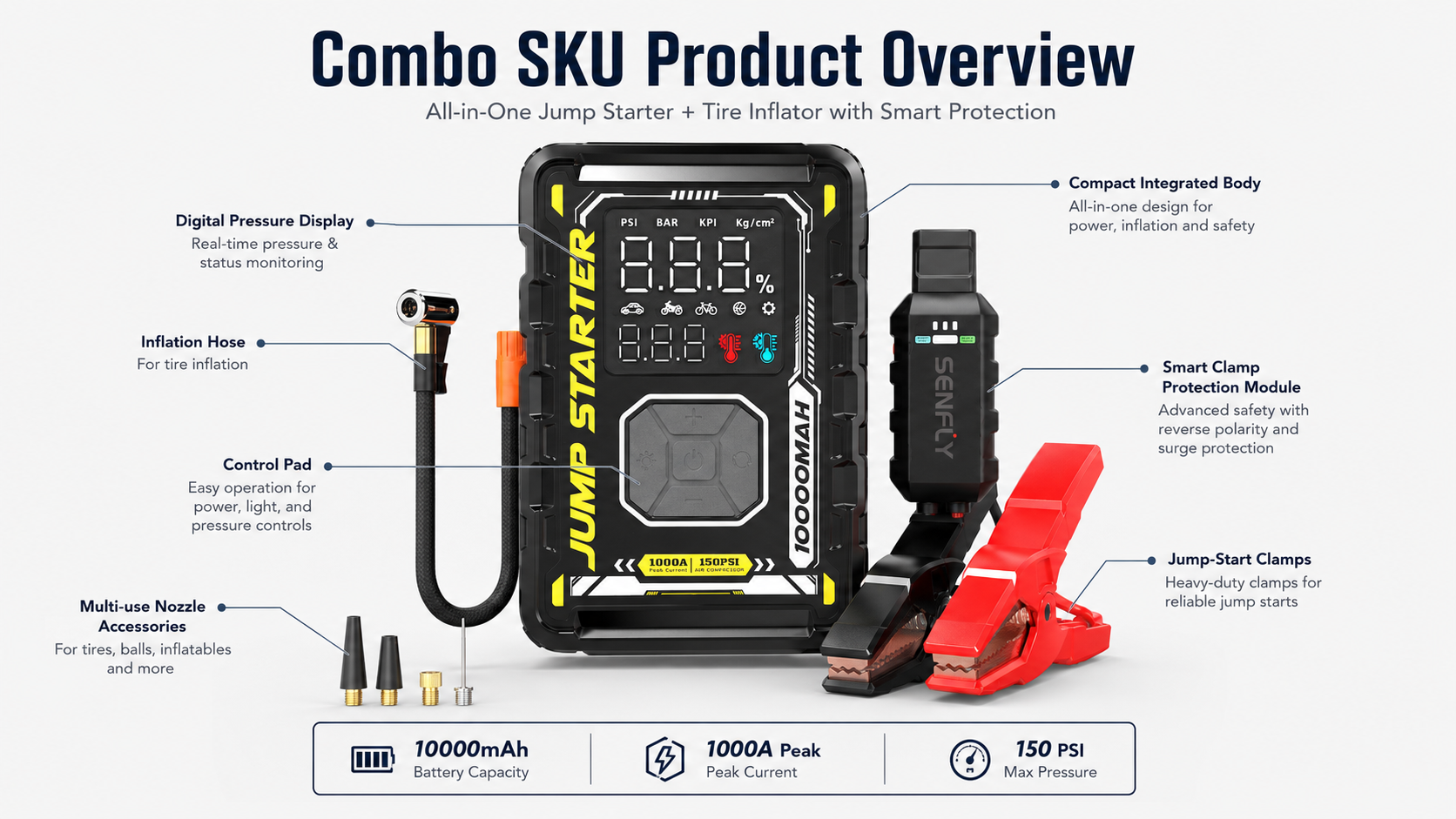
A combo SKU can be the right strategy when the brand wants a simple, high-impact product story: one product, one box, one roadside emergency solution. This is especially useful for channels that value a clear hero product, such as retail shelves, distributor catalogs, bundled roadside kits, and private-label programs where the buyer wants fewer moving parts.
Senfly's combo platforms such as the T53 Jump Starter & Air Pump show why this route can be attractive. T53 uses a LiCoO2 4S battery platform, offers multiple energy configurations from 29.6 Wh to 59.2 Wh, supports 300-800 A start current and 600-1600 A peak current, and integrates a 25 mm air pump with a documented 3-150 PSI pressure range. For buyers comparing combo architectures, these specifications provide a concrete baseline for assessing whether the inflator is a real product function or only an add-on.
The trade-off is that integration creates design pressure. In a combo product, battery discharge, pump motor operation, heat, display logic, charging, and enclosure design all interact. A buyer should therefore evaluate:
For an OEM buyer, the combo path works best when the target market rewards convenience and when the supplier can prove the product is engineered as an integrated system, not just a jump starter with a low-grade pump attached.
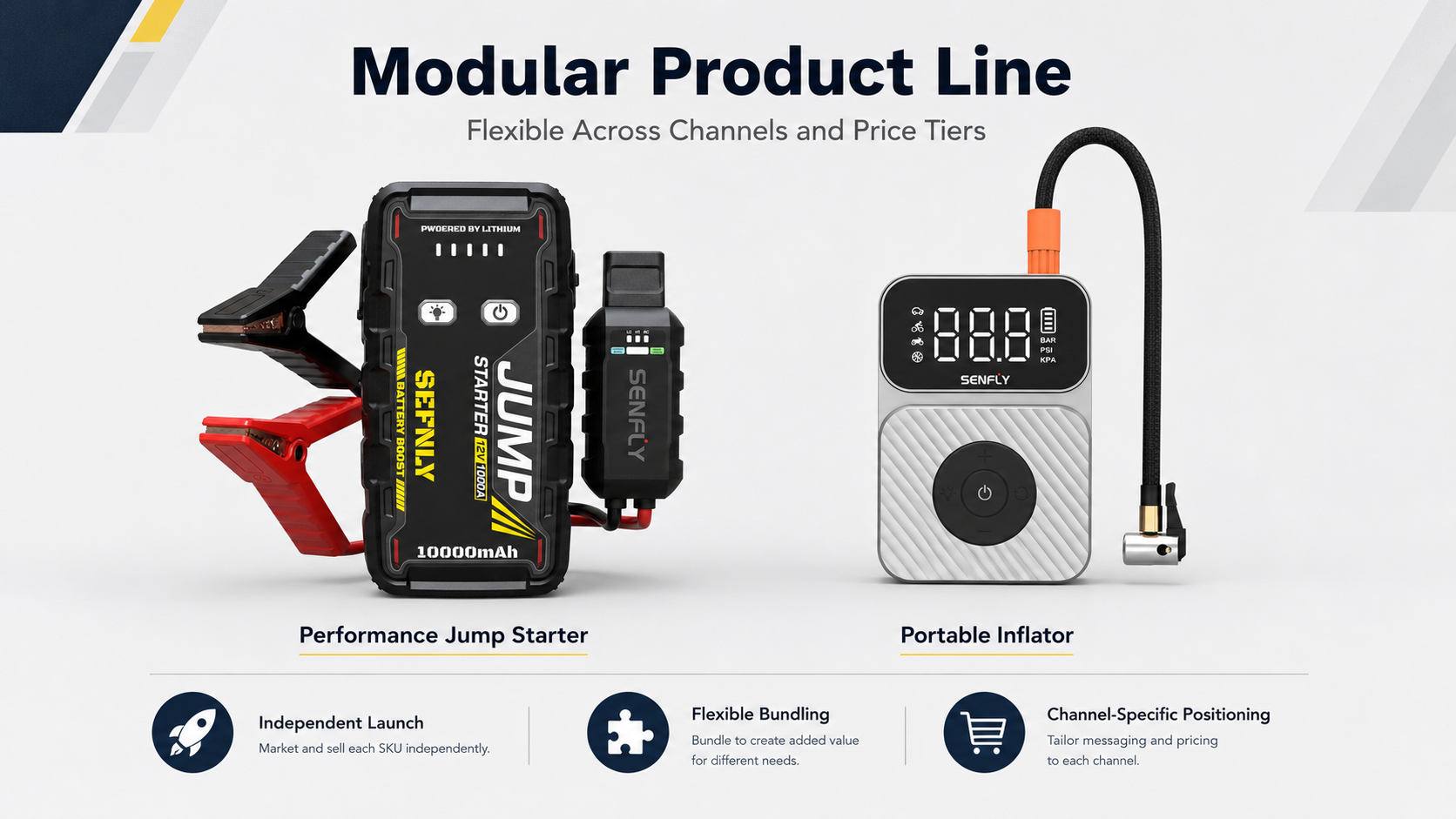
Separate SKUs are usually stronger when the brand wants more flexibility across price bands, channels, and customer groups. A standalone jump starter can target performance, charging speed, clamp design, or battery capacity. A standalone tire inflator can target inflation speed, pressure accuracy, compactness, and accessory use cases.
For example, Senfly's standalone jump starter platforms include models such as T11, which supports PD 65 W bidirectional Type-C charging and high-output jump-start configurations. On the inflator side, Q16 Air Pump is a standalone portable inflator with an 18.72 Wh 18650 battery platform, 19 mm pump structure, USB-A output, and documented certifications including UL, FCC, CE, PSE, RoHS, and CCC in the current knowledge base.
This structure gives brand owners several advantages:
The downside is management complexity. Separate SKUs require separate forecasts, safety stock, packaging plans, certification files, and promotion logic. The brand gains flexibility, but the operations team must be ready to manage it.
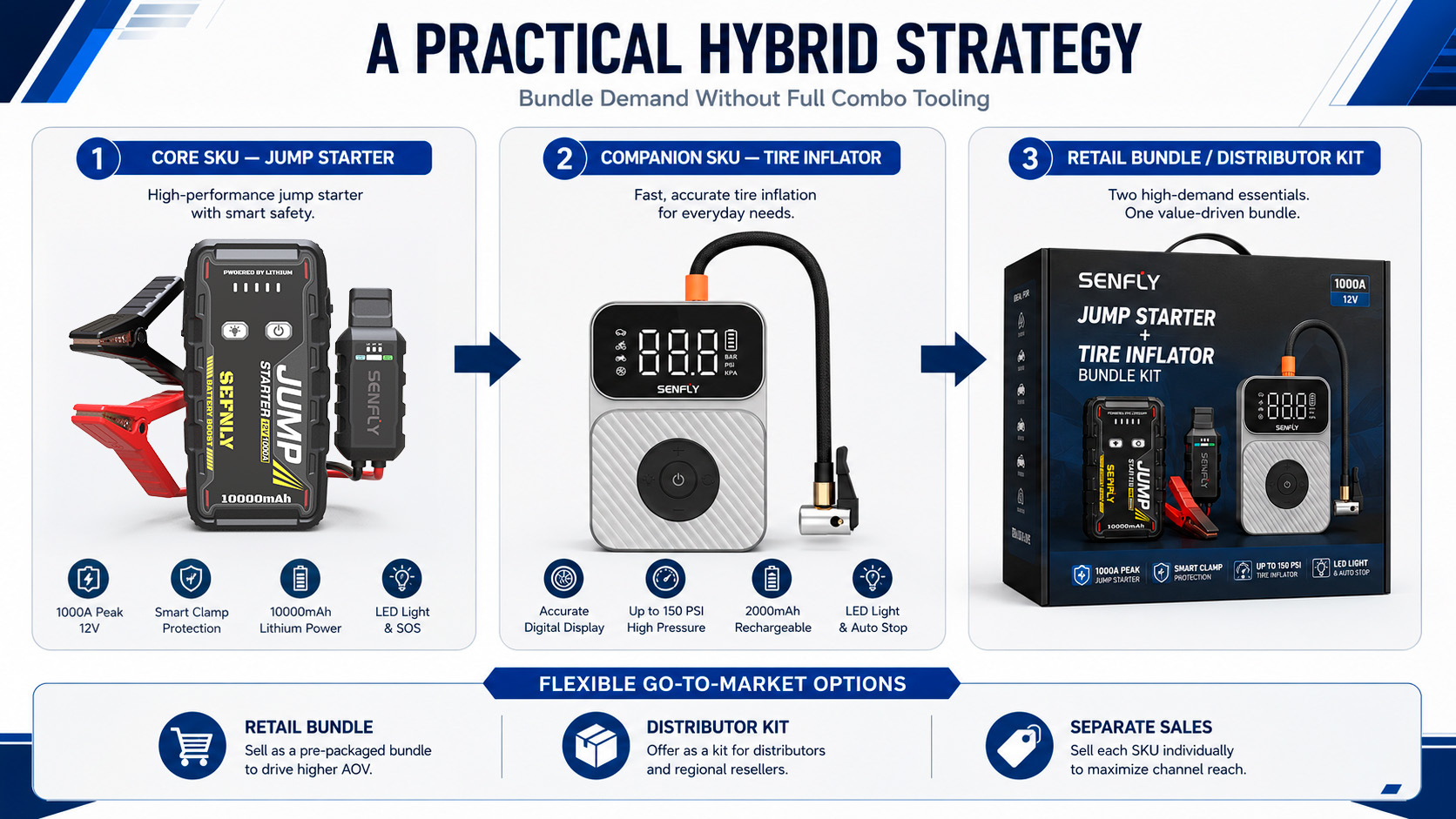
For many OEM projects, the best first move is not a fully integrated combo. It is a hybrid architecture: use a proven jump starter as the core SKU, add a standalone inflator as a companion accessory, and create a bundle package for selected channels.
This approach lets a brand test combo-style demand without committing immediately to a fully integrated mold. It also keeps the products individually sellable. If inflator demand rises seasonally, the buyer can adjust the bundle ratio. If a market prefers professional standalone tools, the brand can sell the same products separately.
Senfly is well positioned for this route because its public product range includes both combo jump starter air pump models and standalone product platforms. For an OEM buyer, that means the discussion can start from real model data rather than a blank concept drawing.
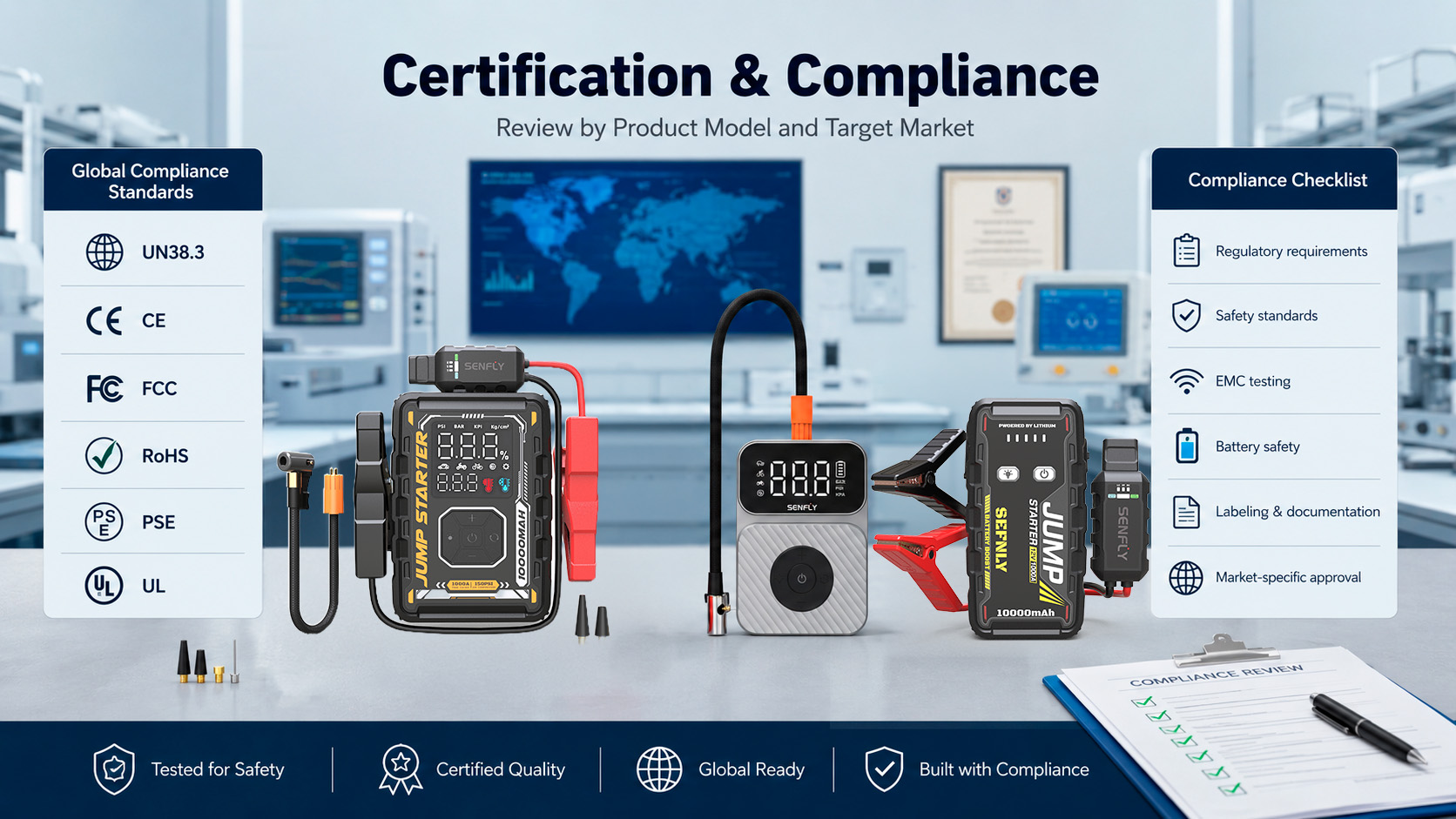
Compliance should be reviewed by product model and target market, not as a blanket claim. Lithium jump starters typically require transport and product safety documentation such as UN38.3, and market-facing devices may require CE, FCC, RoHS, PSE, UL, or other documentation depending on the model and destination.
Combo products require particular attention because the battery system, pump motor, enclosure, and EMC behavior interact in one device. Separate products can sometimes make documentation management easier because each device has its own product file. However, the brand still needs a clear compliance map for the final sales package, especially if the products are bundled.
Senfly can provide model-specific certification documents and test-report references where available. For custom OEM or ODM projects, the exact certification plan should be confirmed during project review rather than assumed from another model.
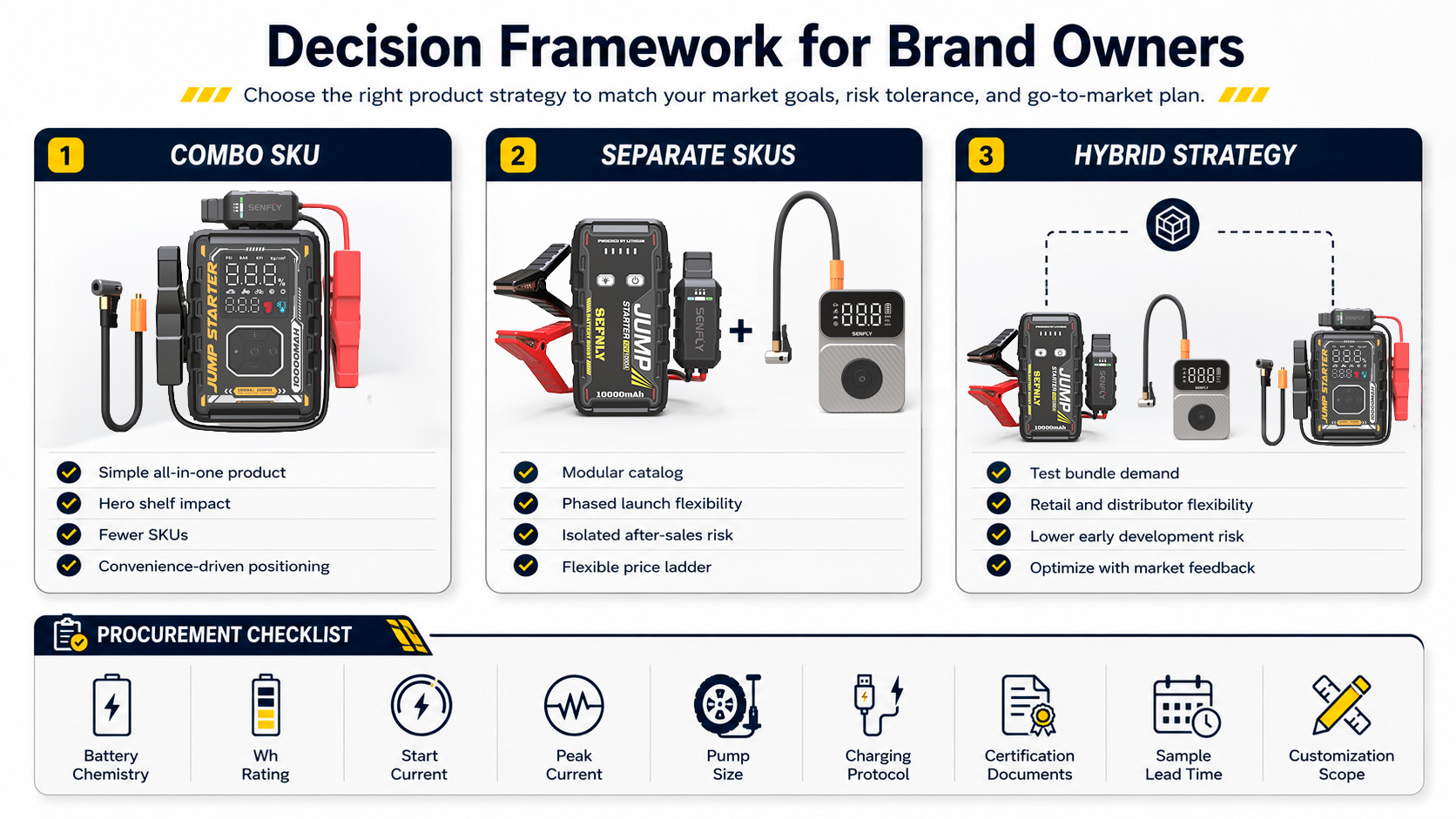
Choose a combo SKU when:
Choose separate SKUs when:
Choose a hybrid strategy when:
Procurement recommendation: before selecting the architecture, ask the supplier for a model-level matrix covering battery chemistry, Wh rating, start current, peak current, pump cylinder size, inflation time, charging protocol, certification documents, sample lead time, and available customization scope.
For qualified OEM inquiries, Senfly can support both paths: existing combo platforms for faster validation, standalone jump starter and air pump platforms for modular product lines, and ODM project review when a custom integrated architecture is required. Warranty options, certification documents, sample verification, branding, packaging, manuals, and third-party factory audit support can be discussed according to project scope.
The right supplier should not force your brand into one architecture. It should help you choose the structure that fits your channel, target buyer, and long-term product line. That is where a disciplined OEM discussion creates more value than a simple model quotation.
 Hot News
 EN
EN