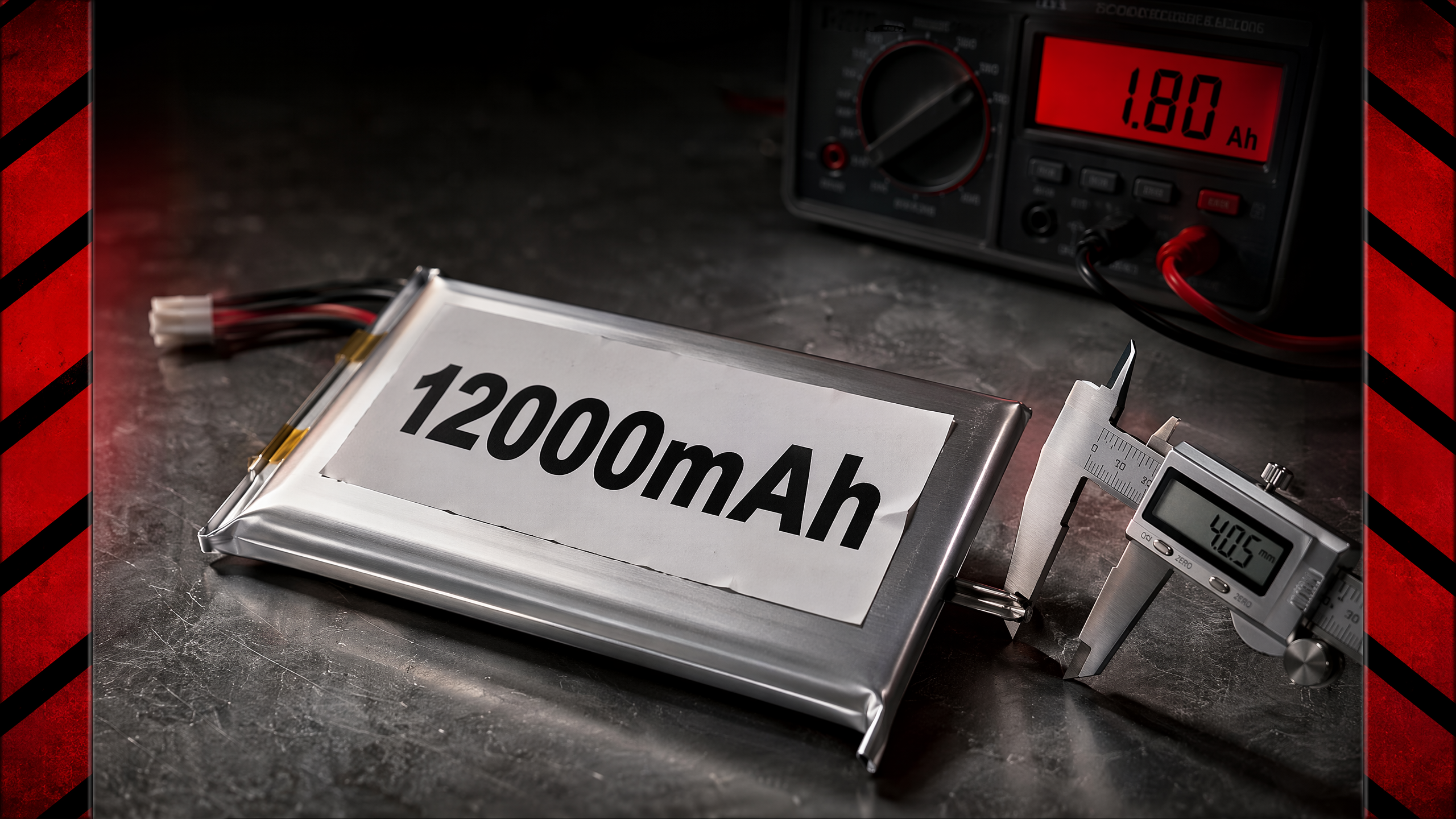
The most expensive battery cell is the one you thought you bought but didn’t. In OEM jump starter procurement, capacity fraud is not a quality defect — it is a supply chain structural risk. The cells inside the housing determine everything: real engine‑start performance, warranty return rates, and whether your brand survives the next Amazon review cycle. This guide gives procurement teams a systematic method to verify capacity before it becomes a recall.
When an OEM buyer evaluates jump starter samples, the impulse is to test peak current — clamp it to a dead battery, measure the crank. That test is valuable. But it tells you nothing about how many actual starts the unit will deliver over its service life, or whether the energy you paid for exists in the first place.
Battery capacity — expressed in watt‑hours (Wh) or milliamp‑hours at nominal voltage — is the engineering reality behind every marketing claim. Peak current can be sustained for milliseconds by capacitors and low‑resistance paths. Capacity cannot be faked for long under real discharge load.
The commercial consequences of underspec’d cells cascade quickly:
| Stage | Impact | Owner |
|---|---|---|
| End‑user returns | Product fails to deliver promised number of starts; negative reviews multiply | Brand owner |
| Warranty claims | Premature capacity fade triggers replacement requests within months | Brand owner / supplier |
| Regulatory exposure | EU Battery Regulation 2023/1542 and evolving market surveillance make capacity labeling legally enforceable | Brand owner, importer of record |
| Supply chain instability | Supplier found misrepresenting one parameter is likely misrepresenting others (cell grade, BMS quality, certification currency) | Buyer’s procurement function |
Risk point for buyers: UN38.3, IEC 62133‑2, UL 2054 — none of these mandatory certifications verify rated capacity. A product that clears customs with compliant safety paperwork may simultaneously carry a 40–70% inflated capacity claim.
For OEM buyers, capacity is the core value metric of a jump starter. It determines how many engine starts before recharge, how well the unit performs in cold weather, and the real‑world experience of the professional who depends on it. A product with honest capacity at 44.4 Wh will outperform a fraudulently labeled “88.8 Wh” unit every time, because the latter’s numbers never existed in the first place.
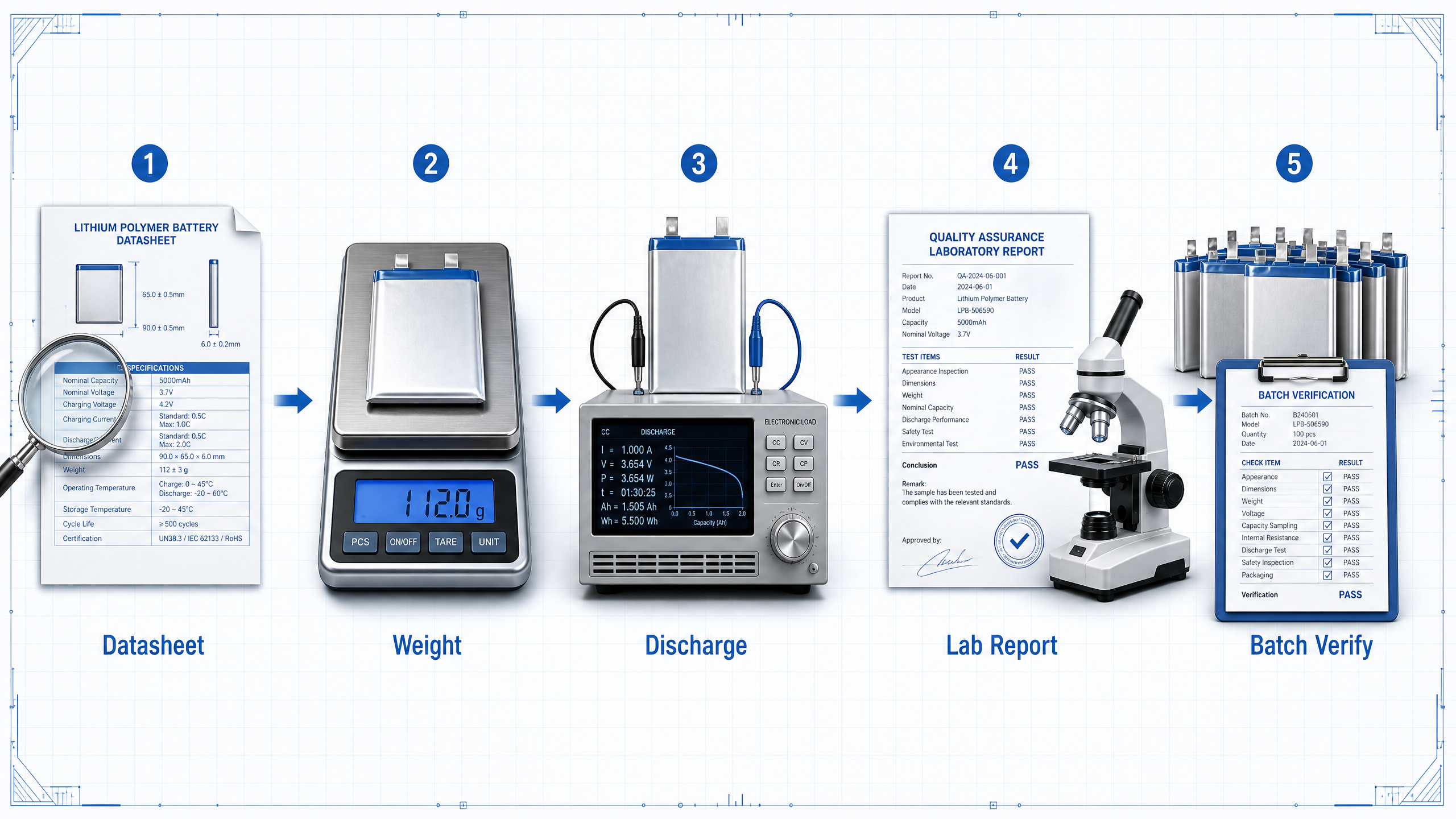
The following checklist is designed for procurement teams without dedicated battery laboratories. Each step can be executed with minimal equipment investment and, more importantly, applied during supplier evaluation — before a production order is placed.
| Priority | Verification Step | Equipment / Access Required | Detects |
|---|---|---|---|
| CRITICAL | Cell datasheet cross‑check against known physics | Internet access, Battery University reference tables | Implausible capacity claims (fraud technique #1) |
| CRITICAL | Physical pack weight measurement | Digital scale, expected cell weight knowledge | Cell substitution, under‑filled cells |
| HIGH | Request discharge curve data | None (supplier provides) | Unrealistic test conditions (0.1 C discharge) |
| HIGH | Verify certification report currency and scope | Document review | Expired reports, wrong test standards |
| MEDIUM | Low‑cost discharge test on pre‑production samples | Electronic load or constant‑power resistor | Actual capacity vs label claim |
| MEDIUM | CT or X‑ray spot‑check (for high‑value contracts) | Third‑party imaging lab | Internal construction defects, electrode alignment |
Every legitimate lithium‑ion cell has a datasheet. It lists the cell manufacturer, model number, nominal capacity, discharge cutoff voltage, and discharge curves at standard rates (typically 0.2 C, 0.5 C, 1 C).
What to request: The cell manufacturer’s original datasheet — not a summary prepared by the jump starter assembler.
What to verify:
Red flag: Any jump starter with ambiguous cell type claims, or a series pack whose mAh label exceeds the single‑cell rating — without transparent documentation to justify the number.
A test report’s existence does not equal capacity verification. Buyers must check three attributes:
Test standard scope. UN38.3 (T.1–T.8) covers vibration, thermal cycling, and altitude simulation — none of which measure capacity. IEC 62133‑2 evaluates electrical and mechanical safety; capacity is not a pass/fail criterion. UL 2054 verifies fire and explosion risk, not energy content. Only standards such as IEC 61960‑3 address capacity testing methodology and labeling accuracy.
Laboratory accreditation. Demand reports from laboratories recognized by CNAS (China National Accreditation Service) or A2LA (American Association for Laboratory Accreditation). An in‑house test sheet without accreditation is not a substitute.
Test conditions documented on the report. Legitimate capacity measurements specify C‑rate, cutoff voltage per cell, and ambient temperature. A report that lists only “test result: pass” without the discharge curve or test parameters is incomplete.
Actionable item: Request capacity test data from an accredited laboratory, ideally to a standard such as IEC 61960‑3. If an IEC 61960‑3‑specific certificate is not yet available, a detailed discharge test report from a CNAS‑recognized facility — with documented C‑rate, cutoff voltage, and temperature — serves as equivalent verification of marketed capacity. In all cases, clarify in writing that safety certifications alone do not validate energy content claims.
Physical checks require only a scale and a caliper, yet they expose some of the most common fraud techniques.
Hard rule: If the supplier cannot identify the cell brand and model, treat the product as if the capacity is unverifiable until proven otherwise.
A basic discharge test provides direct evidence of actual capacity without requiring a full battery lab.
Methodology (buyer‑side):
This test can be adopted as an incoming inspection criterion on pre‑production samples and repeated on random draws from production batches. Because the required equipment is minimal, it costs a fraction of the risk it mitigates.
Even before testing, supplier behavior often reveals whether capacity honesty is embedded in their quality system. Procurement teams should watch for these signals:
Senfly’s standard practice as a benchmark: During supplier evaluation with Senfly’s technical team, you receive cell‑model‑level datasheets for the lithium polymer pouch cells used, a current certification documentation package (UL, CE, FCC, PSE, RoHS, UN38.3, IEC 62133‑2 for target models), and an invitation to perform third‑party factory inspection or to review CNAS‑recognized in‑house test data. While IEC 61960‑3 capacity certification is not part of Senfly’s standard certification package, Senfly’s CNAS‑recognized laboratory can perform full discharge testing under equivalent methodology, and Senfly supports customers who require that specific certification as a custom‑order add‑on. These are not premium add‑ons — they are the baseline evidence an OEM buyer should demand from any serious partner.
Procurement teams that rely on ad‑hoc sample testing will eventually receive a production batch that differs from what was approved. Standardization closes this gap.
| Step | Action | Owner | Timing |
|---|---|---|---|
| 1. Supplier pre‑qualification | Request cell manufacturer, pouch cell model, datasheet, certification report inventory | Buyer procurement | Before RFQ issuance |
| 2. Physical sample inspection | Weigh product and battery module; measure pouch cell thickness/length/width; compare to datasheet; verify cell brand marking | Buyer quality / third‑party inspector | Upon sample receipt |
| 3. Document review | Verify certification reports: issuing lab accreditation, report date (<12 months), test standard relevance to capacity (e.g., whether it includes capacity testing per IEC 61960‑3 or provides accredited discharge curve data) | Buyer quality engineer | Concurrent with Step 2 |
| 4. Discharge test (sample) | 0.2 C constant‑current discharge to 3.0 V/cell cutoff; record actual capacity vs label | Buyer or contracted lab | Before production approval |
| 5. Contract clause | Insert: “Actual capacity ≥95 % of rated capacity at 0.2 C, 3.0 V/cell, 25 °C ± 5 °C; batch test reports required per production lot” | Buyer procurement / legal | Purchase agreement |
| 6. Batch‑level verification | Require supplier‑submitted capacity test data for each production lot; random spot‑check via third‑party inspector | Buyer quality / appointed inspection agency | Each production batch |
| 7. Ongoing supplier review | Track batch‑to‑batch capacity variance over multiple orders; flag drift exceeding ±5 % | Buyer procurement / quality | Quarterly review |
Senfly’s position in this workflow: Buyers working with Senfly gain access to documented pouch cell supply chains, certification files for target models, sample‑stage verification support, and a CNAS‑recognized in‑house laboratory capable of performing the mechanical, environmental, and electrical safety tests referenced in this SOP — including capacity discharge testing under controlled conditions. Senfly maintains factory‑level ISO 9001, IATF 16949, and ISO 14001 certifications with a quality management system designed for full batch‑level traceability — from incoming cell inspection through finished‑product testing. If a buyer requires formal IEC 61960‑3 certification, Senfly can coordinate that as part of the project scope. This infrastructure reduces the buyer’s verification burden without eliminating the need for independent oversight — the healthiest relationship in OEM procurement.
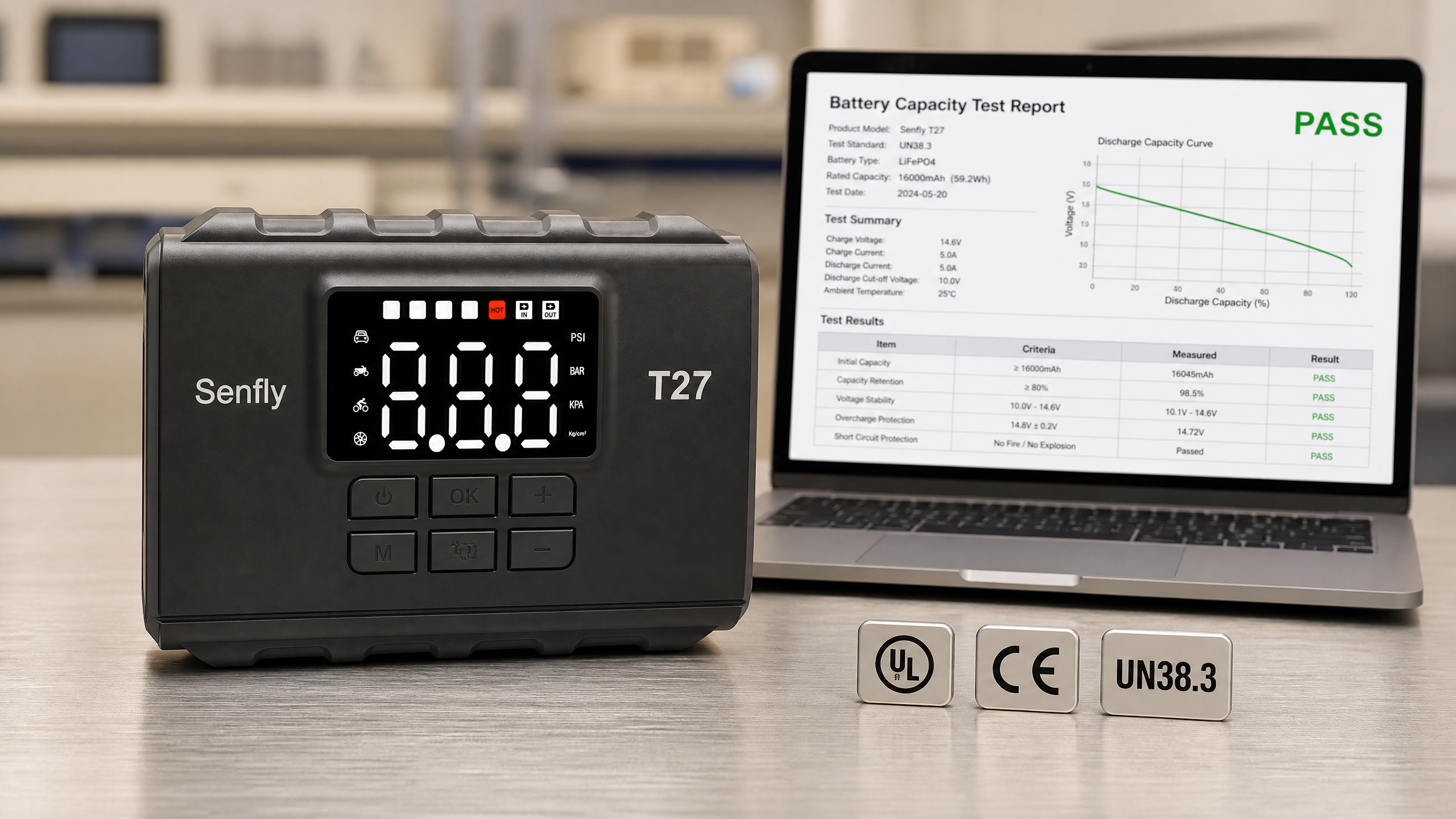
The gap between claimed and actual battery capacity is one of the most persistent — and preventable — risks in jump starter OEM procurement. It persists not because detection technology is unavailable, but because too many buyers treat capacity as a marketing number rather than an engineering specification, and too many suppliers understand that mandatory certifications will not expose their claims.
A systematic verification workflow — cell datasheet cross‑check, physical weight and dimension measurement, discharge testing at standardized conditions, document verification, and batch‑level contractual requirements — transforms capacity from a sales promise into a measurable acceptance criterion. It also separates suppliers with transparent quality systems from those who depend on buyer ignorance.
Senfly’s T‑series jump starters — including the T27 (44.4 Wh, 500 A start / 1,000 A peak), T53 (29.6–59.2 Wh, configurable across the product range), and the full T11/T15/T23/T25 family — are built on documented lithium polymer pouch cell supply chains, supported by product‑level certifications (UL, FCC, CE, PSE, RoHS, IEC 62133‑2 for target models), and backed by factory‑level quality systems (IATF 16949, ISO 9001, CNAS laboratory). For OEM buyers seeking a partner that treats capacity as an engineering commitment rather than a negotiating variable, Senfly provides the documentation, transparency, and verification support that form the foundation of a resilient supply relationship.
Next step for OEM buyers: Contact Senfly to discuss your project and receive:
- Model‑specific certification documentation (UL, CE, FCC, UN38.3, IEC 62133‑2)
- Sample units for independent capacity verification
- OEM/ODM customization scope including branding, packaging, and battery configuration
Capacity honesty is not a premium feature reserved for top‑tier brands. It is the minimum condition for any supplier that belongs in your supply chain. The verification methods in this guide give you the tools to enforce that condition — systematically, repeatably, and before the first container leaves the factory.
 Hot News
 EN
EN