A Procurement Manager's Testing Guide | Senfly OEM/ODM | May 2026
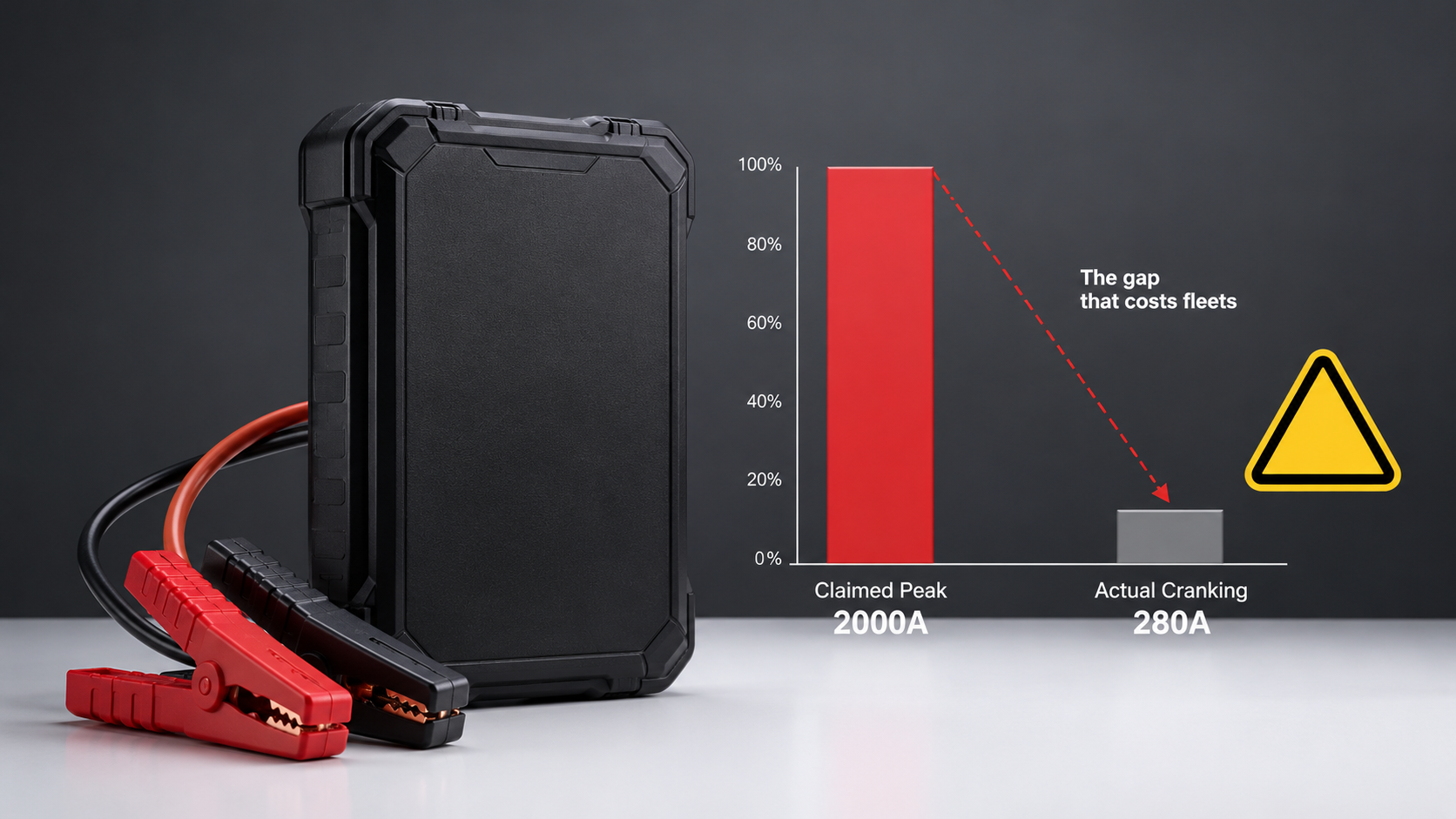
“Jump starter peak amps can be dangerous to rely on — because you have no idea what that number really represents.” — Rick’s Free Auto Repair Advice
B2B procurement managers evaluating lithium jump starters face a hidden supply‑chain risk: the headline specification they use to compare products —peak amps— isnot regulated by any published industry standard.Manufacturers are free to define “peak” as they choose, using different test durations, temperatures, and termination thresholds. The result is a market where a “2000 A” unit from one supplier may deliverless than a quarterof that figure in sustained cranking current.
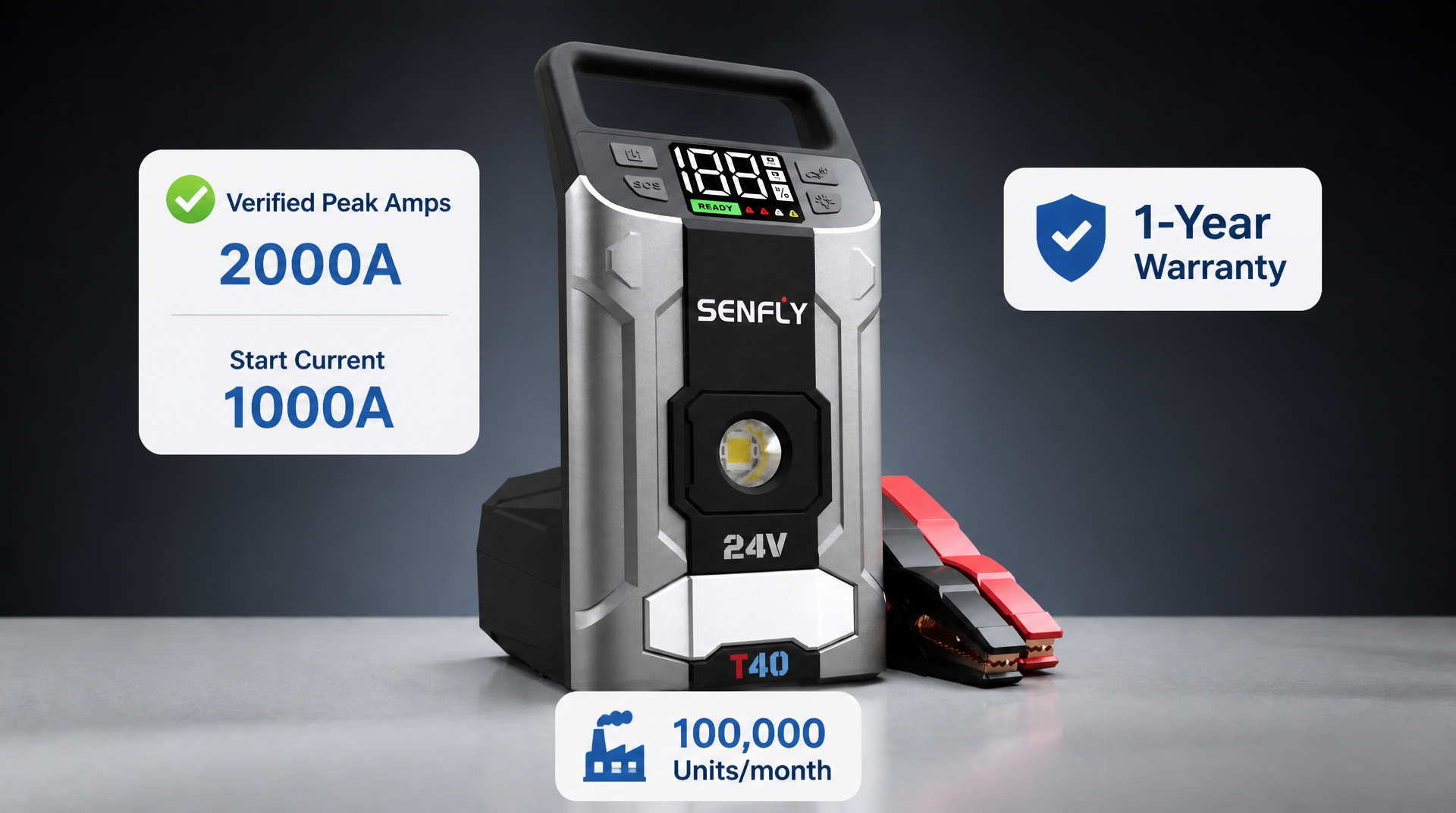
Senfly — an OEM/ODM manufacturer with 100,000‑unit monthly capacity and a track record of supplying Tier‑1 automotive brands — has addressed this opacity directly. Our engineering teams provideverifiable cranking‑amp data, not just a peak headline, and back every jump starter with a1‑year warrantyas standard (extended warranty options available). The following guide equips procurement professionals with a systematic verification protocol, built from industry‑standard electrical principles and real‑world failure data, so that your next bulk order doesn’t come with a reliability gap you can’t see until the first warranty claim.
Each item below is drawn from documented failure modes, safety recalls, and field experience. They are ranked by impact on supply‑chain risk.
|
Priority |
Pitfall |
Risk Description |
Consequence |
Mitigation |
|
**CRITICAL** |
Treating peak current as a performance spec |
No standard defines measurement duration, temperature, or voltage cutoff for “peak amps.” Claims are unverifiable without a defined protocol. |
Unit fails to crank the target engine; fleet downtime; warranty returns. |
**Require cranking‑amp (CA) data** derived from a published test sequence (e.g., 30 s discharge at 0 °C). |
|
**CRITICAL** |
Ignoring battery energy capacity (Wh) |
A 24 Wh pack (like a NOCO GB40 at ~2 Ah) cannot sustain 500 A for more than a few seconds. Peak claims exceeding 1,500 A on sub‑40 Wh packs are physically constrained. |
Thermal shutdown or BMS cut‑off mid‑start; incomplete cranking on cold mornings. |
**Verify pack capacity in Wh** before evaluating current claims. Rule of thumb: diesel applications need ≥70 Wh. |
|
**HIGH** |
Assuming certification verifies performance |
UL 2743 tests **safety** — enclosure integrity, thermal runaway propagation, dielectric strength. It does not measure, validate, or certify peak or cranking current. |
Certification gives a false sense of confidence; unit still may underperform. |
**Request independent lab test reports** showing current‑over‑time curves (oscilloscope trace). |
|
**HIGH** |
Overlooking BMS current‑limiting |
A conservative battery management system may cut output at 200 A even if the cells could deliver more. The buyer receives intermittent “no‑start” reports but no consistent pattern. |
Sporadic failures that are hard to diagnose; brand trust erosion. |
**Ask for BMS trip current** and verify that it exceeds the required cranking current by at least 20 %. |
|
**MEDIUM** |
Not inspecting the current‑carrying path |
Thin cables (≥8 AWG) or steel‑core clamps introduce significant voltage drop between the pack and the starter, wasting available current. |
The unit delivers less current at the clamp than at the internal busbar; unreliable starting. |
**Physically verify wire gauge (≥6 AWG for main leads), connector type (EC5/EC8 with gold‑plated contacts), and BMS MOSFET count** during sample inspection. |
|
**MEDIUM** |
Minimum‑order‑quantity decisions without thermal margin |
A unit rated for 250 A sustained might work in a climate‑controlled test lab but fails at -10 °C because cold increases internal resistance. |
Cold‑weather returns spike; the supplier’s “spec” appears to be inaccurate. |
**Test samples under worst‑case cold conditions** using a programmable electronic load and temperature chamber. |
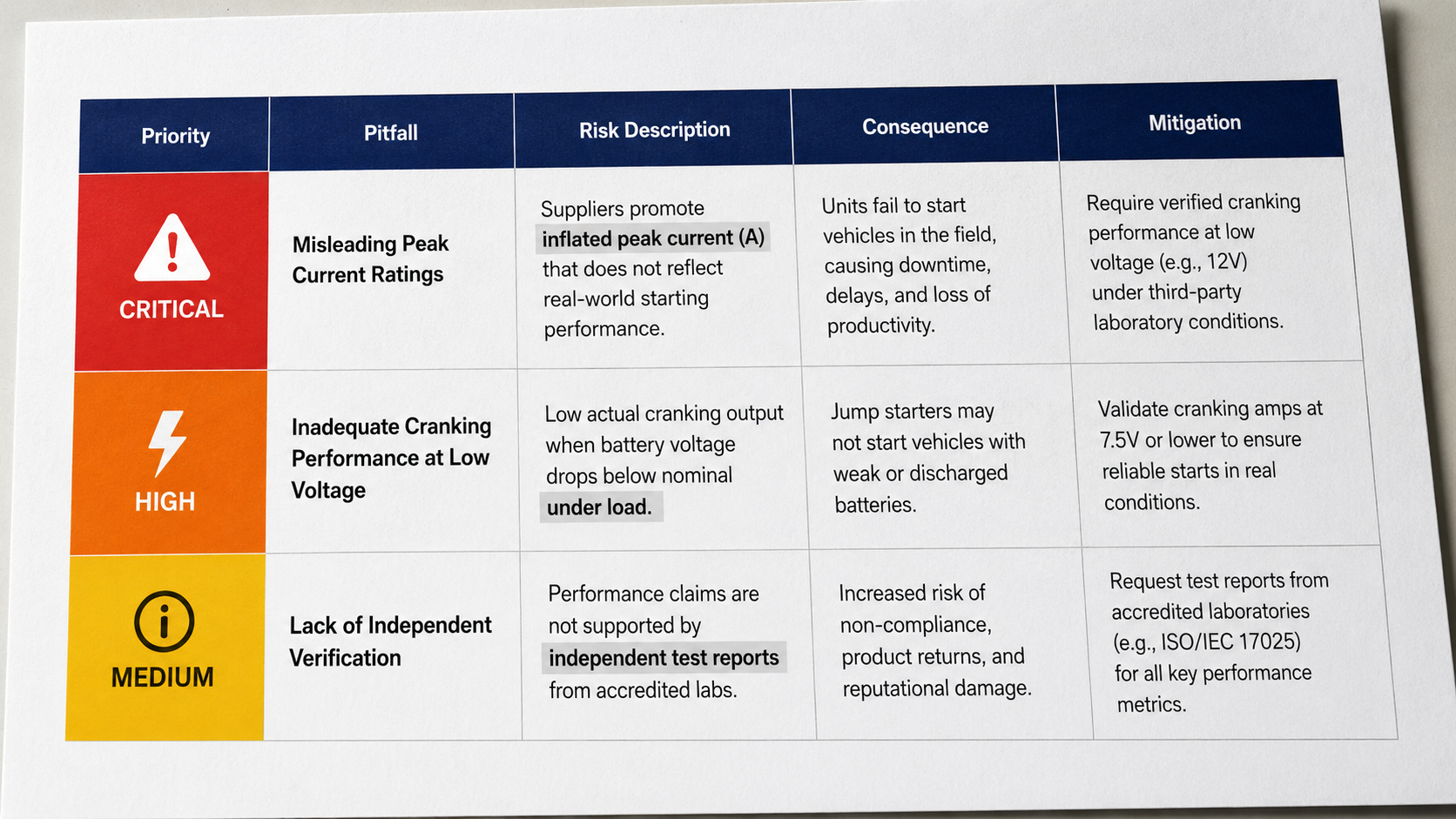
*Anonymized composite based on industry feedback*
A European automotive accessories distributor ordered 5,000 portable jump starters, each branded with the distributor’s logo, for its B2B fleet‑service catalogue. The supplier’s data sheet listed2,000 A peakand a battery capacity of 44.4 Wh. During acceptance testing at the distributor’s lab, the units started a 2.0 L gasoline engine at 20 °C without issue — the spec appeared legitimate.
Six months later, field reports began arriving. Fleet customers attempting to jump‑start 2.5 L diesel vans at 0 °C found that the unit would cut out after the second cranking attempt. A teardown revealed the root cause: the BMS was set to a200 A current limit, below the 280 A needed for the diesel starter. The 2,000 A peak figure had been measured across an internal capacitor bank for less than 10 ms — a value that bore no relationship to the usable cranking current.
The distributor ultimately replaced the entire batch, incurring a six‑figure recall cost. A verification protocol that includedrequesting cranking‑amp dataandchecking the Wh‑to‑peak ratiowould have flagged the mismatch before the purchase order was signed. Senfly’s B2B programme addresses this vulnerability by providing afull discharge curvefrom an independent CNAS‑accredited laboratory with every ODM proposal, so buyers never have to extrapolate from a single peak number. And with a standard1‑year warranty, the post‑shipment risk is contractually bounded.
Incorporate these steps into your supplier qualification process to separate verifiable performance from marketing claims.
Ask the supplier: “What is the sustained cranking current at 0 °C for 30 seconds, maintaining terminal voltage above 7.2 V?” If the answer is a peak‑amp number or “we don’t test that,” treat it as ared flag. The SAE J537 standard defines cold‑cranking amps (CCA) for automotive batteries; while not directly applicable to portable packs, its measurement protocol provides a reasonable benchmark for comparison.
A 12 V pack with a74 Wh capacity(≈6.17 Ah) can theoretically deliver 500 A for only 44 seconds under ideal conditions — before accounting for voltage sag, BMS cut‑off, and cable losses. Real‑world duty cycle is much shorter. Use the following relationship to sanity‑check claims:
**Theoretical discharge time (s) = (Pack capacity in Ah × 3600) ÷ Discharge current in A**
For example, a 24 Wh pack (2 Ah) trying to sustain 400 A yields a theoretical maximum of 18 seconds — likely less than three cranking cycles.Demand the Wh ratingfrom the supplier and reject any unit whose peak‑to‑capacity ratio exceeds industry norms.
-UL 2743ismandatory for US retail(Amazon, Walmart) andtests safety, not performance. A valid UL 2743 report confirms the BMS prevents thermal runaway, the enclosure passes a rain test, and the dielectric withstand meets requirements.
-UN38.3ismandatory for air freightof lithium batteries. Ensure the test report is current — reports typically expire after one year (check the issuing lab’s validity period).
-Certifications do not verify peak current.A UL‑listed unit can still have a 10:1 peak‑to‑cranking ratio.
Insist on an oscilloscope trace that showscurrent vs. timefor a full cranking cycle. The graph should reveal:
- peak amplitude (the brief spike),
- sustained current plateau,
- voltage sag at the clamps, and
- thermal shutdown point, if any.
A supplier unwilling to provide a test report from an ISO 17025‑accredited laboratory is effectively asking you to take the peak number on faith.
Match the verifiedsustained cranking currentto the engine types your customers actually use. The table below is compiled from industry consensus and fleet‑service data.
|
Vehicle Type |
Required Sustained Current |
Realistic Peak‑Claim Range |
|
Small gasoline (4‑cyl) |
150‑250 A |
600‑1 000 A |
|
Large gasoline (6‑8 cyl) |
250‑400 A |
1 000‑1 500 A |
|
Diesel light truck |
400‑600 A |
1 500‑2 000 A |
|
Heavy diesel (commercial) |
600‑1 000 A |
2 000‑3 000 A |
*Source: verified through industry consensus (multiple secondary sources).*
During sample evaluation, inspect the internal construction for three attributes that directly affect current delivery. These components must meet a minimum specification to avoid excessive I²R losses.
|
Component |
Minimum Specification |
Inspection Method |
|
**Main output leads** |
**≥6 AWG** pure copper (not copper‑clad aluminium) |
Measure diameter with a caliper; strip a sample to confirm material |
|
**Connector type** |
**EC5 or EC8** with **gold‑plated contacts** (or equivalent low‑resistance interface) |
Visual confirmation; check for spring‑loaded socket engagement |
|
**BMS thermal management** |
Visible **heatsinking** on MOSFETs; total MOSFET count sufficient for rated current (typically ≥4 parallel TO‑220 devices for 500 A capable packs) |
Open the enclosure; count MOSFETs; verify heatsink attachment |
**Senfly’s ODM engineering team** provides a full teardown report for all new model samples, including AWG measurements and BMS component photographs, so your inspection team can verify compliance before production begins. Every unit shipped carries our **1‑year warranty**, and extended warranty options are available to align with your own brand guarantee.
— — — — — — — — — — — — — — — — — — — —
Procurement teams that follow this six‑step protocol will immediately reduce the risk of product returns, warranty claims, and brand damage caused by overstated jump‑starter specifications. The key is to stop treating “peak amps” as a specification and start demandingsustained cranking‑current data, Wh capacity, independent test reports, and physical inspection of the current path.
Senfly’s B2B jump‑starter programme is built for buyers who need these answers before they place an order. We offer:
-Verifiable cranking‑amp datafor every model, supported by ISO 17025 lab reports.
-Full certification package— UL 2743, UN38.3, CE, FCC, RoHS — as standard.
-Transparent BOM and BMS designdocumentation during the ODM process.
-Standard 1‑year warrantywith customizable extended terms for volume buyers.
-Factory lead time:25 days production, sample lead 7‑10 days; minimum order1 000 units.
To request a technical datasheet for the Senfly 12V and 24V series jump starters — complete with discharge curves and certification copies — contact our B2B team and specify your target vehicle application. We’ll return a data package that lets you verify every claim before the first unit leaves our ISO 9001‑certified production line.
Secure The Unknown. Never Stop.
 Hot News
 EN
EN