EN
EN

Canada Market Brief · July 2026
Canada Jump Starter Market Outlook
Cold-weather reliability is redefining product competitiveness
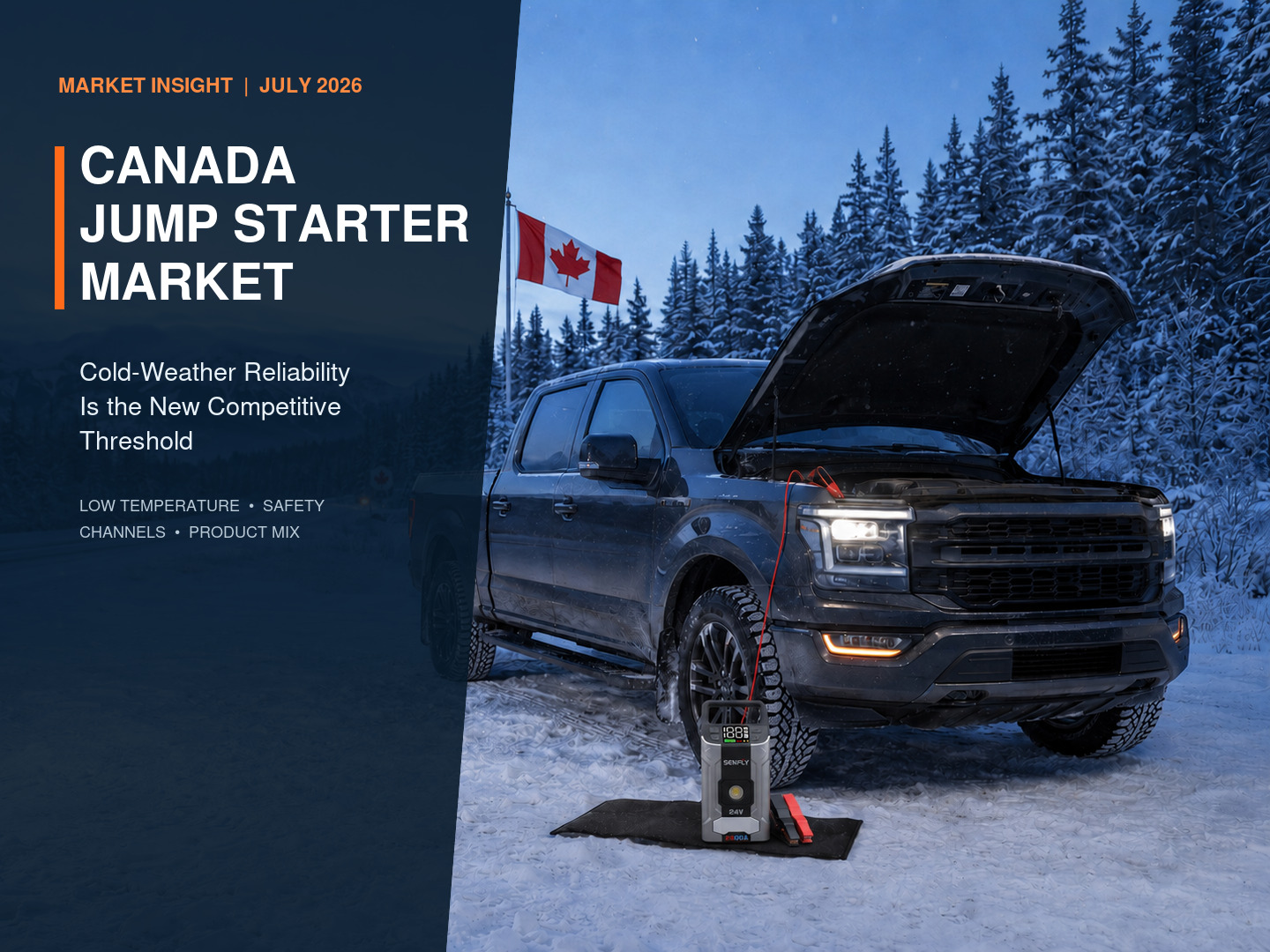
Canada is not the world’s largest jump starter market, but it is one of the most demanding markets for product reliability. Long winters, frequent cold starts, a high share of pickups and SUVs, and long-distance driving across sparsely populated regions all raise the performance expectations for vehicle emergency equipment.
For brands, importers, purchasing managers, and retail channels planning to grow in Canada, the competitive focus is moving beyond peak-amp claims. Low-temperature reliability, safety protection, durability, and a complete roadside emergency experience increasingly determine whether a product can earn channel support and sustain a premium price.
Executive Takeaways
- Cold-weather capability is the entry requirement: Canadian consumers are effectively buying a winter safety product, not just an automotive accessory.
- Combo products are a key growth direction: jump starting, inflation, lighting, and USB-C power create a clearer purchase proposition than a single-function starter.
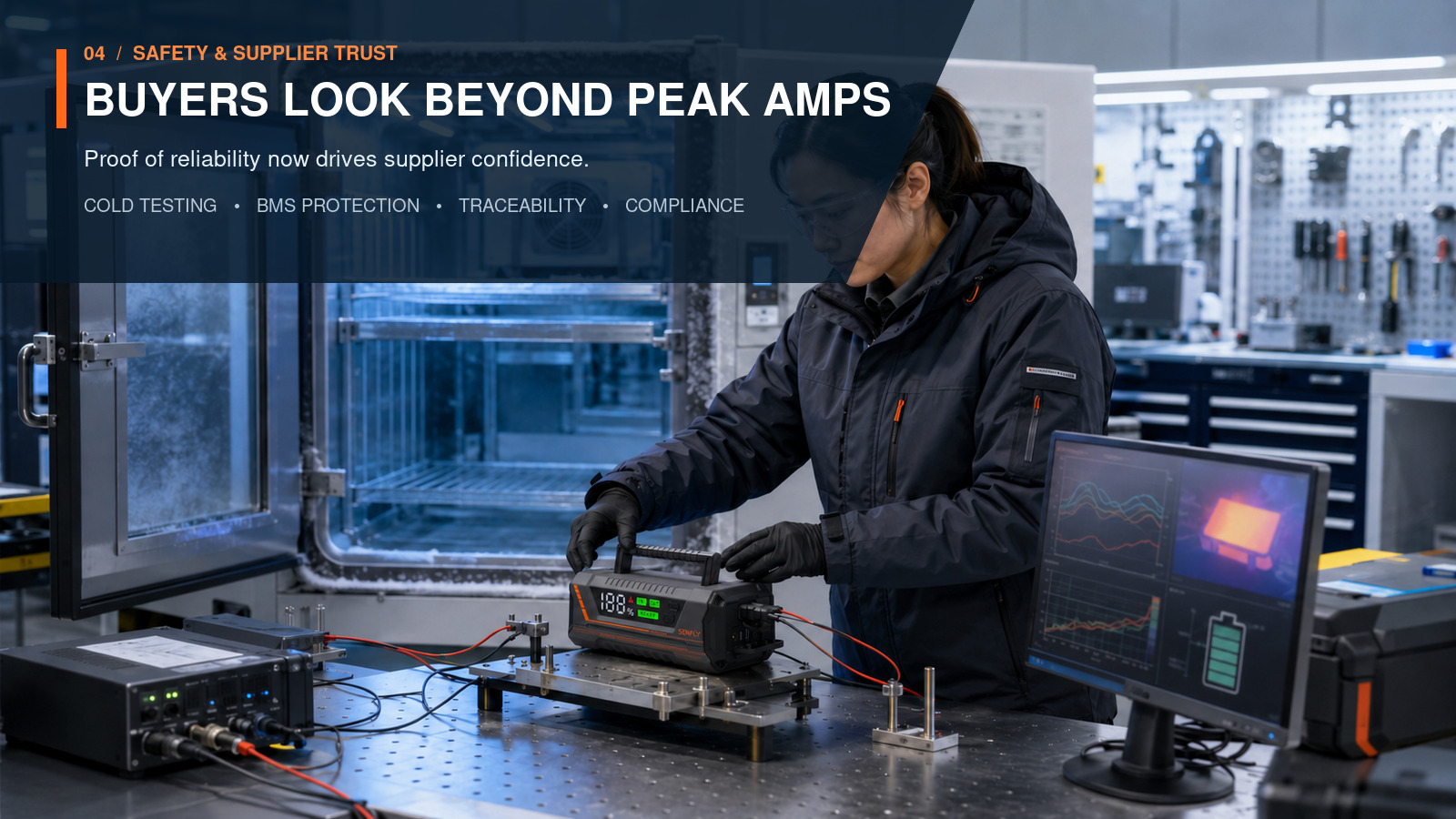
- Safety proof matters more than headline specifications: BMS protection, cold testing, storage safety, and compliance files are becoming central to brand trust.
- Retailers can support mid-to-premium pricing: but only when reliability is backed by test data, quality documentation, and a credible after-sales system.
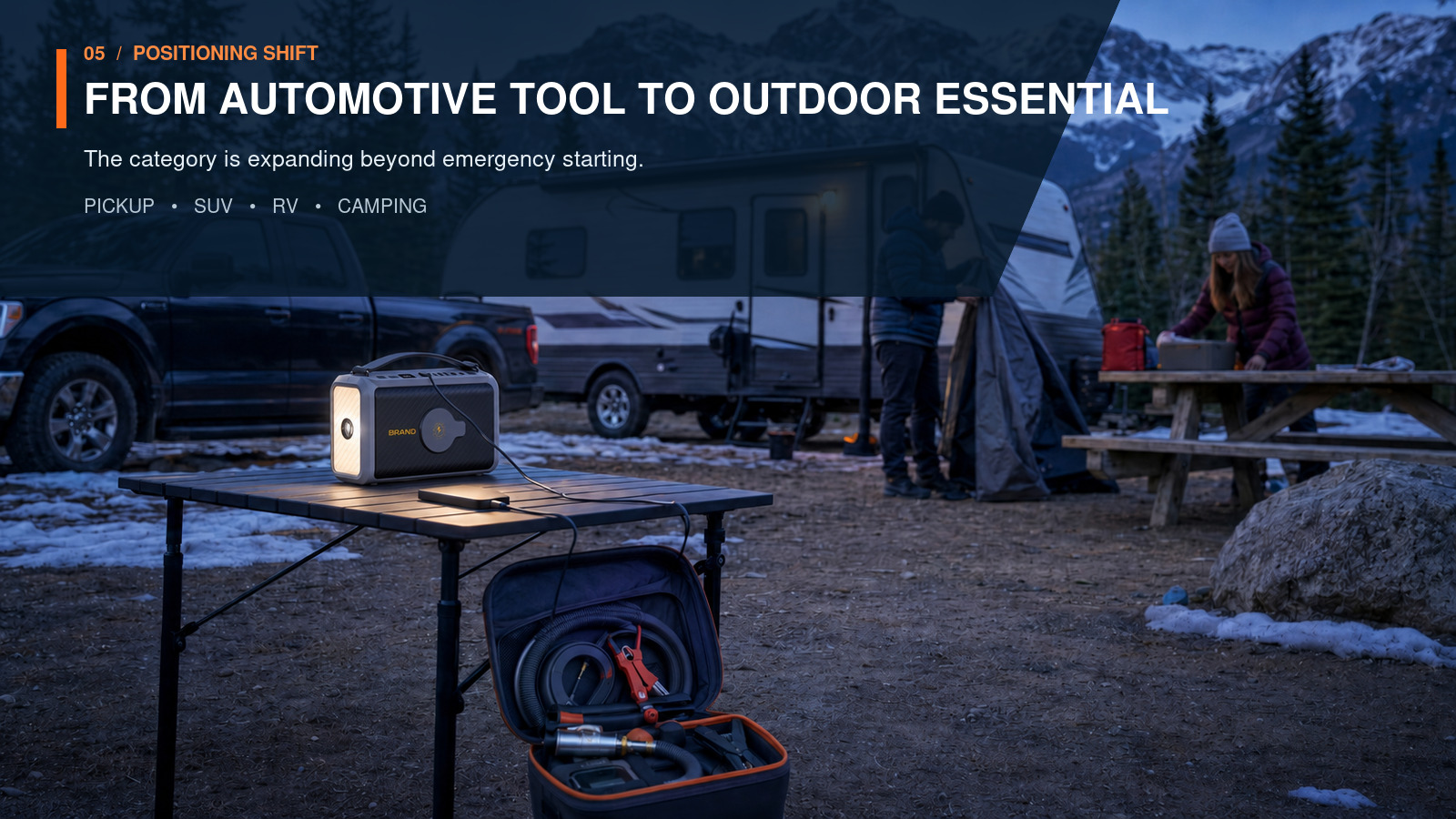
- The category is expanding: jump starters are evolving from automotive tools into outdoor emergency equipment for pickup, SUV, RV, and camping users.
01Demand Fundamentals: Cold Weather Remains the Primary Purchase Driver
Every winter, weak batteries, no-start events, and falling tire pressure drive seasonal demand for jump starters and portable inflators. Growth in camping, RV travel, off-roading, and long-distance driving is also increasing acceptance of multifunction portable vehicle-power products.
| Use Case | User Pain Point | Key Purchase Priorities |
|---|---|---|
| Winter commuting | Low temperatures reduce battery performance and can leave a vehicle unable to start. | Cold-start capability, long standby time, simple operation, and reverse-polarity protection. |
| Pickup and SUV ownership | Larger engines place greater demands on starting performance and clamp reliability. | Verified starting current, stated engine coverage, heavy-duty cables, and durable housing. |
| Long-distance and remote driving | Roadside assistance may take longer to arrive, while a single-function product covers only one failure mode. | Multiple starts, tire inflation, SOS lighting, and mobile-device charging. |
| RV, camping, and off-road use | Outdoor environments increase both product usage frequency and operating duration. | Higher capacity, USB-C fast charging, lighting, impact resistance, and organized storage. |
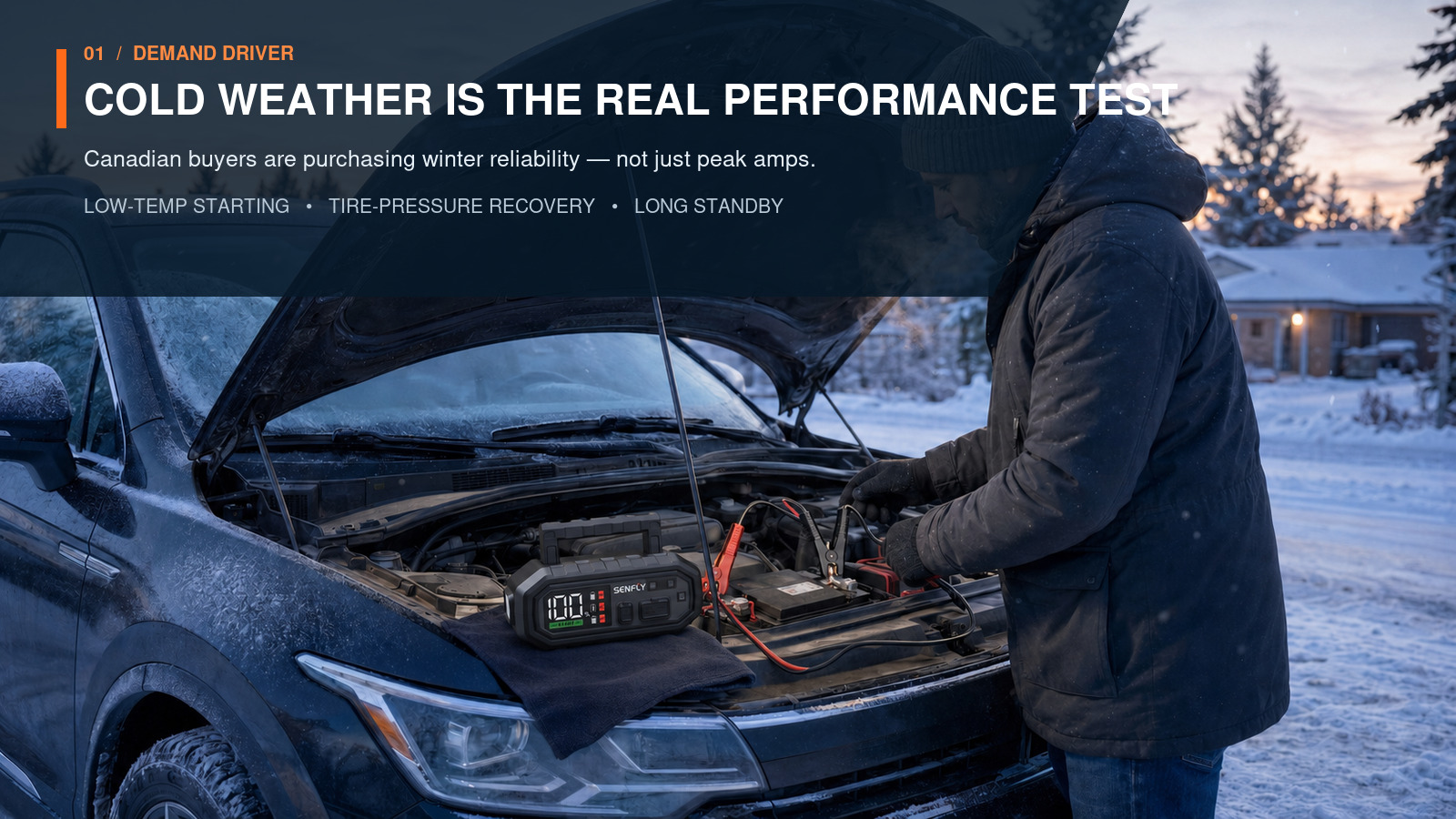
Senfly develops its products around real cold-weather use cases. Its CNAS-accredited in-house laboratory supports environmental testing from −40°C to 150°C, covering the thermal conditions a vehicle-mounted device may encounter across Canadian winters and summers. The T-series combo platform integrates jump starting, tire inflation, USB-C fast charging, and SOS lighting in a single unit.
02Retail and Pricing: Canadian Tire Remains a Key Market Indicator
Canadian Tire remains one of the most useful channels for understanding the structure of Canada’s jump starter category. Its assortment includes professional tool and automotive brands such as NOCO, DEWALT, MotoMaster, and VIKING. At the same time, conventional lead-acid boosters are losing share while lithium products increasingly define the mainstream assortment.
| Market Tier | Representative Product Type | Observed Price Band | Channel Implication |
|---|---|---|---|
| Entry to mid-tier | Pure jump starters such as the MotoMaster EasyBoost 1350A. | Approx. CAD 160–220 | Core reliability and value remain the primary selling points. |
| Mid-to-premium growth tier | Products such as the MotoMaster Eliminator XB30 3000A, DEWALT 2500A, and NOCO AX65 combo unit. | Approx. CAD 220–350 | Multifunctionality, brand credibility, and performance proof support the premium. |
| Professional tier | Higher-output products for larger engines or professional users. | CAD 400+ | Requires stronger testing, compliance, warranty, and after-sales support. |
The implication is clear: Canadian consumers can accept mid-to-premium price points, but retailers will not pay more for headline specifications alone. Brands must translate cold-weather performance, vehicle compatibility, safety systems, and long-term utility into credible product evidence.
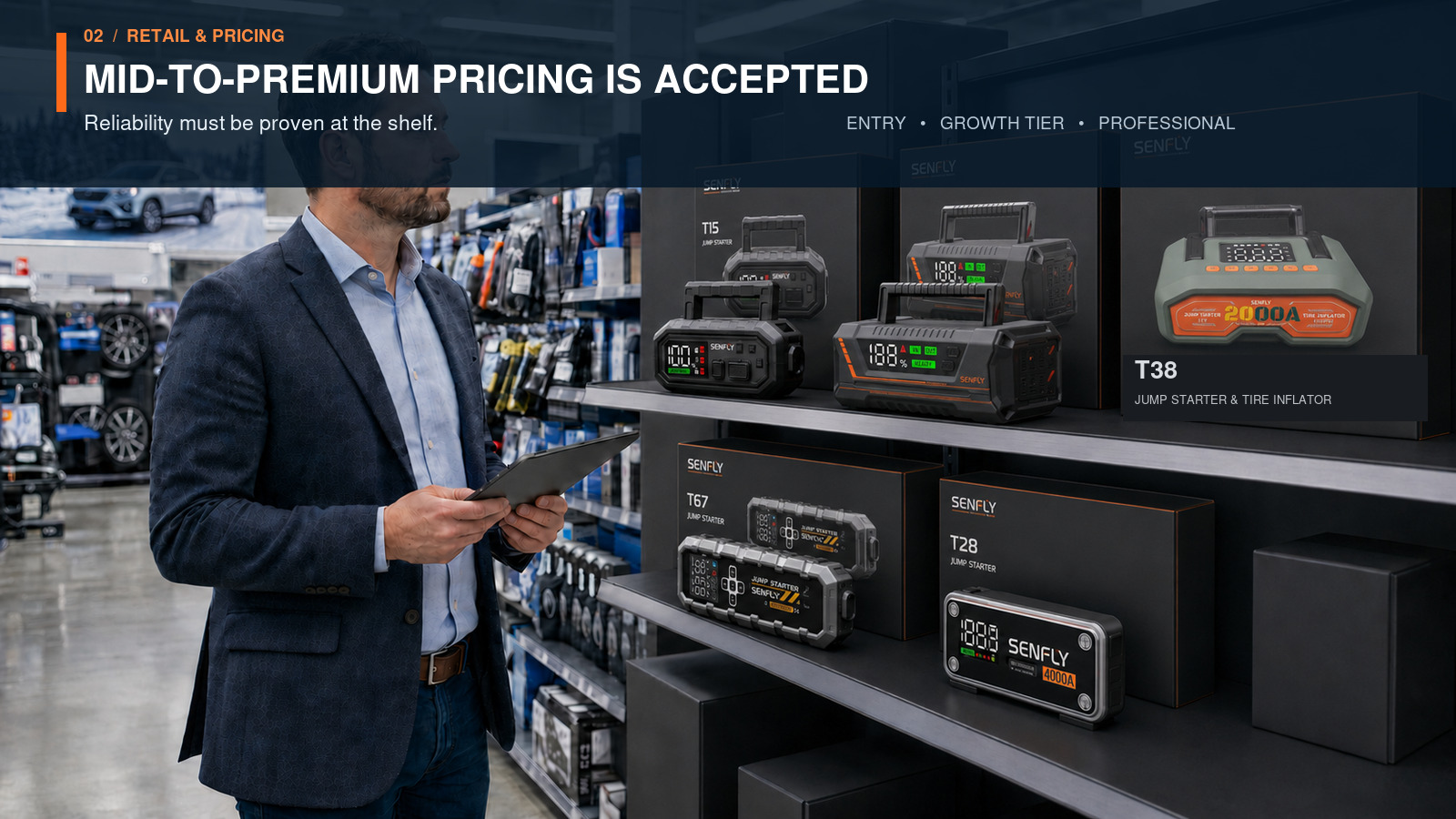
Senfly’s portfolio is structured to cover these major price tiers. Pure jump starter models T47, T55, and T11 target the entry-to-mid segment, while T25, T53, and T39 jump-starter/inflator combos address the mid-to-premium growth tier. Standard OEM handover documentation includes model-specific certification files, component sourcing records, and production-batch traceability.
03Product Trend: Jump Starter and Inflator Combos Are Becoming a Growth Priority
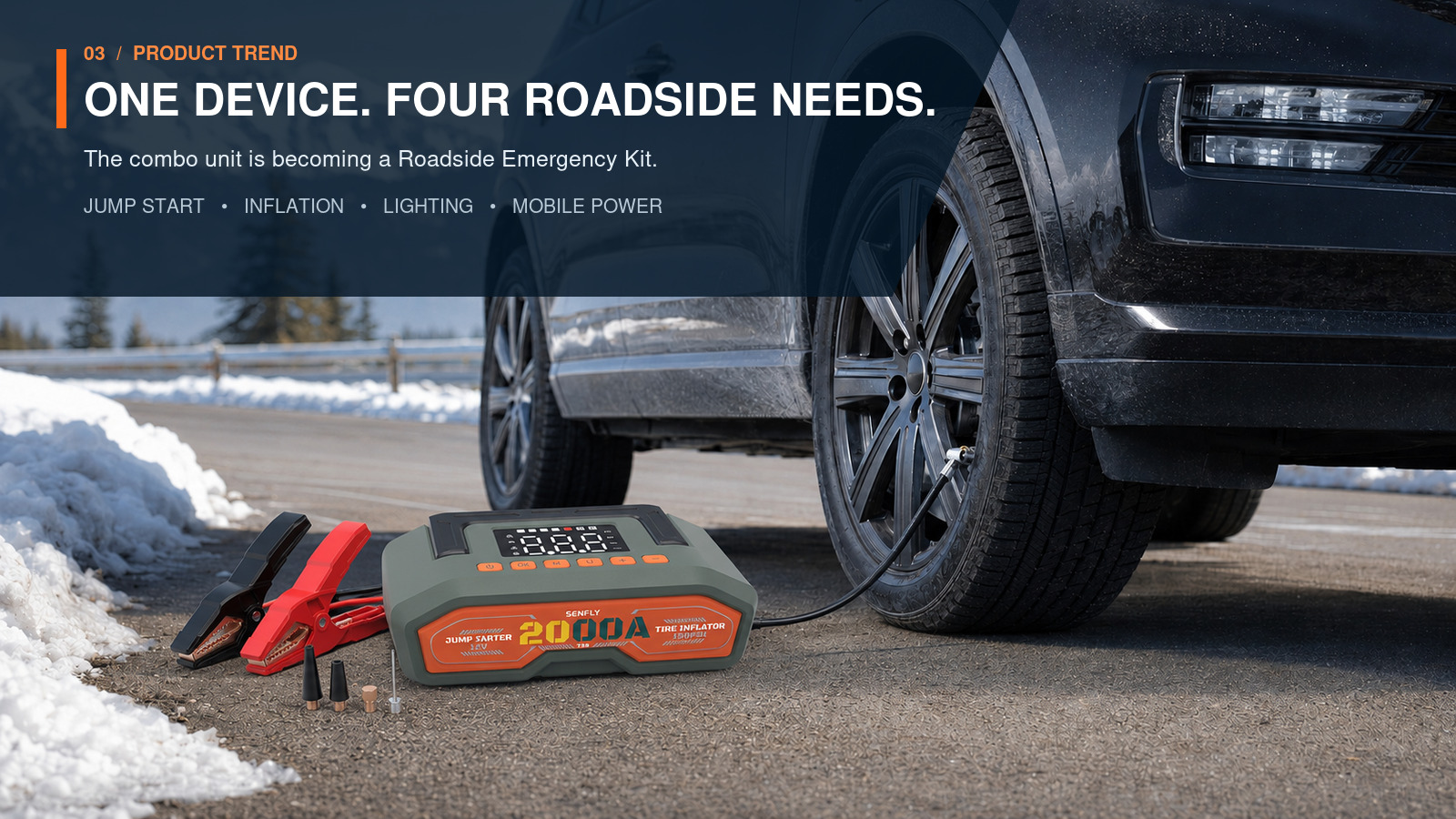
Canadian consumers increasingly prefer one product that can address several roadside problems. Beyond jump starting, they value winter tire-pressure recovery, outdoor lighting, USB-C fast charging, digital pressure readouts, and automatic inflation shutoff. The NOCO AX65 has helped validate the jump-start, inflation, and USB-power combination in retail, while the broader market still leaves room for suppliers able to offer a complete entry-to-flagship combo range.
| Roadside Problem | Relevant Product Function | Value to Brands and Retailers |
|---|---|---|
| Vehicle will not start | Cold-weather starting, repeated starts, and smart clamps. | Delivers the category’s core value while reducing misuse and avoidable returns. |
| Winter tire-pressure loss | 150 PSI inflation, digital display, preset pressure, and automatic stop. | Increases usage frequency and makes the product more than an emergency-only purchase. |
| Nighttime or remote breakdown | High-output work light, SOS, strobe, and red warning modes. | Extends the product into roadside safety and outdoor use. |
| Mobile devices lose power | USB-C and QC fast charging with power-bank functionality. | Adds daily utility and supports a stronger mid-to-premium position. |
Senfly offers eight jump-starter/inflator combo models with battery capacities from 29.6Wh to 88.8Wh. The T53 uses a 25-cylinder, 150 PSI air pump and can inflate a standard tire in approximately four to five minutes. The T39 includes dual QC18W USB ports and an intelligent cooling fan. The T25 can be configured up to 88.8Wh with 1000A starting current and 2000A peak current for larger-displacement gasoline pickups and SUVs. The range integrates SOS lighting, digital pressure display, automatic stop, and multiple lighting modes.
Direct implication for OEM brands: the combo line should be planned as a standalone Roadside Emergency Kit category, not as a minor extension of a basic jump starter. Entry, mid-tier, and flagship models need clear differentiation in battery capacity, inflation speed, ports, cooling, and structural design.
04Purchase Decisions: Consumers Are Shifting from Specifications to Safety Proof
One recurring question in Canadian automotive communities is whether a lithium jump starter can remain in the vehicle year-round. Because drivers face both deep winter cold and high summer cabin temperatures, consumers are paying closer attention to cell aging, fire risk, BMS protection, long-term storage, and maintenance guidance.
Brands such as NOCO and MotoMaster are frequently recommended, but the reasons are increasingly linked to brand reliability, protection systems, and storage performance rather than amperage alone. Product communication should evolve accordingly.
| Consumer Question | Evidence the Brand Should Provide | Recommended Communication |
|---|---|---|
| Will it still start the vehicle in severe cold? | Low-temperature start testing and a defined engine-coverage range. | Use tested temperatures and vehicle ranges instead of vague power claims. |
| Is it safe to keep in the vehicle year-round? | BMS logic, temperature protection, storage tests, and maintenance guidance. | State the approved storage conditions and recommended recharge interval clearly. |
| What happens if the clamps are reversed? | Reverse-polarity, short-circuit, over-current, and over-temperature protection. | Use smart-clamp demonstrations and clear protection-status indicators. |
| Will it work after months without use? | Self-discharge, cycle, batch, and cell-consistency testing. | State realistic standby performance and provide an actionable maintenance schedule. |
The T series incorporates multi-layer protection against over-current, over-temperature, over-voltage, short circuit, and reverse polarity. The BMS monitors cell status during charging and discharging and includes high-temperature cutoff thresholds. Smart clamps are available across multiple models to reduce reverse-connection errors, while production batches are verified through in-house laboratory testing before shipment.
05Positioning Shift: From Automotive Tool to Outdoor Emergency Equipment
As jump starters move into camping, RV, and off-road use, product design is changing. Rubberized anti-slip structures, stronger housings, larger lighting surfaces, USB-C PD fast charging, glove-friendly controls, and larger winter-readable displays are becoming more important competitive features.
| Target User | Primary Environment | Design Priorities |
|---|---|---|
| Urban commuters | Everyday in-vehicle storage and occasional winter starts. | Compact size, simple operation, long standby, and clear status indicators. |
| Pickup and SUV owners | Larger engines, winter driving, and long-distance travel. | Higher verified starting performance, heavier cables, and impact-resistant construction. |
| RV and camping users | Outdoor lighting, device charging, and tire maintenance. | Higher capacity, multiple lighting modes, USB-C, and inflation capability. |
| Snowmobile and boat users | Cold, wet, or seasonal operating conditions. | Low-temperature reliability, protective construction, portable storage, and clear maintenance guidance. |
The T series uses impact-resistant enclosures and integrates high-output white light, SOS, strobe, and red warning modes. Combo models support PSI and BAR pressure units with automatic stop, while battery capacities up to 88.8Wh can provide power for phones, tablets, and other USB-C devices.
06Compliance and Transport: Supplier Audits Must Cover the Full Lithium-Battery Chain
When importing lithium-battery products into Canada, purchasing teams must evaluate more than the safety of the finished device. Cell sourcing, transportation testing, packaging, and batch traceability can all affect market-entry efficiency and downstream risk.
| Purchasing Checkpoint | What to Confirm | Recommended Evidence |
|---|---|---|
| Lithium-battery transport | Whether the battery has completed transport-safety testing and whether the packaging is suitable for the shipping method. | UN38.3, transport documents, and packaging specifications. |
| Cells and BMS | Cell origin, protection logic, and critical operating thresholds. | Supplier records, BOM, BMS specifications, and test reports. |
| Low-temperature performance | Whether cold storage and cold-start capability have been validated. | Environmental tests, start tests, and sample records. |
| Quality traceability | Whether a problem can be traced to the production batch and critical components. | Batch coding, inspection records, and component traceability data. |
| Market localization | Whether packaging, labels, and manuals are suitable for Canada. | English/French bilingual packaging and instructions. |
Senfly’s product portfolio carries UL, FCC, CE, PSE, and RoHS coverage, while multiple models have IEC 62133-2:2017 + AMD1:2021 product-level reports. The Dongguan factory operates under systems including IATF 16949, ISO 9001, ISO 14001, BSCI, and Walmart FCCA. Support for Canadian importers includes model-level technical files, BOMs, batch traceability, pre-production packaging review, and English/French documentation.
07Recommended Product Portfolio for Canada
Rather than relying on one model across every channel, brands should build a clear four-level portfolio based on use case, price tier, and channel role.
| Product Line | Target Channel / User | Recommended Configuration | Positioning |
|---|---|---|---|
| Pure jump starter | Amazon Canada, Canadian Tire, and online retail. | 37Wh–44.4Wh; 400A–500A starting current; dual QC3.0 USB; four-LED battery indicator; SOS lighting; multi-temperature protection; hard storage case. | Reliable, compact, and accessible. |
| Jump starter + inflator combo | Households, SUV and pickup owners, and winter drivers. | 44.4Wh–88.8Wh; 500A–1000A starting current; 150 PSI; digital pressure display; auto-stop; USB QC18W; SOS/red warning light; extended air hose. | Core growth category. |
| Flagship combo | Tool chains, RV owners, commercial fleets, and farm equipment. | 59.2Wh–71.04Wh; 700A–800A starting current; 25-cylinder pump; approximately four-to-five-minute inflation; intelligent cooling; dual QC18W; percentage display; reinforced housing. | Efficiency and professional credibility. |
| Flagship pure starter | Professional users, long-distance drivers, and multi-device power users. | 59.2Wh–71.04Wh; 700A–800A starting current; bidirectional 65W USB-C PD; 1% battery display; DC output; integrated clamps. | High performance and expanded power utility. |
08Four Actions for Brands and Purchasing Teams
-
Lead with cold-weather test results, not peak amps.
Use low-temperature start tests, engine-compatibility ranges, and repeated-start performance as the primary evidence behind the product claim. -
Audit the complete winter user experience.
Review glove-friendly controls, display readability, cable length, accessory storage, and structural reliability at low temperatures. -
Treat combo products as a standalone category.
Create entry, mid-tier, and flagship options with clear differences in capacity, inflation speed, ports, cooling, and construction. -
Localize documentation before retailer engagement.
Prepare English/French packaging and manuals, lithium-battery transport files, model-level reports, and batch-traceability procedures before the channel review begins.
The Canadian opportunity does not belong only to the product with the highest specification. It belongs to the brand that can combine cold-weather reliability, multifunction roadside utility, safety proof, and complete supplier documentation. For a new market entrant, starting with one well-positioned mid-tier combo model and then expanding into pure-start and flagship products can create a clearer retail ladder than launching many similar SKUs at once.
Conclusion
Canada represents a higher standard for reliability, durability, and safety in the jump starter category. As lithium products continue to replace traditional lead-acid boosters and jump-starter/inflator combos gain momentum, the products most likely to win brand and retailer support will combine strong performance with verifiable advantages in cold-weather operation, safety systems, user experience, and supply-chain quality management.
ABOUT SENFLY
Senfly (Guangzhou Senfei Technology Co., Ltd.), founded in 2011, specializes in automotive jump starters, portable inflators, and vehicle-power solutions. The company is headquartered in Guangzhou and operates an 8,000-square-meter wholly owned factory in Dongguan. It has 110 employees, including more than 50 R&D personnel. Monthly production capacity reaches 100,000 units and can scale to 150,000 units during peak periods. Senfly holds 82 global patents and product certifications including UL, FCC, CE, PSE, and RoHS, supported by factory systems such as IATF 16949, ISO 9001, ISO 14001, BSCI, and Walmart FCCA. Its products serve OEM, ODM, and technology-licensing customers in more than 20 countries.
July 2026 · Market Research Brief · For Reference Only




 Hot News