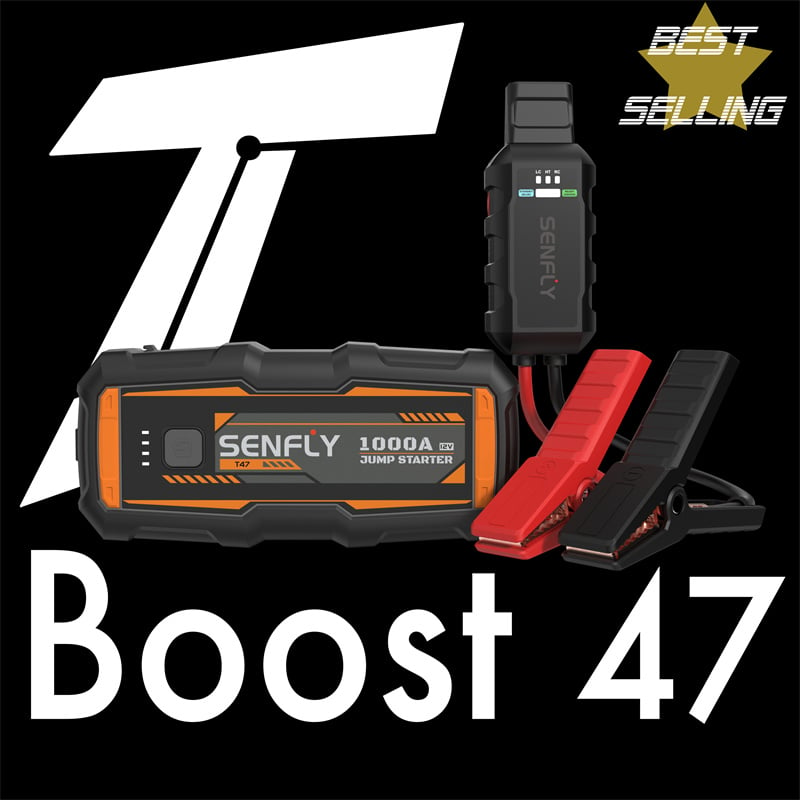
While many importers are still struggling with the United States’ 28% Section 301 tariff and the expanding compliance burden of the EU Battery Regulation, the Middle East is quietly reshaping the sourcing map with a very different set of numbers: a unified 5% GCC import tariff, 0% duty on re-exports through Dubai’s JAFZA free zone, strong demand for high-output products driven by fleets of V8 Land Cruisers and similar vehicles, and buyers who often prioritize quality over price.
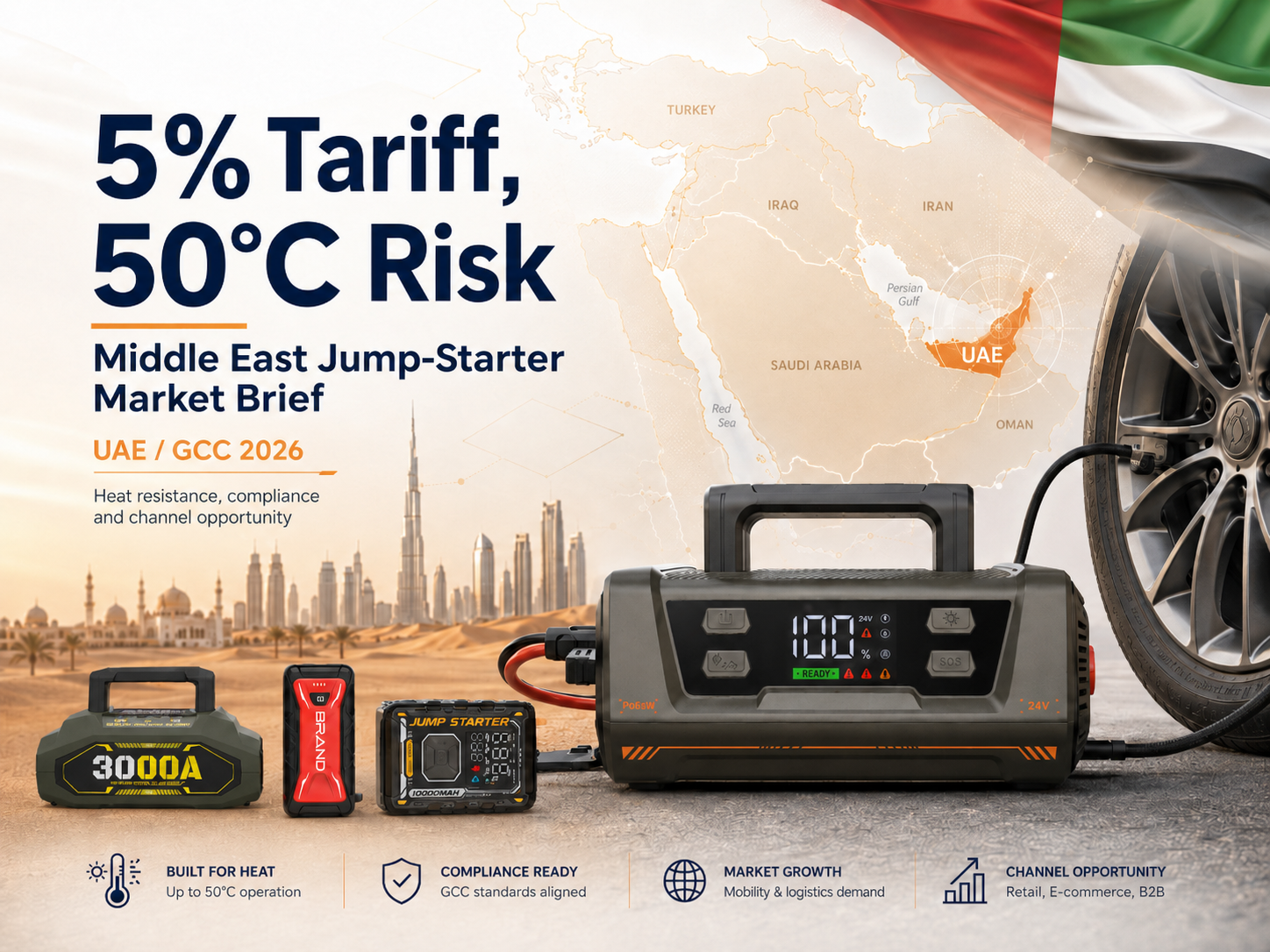
At first glance, it looks like one of the last low-barrier growth markets. Yet summer temperatures of 45–50°C can push battery failure rates to two to three times those seen in Europe. Heat-related returns and accelerated cell degradation can quickly consume what appears to be an attractive margin.
This issue uses the UAE—the Gulf’s leading re-export hub—as the entry point to examine the market from the perspectives of brand owners, importers, and purchasing managers. It also provides practical recommendations for product selection, channel development, and market operations.
A note on peak-current claims: Peak-current figures of 3,000A–4,000A are widely promoted in the Middle East, but they are often marketing claims rather than engineering-level ratings. Actual continuous cranking demand is far lower: a V8 gasoline SUV typically requires around 300–600A for a real cold start, while heavy-duty diesel vehicles generally require approximately 600–1,000A. These larger numbers are referenced in industry materials as market conventions, but this article labels them as “marketed figures” to distinguish them from verified technical performance. For importers, honest current ratings and verifiable test reports are more meaningful indicators of product quality than the size of the number printed on the packaging.
Information currency: This article draws on publicly available information from Deep Market Insights, 6Wresearch, the WANPU Middle East wholesale guide (April 2026), Automechanika Dubai, GSO/GCC technical regulations, and academic research, current through July 2026.
| Indicator | Data | Source |
|---|---|---|
| UAE jump-starter market size, 2025 | US$14.61 million, projected to reach US$17.56 million by 2034, CAGR 2.11% | Deep Market Insights |
| Saudi portable energy-storage market size, 2025 | US$10.60 million, projected to reach US$28.74 million by 2034, CAGR approximately 11.7% | Deep Market Insights |
| Middle East automotive parts and aftermarket, 2025 | Approximately US$4.2 billion | WANPU industry guide |
| Registered vehicles in the GCC + Egypt | 58 million+; Saudi Arabia alone exceeds 11 million | WANPU |
| Unified GCC import tariff on automotive parts | 5%; UAE adds 5% VAT, Saudi Arabia 15% VAT | WANPU / GCC Common External Tariff |
| JAFZA re-export duty | 0% for re-export through Dubai’s free zone to more than 50 countries | JAFZA / WANPU |
| Summer in-vehicle temperatures in the Gulf | Often above 50°C; battery failure rates can be 2–3 times Europe’s | WANPU / academic research |
| Automechanika Dubai 2026 | 10–12 November 2026, Dubai World Trade Centre | Official event information |
In one sentence: the Middle East combines 5% import duty, 0% re-export duty, and high-value V8 fleets, but its true barrier is not customs—it is heat resistance and brand trust. Suppliers that build a credible package around heat-resistant cells, Arabic packaging, and GCC compliance will be best positioned to capture the opportunity.
The market is crowded with private-label products, but there is still room for strong brand premiums—and heat resistance is becoming an invisible moat.
Unlike the United States, where NOCO defends an established leadership position, or Germany, where GS certification effectively acts as a market-entry ticket, the Middle East still has a relatively open brand landscape. Retail shelves and the home pages of Noon and Amazon.ae are filled with Chinese white-label and unbranded combination units, while genuinely influential local brands remain limited.
High average selling prices create a structural opportunity. Gulf vehicle fleets are dominated by V6 and V8 SUVs such as the Toyota Land Cruiser, Nissan Patrol, GMC Yukon, and Dodge Charger, alongside diesel trucks. Demand for higher-output models is therefore strong. Although marketed figures of 3,000A–4,000A are common and often exaggerated, affluent buyers in the GCC typically place quality ahead of price. Premium jump-starter and inflator combo units can retail at AED 340–460, or roughly US$93–125, leaving meaningful room for brand premium.
A jump starter with an integrated inflator is not a niche differentiator—it is increasingly expected. Desert driving often involves lowering tire pressure to improve traction on sand. Before returning to paved roads, drivers must reinflate the tires. As a result, a jump starter with an integrated air compressor is close to being a safety essential in the Gulf, with stronger demand than in Europe or North America. Multi-function products similar to 16-in-1 all-in-one units are more relevant in the Middle East than in markets such as Germany.
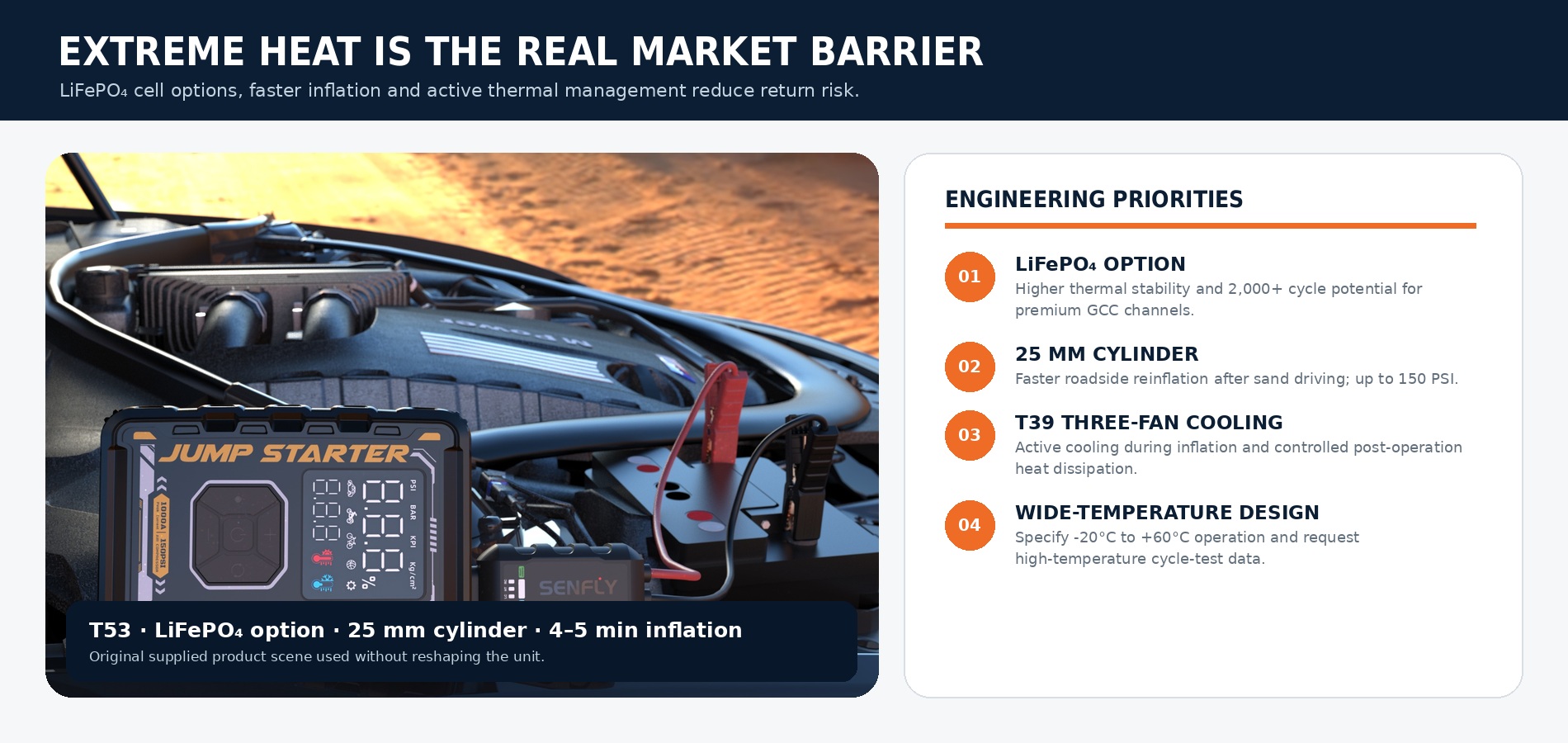
Extreme heat is both a hidden return-rate trap and a potential brand moat. Academic research shows that lithium-ion batteries exposed to temperatures above 50°C can suffer performance loss, higher internal resistance, lithium plating, and increased thermal-runaway risk. In Gulf summers, in-vehicle temperatures above 50°C are common. A conventional battery left inside a vehicle for three months can experience noticeable capacity degradation. Brands able to provide wide-temperature cells rated from -20°C to +60°C, effective thermal management, and high-temperature cycle-test reports can turn reliability into a competitive advantage while low-cost white-label rivals struggle with returns.
Reducing heat-related returns requires more than a marketing claim. It demands coordinated decisions in cell chemistry, heat-dissipation architecture, and quality control. The Senfly T-series all-in-one product line provides a practical example of how an integrated manufacturer can approach all three areas.
Standard Senfly T-series configurations use a 4S lithium cobalt oxide, or LiCoO₂, cell system. It offers high energy density and strong peak-current capability within a compact enclosure.
For the Middle East and other high-temperature applications, both the T53 and T39 can also be customized with lithium iron phosphate, or LiFePO₄, cells. LiFePO₄ offers significantly better structural stability at elevated temperatures, a higher thermal-runaway threshold, cycle life of more than 2,000 cycles, and slower capacity loss during hot storage.
For GCC importers, this creates a useful two-track strategy within the same housing and certification framework:
Gulf summer conditions test not only the battery cells but also the unit’s ability to control heat during continuous operation.
The T39 uses three coordinated intelligent cooling fans. They activate automatically during inflation. After the compressor stops, if the internal temperature remains above 80°C, the fans continue operating until the temperature falls below the control threshold.
This design directly reduces return risk in two common scenarios:
Within Senfly’s all-in-one range, the T39 offers the most advanced cooling configuration.
Inflation speed carries more weight in the Middle East than in many Western markets because desert tire reinflation happens roadside, not in a workshop.
Both the Senfly T53 and T39 use a 25 mm compressor cylinder, the largest cylinder size in the current range. The T53 can inflate a tire from 0 to 35 PSI in approximately 4–5 minutes, while the T39 takes roughly 4.5–5 minutes. That is about 30% faster than models using a 19 mm cylinder.
Both models support up to 150 PSI, making them suitable for the full reinflation cycle after desert tires have been lowered to around 15–20 PSI.
The real moat in the Middle East is not a larger peak-current number. It is the four-part combination of:
heat resistance + Arabic localization + GCC compliance + integrated inflation
Turning high-temperature reliability into a brand story through cycle-test videos, Gulf summer demonstrations, and real-use testimonials is more effective than simply stacking larger numbers on the packaging.
Tariffs are unusually attractive, but compliance and logistics still contain several hidden risks.
| Market | Import Duty | VAT | Core Compliance | Key Risk |
|---|---|---|---|---|
| United Arab Emirates | 5% | 5% | ECAS/ESMA registration; CE commonly used as a baseline | JAFZA re-export compliance; heat-related returns |
| Saudi Arabia | 5% | 15% | Mandatory SABER registration since 2023; stronger SASO enforcement | Arabic packaging; product-liability requirements |
| Kuwait / Qatar / Bahrain / Oman | 5% | Varies | KUCAS / GCC GSO conformity | Often supplied through UAE distributors |
| Egypt | 15–20% | 14% | CE + EOS | EGP exchange-rate risk; USD pricing preferred |
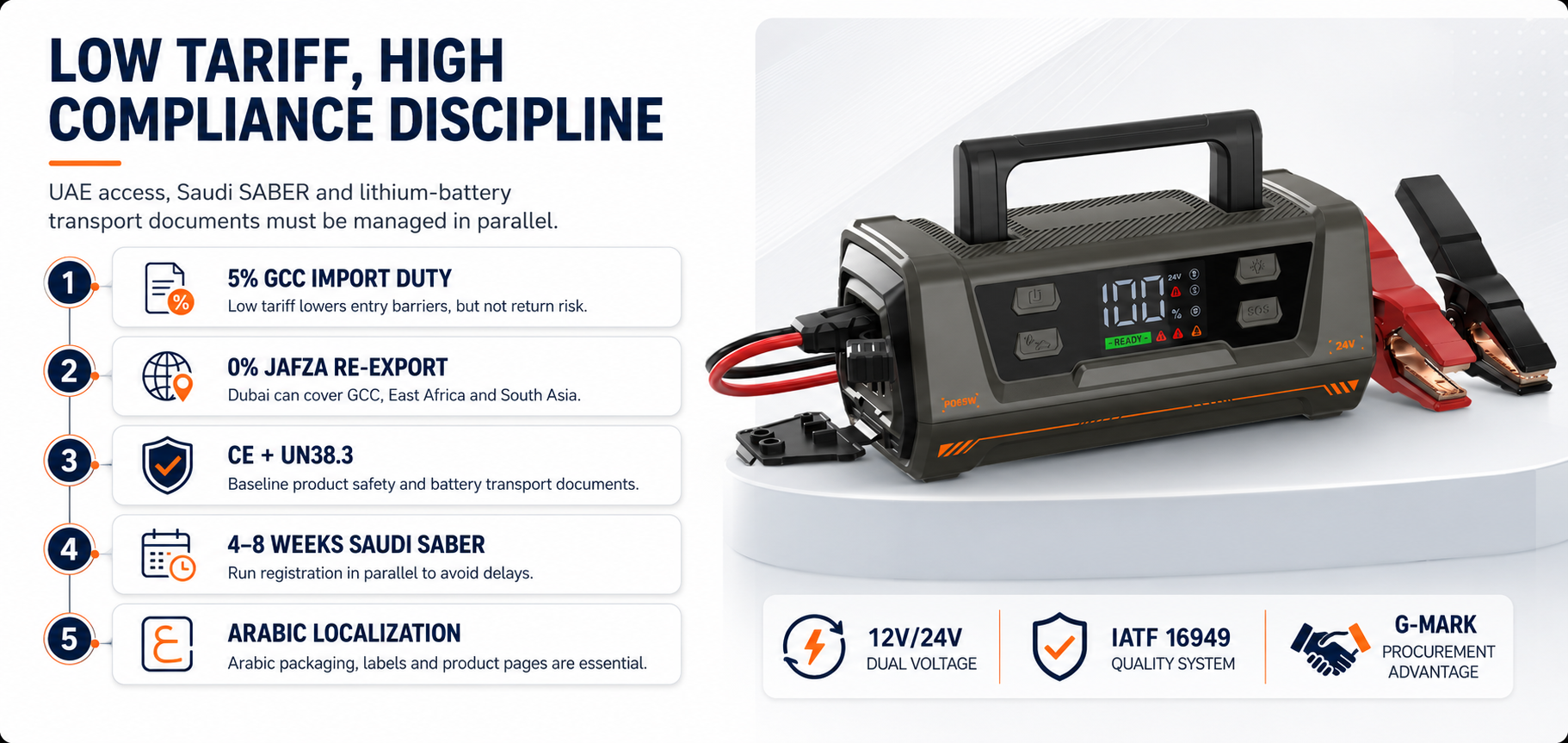
Key point: The GCC common external tariff may be 5%, but Saudi SABER remains a separate market-entry gate. Importers should not assume that successful ECAS registration in the UAE automatically provides access across the entire GCC. Saudi enforcement has become stricter since 2025, and SABER registration can take four to eight weeks.
CE certification is widely accepted across GCC markets as a baseline. Combined with UN38.3 documentation for lithium-battery transport, it can help importers begin the import process without waiting for every national registration to be completed.
However, SABER and ECAS should still be pursued in parallel for long-term market access. This is particularly important when importers are trying to catch seasonal sales windows.
The Gulf Standardization Organization’s low-voltage electrical equipment regulation, BD-142004-01, requires regulated products to carry the GCTS mark, which combines the G-Mark and a QR code.
The general process is:
technical documentation + CB certificate + EMC report → GSO database registration → GCC-type certificate
Whether a jump starter falls under the mandatory G-Mark scope must be confirmed against the latest GSO product list. Some product categories may enter with CE documentation alone, but G-Mark can strengthen bids for Saudi and Qatari government fleets.
Compliance is not only about having a certificate. When Middle East importers evaluate a supplier, the more important question is whether the certification, test data, and traceability records can be tied to every production batch.
Senfly’s current capabilities provide a useful reference point for supplier evaluation.
The Senfly T-series product line carries core certifications including UL, FCC, CE, PSE, and RoHS. Battery safety is covered under IEC 62133-2:2017/A1:2021.
For GCC importers, this means the baseline CE-level technical documentation is already in place, reducing repeated certification work for the same product.
Senfly’s factory holds IATF 16949, ISO 9001, ISO 14001, BSCI, and Walmart FCCA assessment credentials.
The value of IATF 16949 is that it applies automotive-industry traceability and failure-analysis logic rather than ordinary consumer-electronics quality control. For government fleets, oil-company procurement, and framework agreements in the Middle East, this can become a visible differentiator in tender documentation.
The factory operates a CNAS-accredited laboratory, allowing key validation tests to be completed internally rather than relying entirely on external laboratories.
Combined with monthly capacity of 100,000 units and an average lead time of 25 days, this creates a more predictable timeline from order placement and production to shipment and SABER registration using supplier-provided compliance documents.
Example: a model marketed at 2,000A, with actual output of approximately 600A, sold through GCC channels
| Stage | Amount |
|---|---|
| FOB China | US$22–28 |
| Ocean freight + 5% duty + customs clearance | Landed cost approximately US$30–38 |
| GCC retail price | AED 180–250, approximately US$49–68 |
| Margin structure | Approximately 2.2× FOB, or roughly 40–50% |
Compared with the United States, where tariffs can reach 28%, and Germany, where importers also carry GS and EPR-related costs, the Middle East has the lowest tariff burden.
However, it also supports relatively high average selling prices and imposes the toughest heat-resistance requirements. The margin may look attractive, but uncontrolled high-temperature returns can erase it. For Middle East importers, return-rate control should be the first KPI.
| Channel | Examples | Entry Requirement | Commercial Characteristics |
|---|---|---|---|
| Hypermarkets and supermarkets | Carrefour, LuLu Hypermarket, Panda, Hyper Panda | CE + ECAS + Arabic packaging | Volume-driven; stronger demand before winter and Ramadan |
| Automotive aftermarket chains | AutoPro, Jaidah in the UAE; Al Batha and Al Haraj automotive districts in Saudi Arabia | Technical data + vehicle compatibility information | Vehicle-fitment data is a competitive advantage |
| E-commerce | Noon, Amazon.ae, Amazon.sa | CE + platform compliance + Arabic product pages | Review-driven; Noon is particularly strong in Saudi Arabia |
| Re-export wholesale | JAFZA and Dragon Mart | 0% re-export duty | One Dubai distributor can cover more than 50 countries |
| B2B fleets and government procurement | Saudi and Qatari government fleets, oil-company fleets | Framework agreement + G-Mark advantage | Stable repeat business, strong bargaining power, high focus on reliability and warranty |
Disruption in the Red Sea and Suez routes during 2024–2025 encouraged many Dubai importers to build approximately 60 days of safety stock.
Ocean freight from China to Jebel Ali typically takes around 25–35 days, while production can take 30–45 days. Total lead time is therefore approximately 8–12 weeks. Orders placed in mid-July can still arrive before Automechanika Dubai and the year-end sales season.
V8-heavy vehicle fleets create genuine demand for higher-output products. Land Cruiser, Nissan Patrol, and GMC Yukon models are widely used across the Gulf. Market claims often suggest that V8 gasoline vehicles require 2,500A–3,000A and diesel trucks 3,500A–4,000A, but these are generally marketed figures. Real cold-start demand is more often around 300–600A for gasoline vehicles and 600–1,000A for heavy-duty diesel vehicles. Purchasing decisions should therefore focus on verified continuous output, component quality, and real vehicle tests—not inflated peak-current claims.
An integrated inflator is a desert-driving necessity, not an optional extra. Drivers often reduce tire pressure to increase the contact patch on sand, then reinflate before returning to paved roads. A jump-starter and inflator combo is therefore a genuine safety tool in the Middle East. A compressor rated up to 160 PSI is commonly expected.
Wide-temperature cells are a survival requirement. Operating temperature should cover -20°C to +60°C, and the battery must tolerate long-term storage in vehicles exposed to intense summer heat. The first procurement question should be: “Can the supplier provide a high-temperature cycle-test report?”
Arabic packaging and Arabic product marking are essential. Arabic is mandatory in Saudi Arabia and Egypt. The UAE is bilingual in practice, but Arabic remains a strong consumer expectation. Without Arabic packaging, products cannot enter mainstream Saudi retail.
Affluent consumers are willing to pay a brand premium. Unlike Egypt, where pricing often needs to be 30–40% below GCC levels, buyers in the UAE and Saudi Arabia tend to prioritize quality and brand credibility. Premium combo products can therefore be positioned upward rather than forced into price competition.
These five requirements are not theoretical. Each one should translate into a specific product decision.
Within Senfly’s T-series all-in-one range, the T25 is available in configurations up to 1,000A starting current and 2,000A peak current based on verified specifications rather than exaggerated claims.
That is sufficient for many V8 gasoline applications. Importers should match the product to measured starting demand for target vehicles rather than relying on the largest marketing number.
Senfly’s all-in-one product line ranges from the entry-level T67 with a 19 mm cylinder to the higher-end T53 and T39 with 25 mm cylinders and maximum pressure up to 150 PSI.
For Middle East distributors, the T39 and T53 provide a measurable advantage: they can reinflate a tire from low pressure to standard pressure in approximately 4–5 minutes, which directly addresses desert-driving use cases.
This is one of Senfly’s strongest differentiation points for the Middle East.
Standard products use LiCoO₂ cells. For GCC channels, both the T53 and T39 can be customized with LiFePO₄ cells, offering a higher thermal-runaway threshold, cycle life of more than 2,000 cycles, and better capacity retention after hot storage.
When combined with the T39’s three-fan intelligent cooling system, importers can create two clear channel strategies:
Senfly offers end-to-end OEM/ODM support. Packaging design and product printing can be localized in Arabic and English within the normal production cycle without adding a separate lead-time stage.
For importers preparing for Automechanika Dubai, this reduces the risk of missing the delivery window because of late localization work.
Senfly has supplied or served global customers including Walmart, GEELY, Baseus, Energizer, and Goodyear, supporting a mid-to-premium positioning.
For affluent GCC buyers, the combination of 82 global patents, 13 years without a major quality incident, and IATF 16949 automotive-grade quality management can be translated into visible retail value through certification marks, packaging claims, and brand storytelling.
| Trend | Practical Impact | Recommended Response |
|---|---|---|
| 5% GCC tariff + 0% JAFZA re-export duty | Low entry barrier brings more white-label competition and compresses price bands | Avoid the exaggerated peak-current race. Build a credible premium around heat resistance, integrated inflation, and GCC compliance |
| Battery failure rates can be 2–3 times Europe’s in high heat | Returns can eliminate profit and damage brand reputation | Use wide-temperature cells rated -20°C to +60°C, effective thermal management, and supplier high-temperature cycle-test reports; publish Gulf summer vehicle tests |
| Saudi SABER is mandatory and enforcement has tightened | Products without SABER cannot enter mainstream Saudi channels; launch can be delayed 4–8 weeks | Use CE documentation to begin import preparation while running SABER registration in parallel through a local agent |
| Jump starter + inflator is becoming a standard Middle East configuration | Single-function products compare poorly against combo competitors online | Offer a combo SKU with starting, inflation, power-bank, and LED functions; build the product story around desert tire reinflation |
| Dubai is a re-export hub serving 50+ countries | One capable UAE distributor can cover the GCC, East Africa, and South Asia | Prioritize a Dubai partner with cross-GCC distribution rather than building a separate network country by country |
| Automechanika Dubai 2026 runs 10–12 November | The exhibition is a key distributor-matching and lead-generation event | Place orders early enough for pre-show delivery and prepare Arabic materials plus high-temperature demonstration videos |
| Red Sea route disruption remains a risk | Insufficient stock can create lost sales during peak season | Build around 60 days of safety stock; use air freight for urgent orders with UN38.3 documentation |
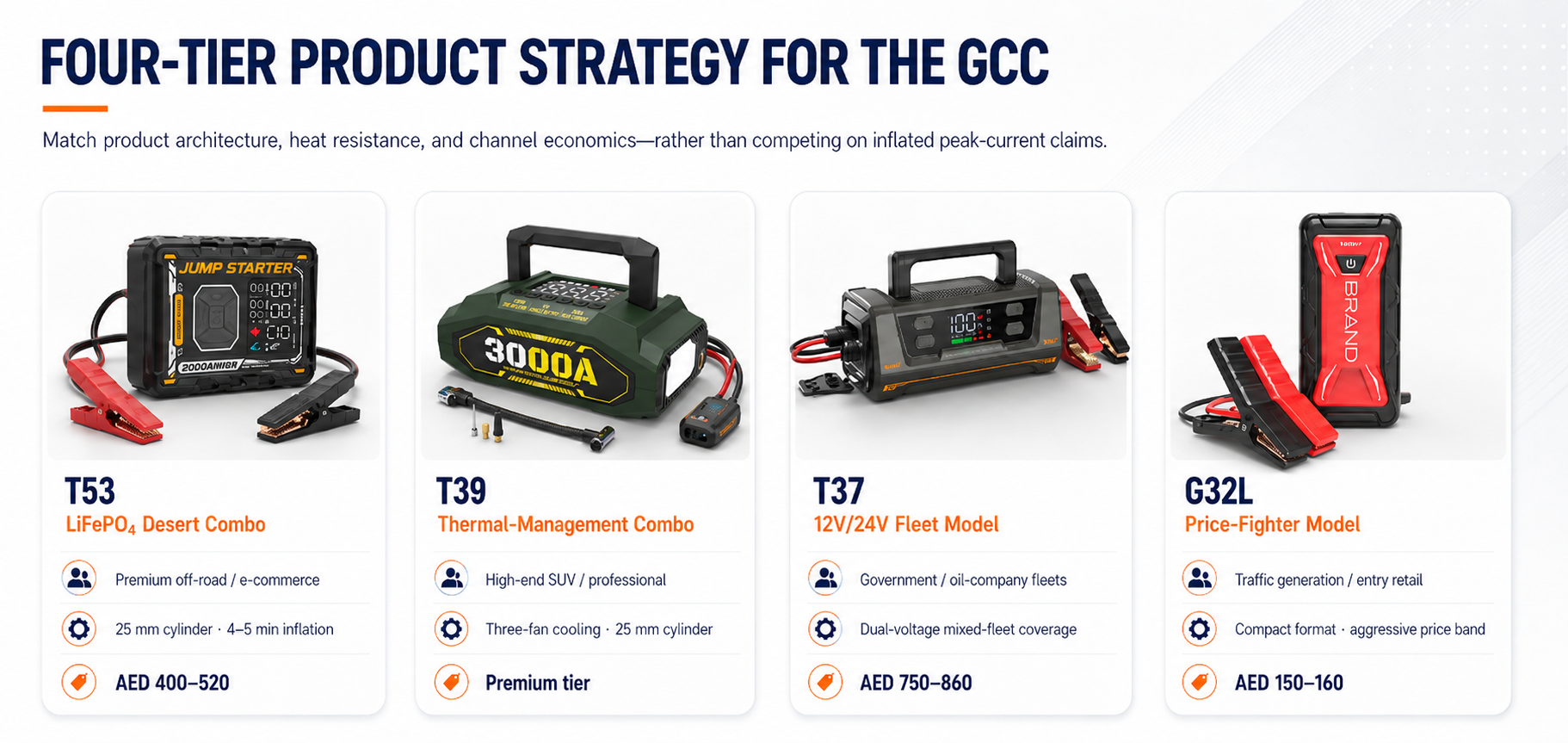
For the Middle East, a four-tier product portfolio is recommended.
Recommended Senfly models: T39 / high-spec T25
This tier targets owners of Land Cruiser, Patrol, GMC Yukon, and other V8 SUVs. The product must support both large-engine starting and rapid tire reinflation after sand driving.
Recommended Senfly models: T37 / T40
This tier is intended for Saudi and Qatari oil-company fleets, government fleets, and other framework-contract buyers. The decision cycle is longer, repeat purchasing is more stable, and compliance and reliability requirements are higher.
Recommended Senfly models: T67 / entry-level T53 / T13-A
This tier targets the long-tail market on Noon and Amazon.ae, as well as price-sensitive markets such as Egypt, where pricing may need to be 30–40% below GCC levels.
Recommended Senfly model: G32L
This tier is designed for aggressive pricing, entry-level promotions, and traffic-generation campaigns.
Any SKU entering the Middle East should have all four of the following:
CE + UN38.3 + Arabic packaging + wide-temperature cells
Saudi Arabia also requires SABER. Fleet and government procurement can benefit from G-Mark.
A high-temperature test report is not a bonus. It is a key safeguard against uncontrolled return rates.
The recommended products above are drawn from Senfly’s existing product matrix rather than requiring new development from the ground up.
Senfly currently offers eight models:
T25 / T27 / T38 / T39 / T53 / T66 / T67 / T68
The range covers battery capacities from 29.6Wh to 88.8Wh, compressor cylinders from 19 mm to 25 mm, and peak-current ratings from 800A to 2,000A.
These products serve channels that do not require an integrated inflator.
This model is designed for outdoor driving, emergency backup power, and recreational use.
For importers, the advantage is the ability to source several product tiers from one supplier rather than coordinating multiple white-label factories. In the Middle East, unified certification management, packaging localization, and synchronized lead times often matter more operationally than a small difference in unit price.
Prioritize the “one Dubai distributor covering the GCC” model. A local wholesaler with cross-Gulf distribution, JAFZA re-export experience, and practical knowledge of SABER and ECAS offers more leverage than building separate country networks.
Use channel segmentation. Hypermarkets such as Carrefour, LuLu, and Panda are suited to volume products. Automotive specialists such as AutoPro and Al Batha are better for technical positioning. Noon and Amazon cover long-tail demand. Higher-priced products can be directed toward fleets and B2B procurement.
Use Automechanika Dubai as a distributor-matching platform. Preparation should begin well before November, including Arabic sales materials, high-temperature test content, and working product samples.
Build content around high-temperature reliability. Gulf summer vehicle tests, high-temperature cycle-test videos, and desert-use testimonials can turn the main return-rate concern into a brand-trust advantage. This also supports search visibility for terms such as “jump starter Dubai” and “high-temperature jump starter.”
Use QR-code authentication and complete SASO / ESMA registration. Counterfeit and unofficial-channel products remain common in parts of the GCC. Unique packaging and QR authentication help protect brand value.
Make return rate the number-one KPI. Heat-related returns are the largest potential profit killer in the region. Track return rates by SKU and replace heat-sensitive cell configurations quickly where necessary.
Create price tiers by market. Protect premium pricing in the UAE and Saudi Arabia. Use simplified configurations and USD-based pricing for more price-sensitive markets such as Egypt.
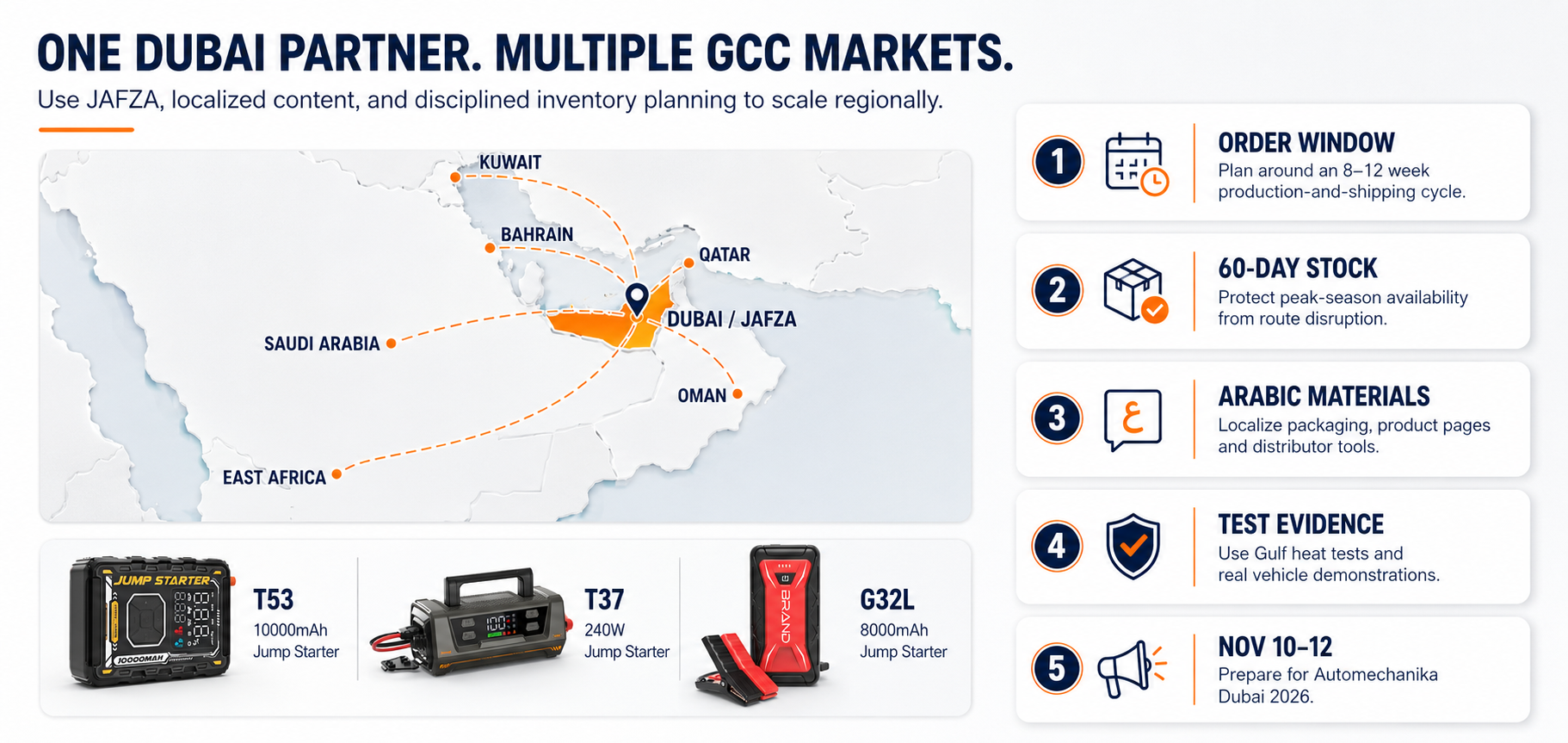
The Middle East is one of the most attractive current growth markets for jump starters and portable vehicle-power products. It combines friendly tariffs, high average selling prices, and a relatively open brand landscape.
But below that opportunity lie two serious risks: extreme heat and fragmented compliance.
The strongest opportunity belongs to suppliers and importers that can execute the complete four-part package:
heat-resistant cells + Arabic localization + GCC compliance + integrated inflation
Dubai’s re-export infrastructure can then be used to cover the broader Gulf region.
Compared with the United States, where tariffs can reach 28%, and Europe, where battery regulation continues to increase compliance costs, the Middle East offers one of the best current growth-to-cost ratios. Yet the market is easy only at the customs level. Reliability remains the real entry barrier. Low-quality white-label thinking is not a sustainable strategy for the Gulf.
Secure orders in time for Automechanika Dubai. Ocean freight from China to Jebel Ali takes approximately 25–35 days, while production can take 30–45 days. The total cycle is about 8–12 weeks. Orders placed in mid-July can still arrive before the November exhibition and year-end peak season. Prioritize combo models and fleet products, and lead with verified performance and heat resistance rather than exaggerated current claims.
Make wide-temperature cells and high-temperature test reports mandatory supplier-entry requirements. Require proof of operation from -20°C to +60°C and high-temperature cycle-test data. Reject batches that cannot provide supporting reports. Ask suppliers to explain the cell strategy clearly: LiCoO₂ standard versions for volume channels and LiFePO₄ high-temperature versions for premium positioning.
Begin Saudi SABER and UAE ECAS registration through local agents. Use CE documentation to support early import preparation while running SABER registration in parallel. Confirm Arabic packaging and product markings at the same time.
Secure one Dubai wholesale partner with a cross-GCC distribution network. A capable UAE distributor operating through JAFZA can re-export at 0% duty to Saudi Arabia, Kuwait, Qatar, Bahrain, Oman, East Africa, and more than 50 other markets. This is a higher-leverage route than building individual country operations.
 Hot News
 EN
EN