EN
EN

Executive Summary
The U.S. market remains attractive, but the basis of competition is changing.
The United States continues to offer stable, long-term demand for automotive jump starters and portable vehicle-power products. The opportunity is supported by an aging vehicle fleet, long-distance driving habits, a high share of pickups and SUVs, and growing consumer expectations for self-service roadside equipment.
The market is no longer driven by peak-amperage claims alone. Retailers and end users are increasingly evaluating actual starting performance, clamp safety, tire-inflation speed, USB-C charging, thermal management, durability, lithium-battery documentation and the supplier’s ability to support product-liability requirements.
| Market Signal | Evidence in the Article | Commercial Implication |
|---|---|---|
| Aging vehicle fleet | The average age of U.S. light-duty vehicles reached 12.8 years in 2025; passenger cars averaged about 14.5 years and light trucks 11.9 years. | Demand for battery-related roadside equipment is structural rather than temporary. |
| Multi-emergency buying behavior | Drivers increasingly expect one product to address a weak battery, low tire pressure, nighttime visibility and mobile-device charging. | Combination products can create a clearer value story than amperage alone. |
| Clear retail price ladder | The market has recognizable tiers at US$80–US$120, US$130–US$200 and above US$200. | Brands need a portfolio architecture, not one universal model. |
| Two major product directions | Compact high-performance jump starters coexist with multifunction roadside-emergency units and professional heavy-duty products. | Positioning should be explicit; excessive feature stacking creates trade-offs. |
| Higher qualification standards | Lithium-battery recalls, transportation rules and state-level recycling requirements are increasing scrutiny. | Traceable cells, test reports, protection validation and return handling are now commercial requirements. |
1. Market Foundation: Aging Vehicles Create Structural Demand
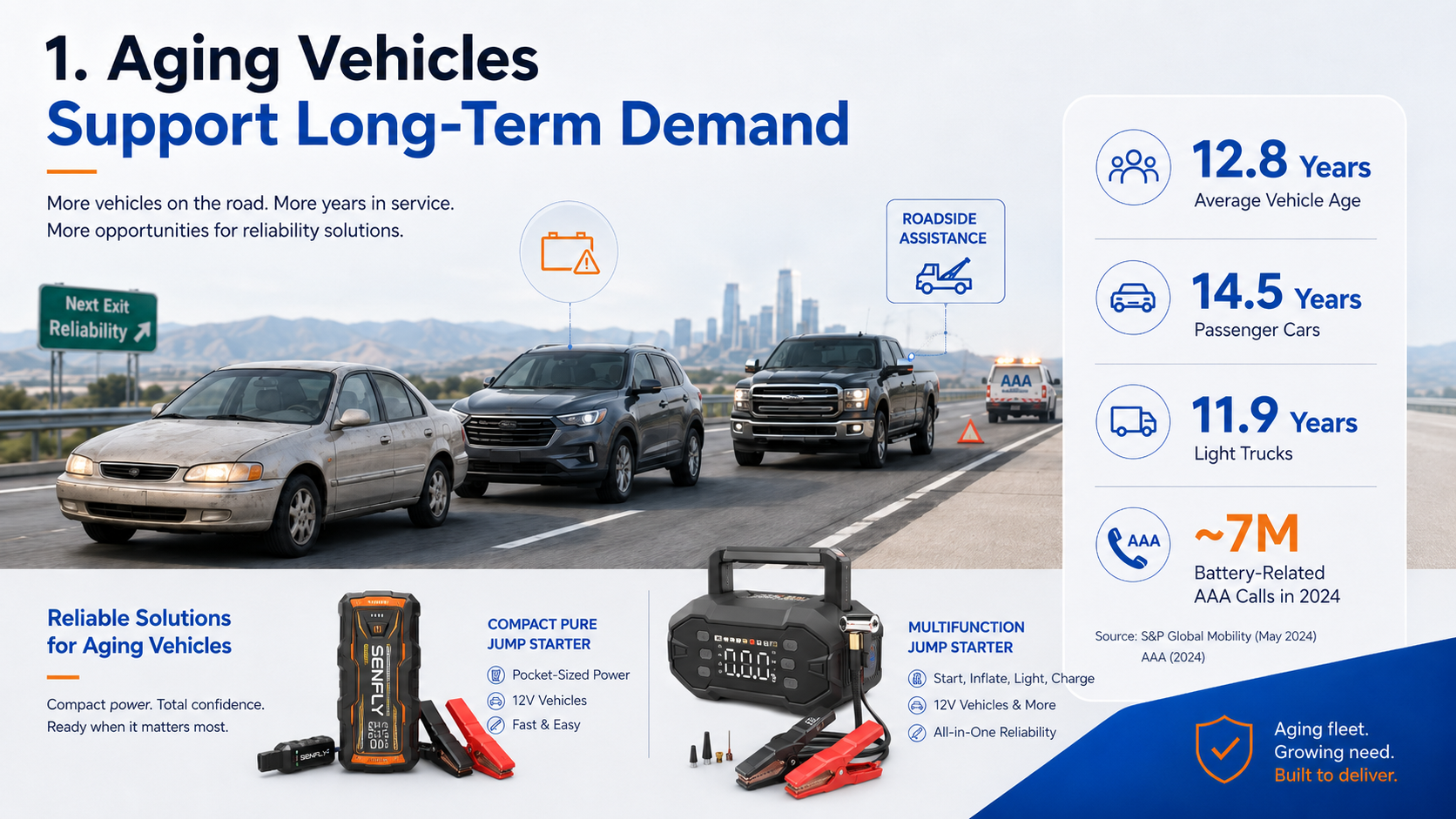
Vehicle aging and battery-related roadside incidents support long-term category demand.
| 12.8 years | 14.5 years | 11.9 years | 7 million |
|---|---|---|---|
| Average age of U.S. light-duty vehicles in 2025 | Average passenger-car age | Average light-truck age | Battery-related AAA incidents cited for 2024 |
As vehicles remain in service longer, more units enter the period in which battery degradation, starting-system failures and maintenance frequency increase. AAA handled more than 27 million roadside-assistance calls across the United States in 2024, including approximately 7 million battery-related incidents. Battery problems were the second-largest cause of roadside assistance after towing.
Senfly therefore views demand created by vehicle aging as structural. Its range spans compact pure jump starters, including the T47 series with 37–44.4Wh configurations, and multifunction jump starter–inflator products such as the T25, T53 and T39 series.
EV Positioning Requires Accurate Language
Electric vehicles still rely on a 12V low-voltage battery for systems such as doors, lighting, electronics and vehicle-management functions. Marketing to EV owners should explain that a jump starter may help address certain low-voltage auxiliary-battery issues. Brands should avoid broadly claiming that the product can “jump-start an electric vehicle.”
2. Demand Shift: From a Jump Starter to a Roadside-Emergency Solution
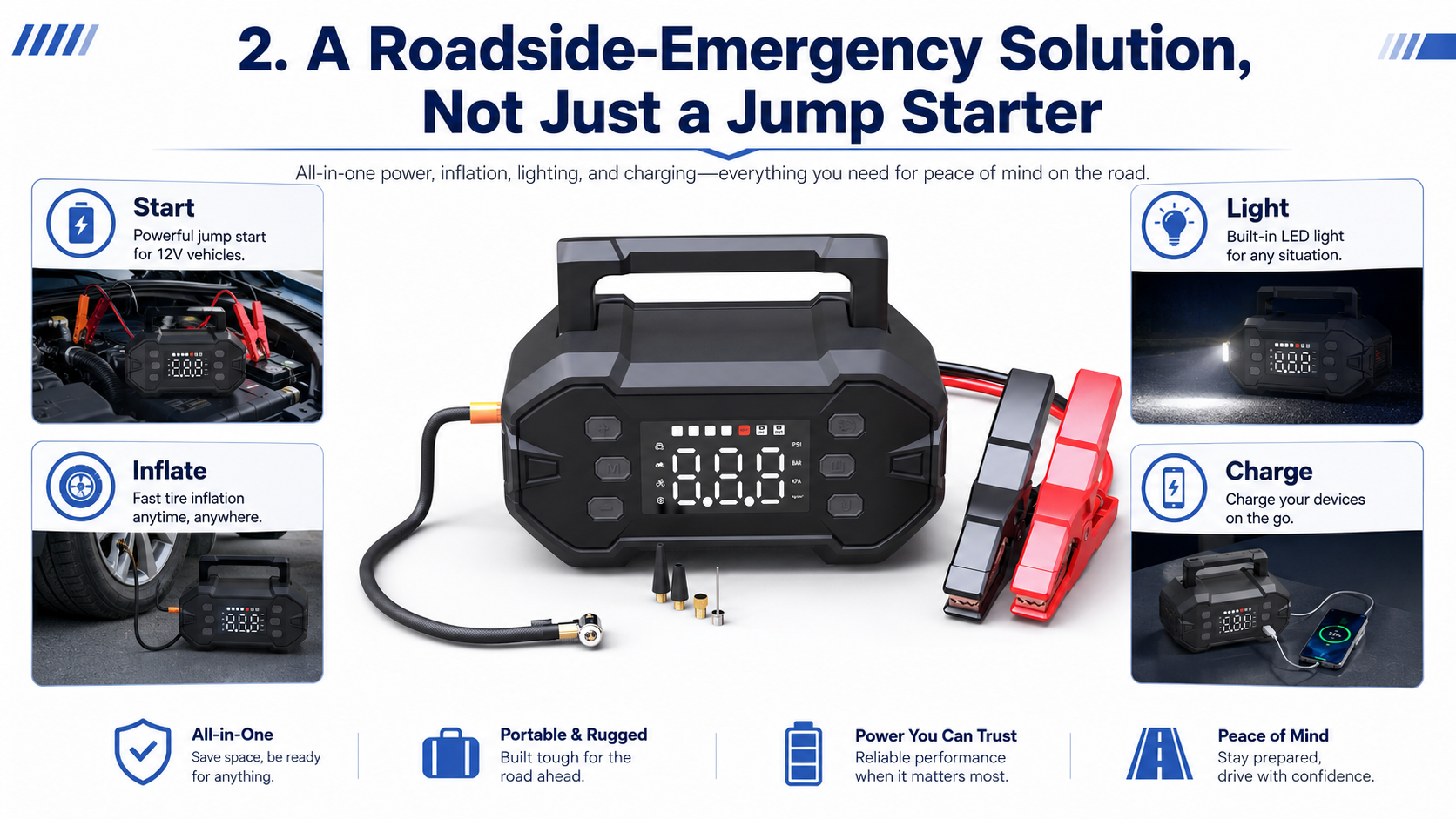
The modern roadside product must cover multiple common emergencies.
AAA’s 2026 Memorial Day travel forecast noted that more than 350,000 roadside-assistance calls were handled during the same holiday period in the previous year. Common problems included dead batteries, tire failures and running out of fuel. This helps explain why U.S. consumers increasingly value products that solve several roadside problems in one package.
| Roadside Need | Required Product Response | Senfly Product Fit |
|---|---|---|
| Starting | Reliable start support for weak or deeply discharged 12V batteries; intelligent clamps; forced-start or low-voltage mode where appropriate. | T47 pure jump starters; T25, T39 and T53 combination models. |
| Tire inflation | Digital pressure display, preset pressure, automatic shutoff, practical inflation flow and controlled temperature rise. | T53 uses a 25-cylinder inflator and can complete a typical passenger-car inflation cycle in about four to five minutes under defined conditions. |
| Night visibility | Work light, focused task lighting and SOS mode that can be operated quickly in darkness. | Integrated lighting across relevant multifunction models. |
| Portable power | USB-C charging, mobile-device support and—on professional models—12V DC output for additional equipment. | T11 adds bidirectional PD 65W and 12V DC output; multifunction T-series products support portable-power use. |
Product Development Question
Instead of asking only, “How many amps does the product need?”, brands should ask whether a driver can use it safely, quickly and independently in darkness, bad weather or during long-distance travel. The strongest combination product is not the one with the most functions; it is the one whose functions work together without creating heat, weight or reliability problems.
3. U.S. Retail Price Architecture
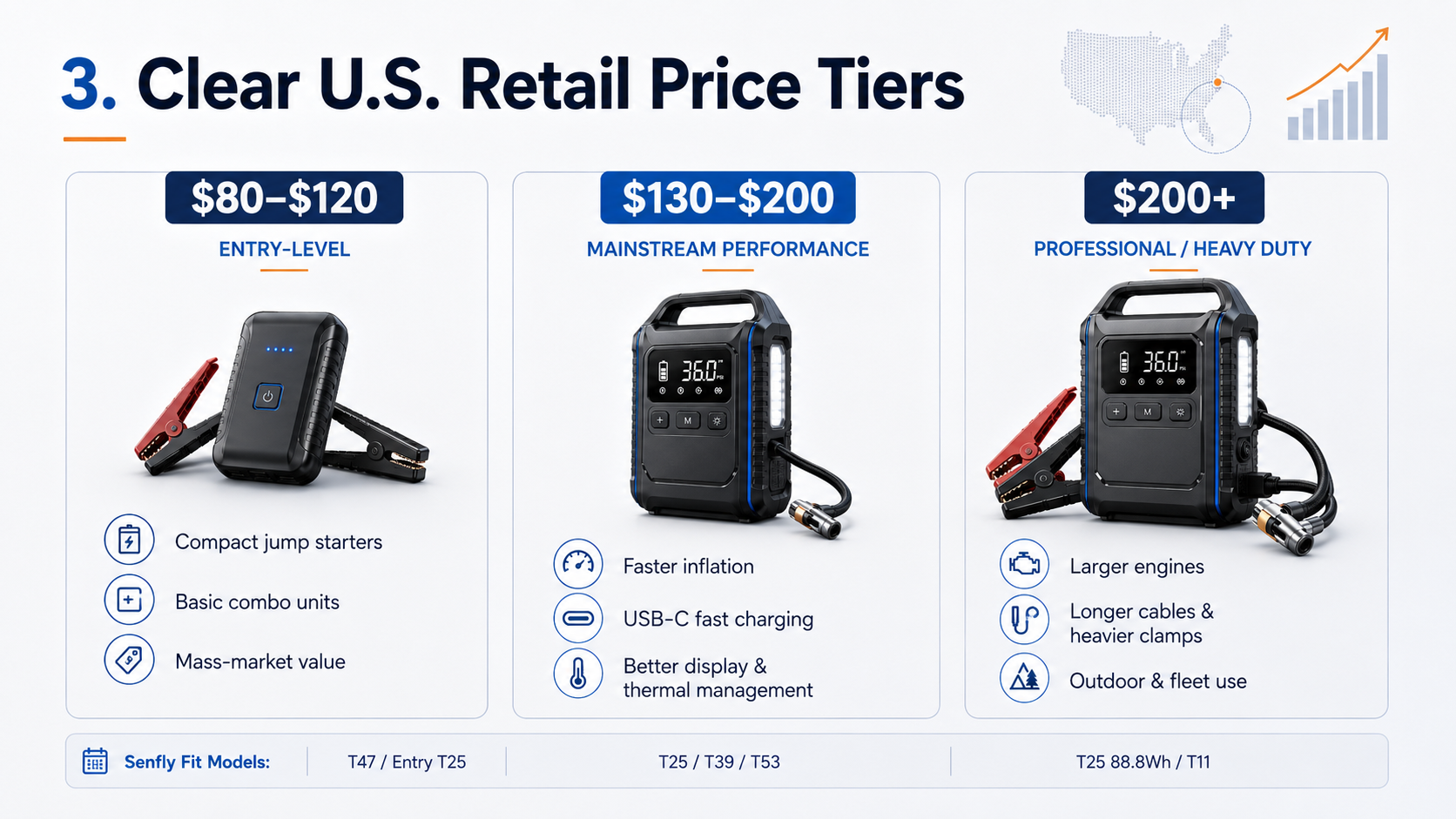
The U.S. market has three recognizable price tiers with different buyer expectations.
The retail market has developed a clear ladder. Each tier requires a different balance of cost, performance, user experience and proof. Brands should define the target price and channel before finalizing the product specification.
| Retail Tier | Core Buyers / Channels | Illustrative Benchmarks | What the Product Must Prove | Senfly Fit |
|---|---|---|---|---|
| US$80–US$120 | Mass-market e-commerce, Walmart-type retail, smaller vehicles and value-focused buyers. | NOCO GB40 around US$99.95; VIKING 1,000 Peak Amp multifunction unit around US$99.99. | Compact format, dependable clamps, clear battery display, basic lighting, storage convenience and attractive packaging. | T47 pure jump starter; T25 37Wh entry-level combination configuration. |
| US$130–US$200 | Mainstream performance buyers, households, SUV owners and active e-commerce programs. | GOOLOO A5 around US$179.99; Wagan iOnBoost V10 Air around US$139.99; several DEWALT models near US$179.99. | Faster inflation, sunlight-readable display, bidirectional USB-C, stronger thermal management, complete accessories and better storage. | T25 44.4Wh/59.2Wh; T39 59.2–74Wh; T53 for a measurable inflation-speed story. |
| Above US$200 | Pickup and large-SUV owners, repair shops, farms, fleets, outdoor users and professional tool channels. | DEWALT 2,000 Peak Amp model around US$209; NOCO GB150 around US$299.95. | Large-engine compatibility, longer/thicker cables, heavy-duty clamps, repeated starts, environmental durability and equipment power output. | T25 88.8Wh; T11 pure jump starter with PD 65W and 12V DC output. |
4. Competitive Landscape and Product Positioning
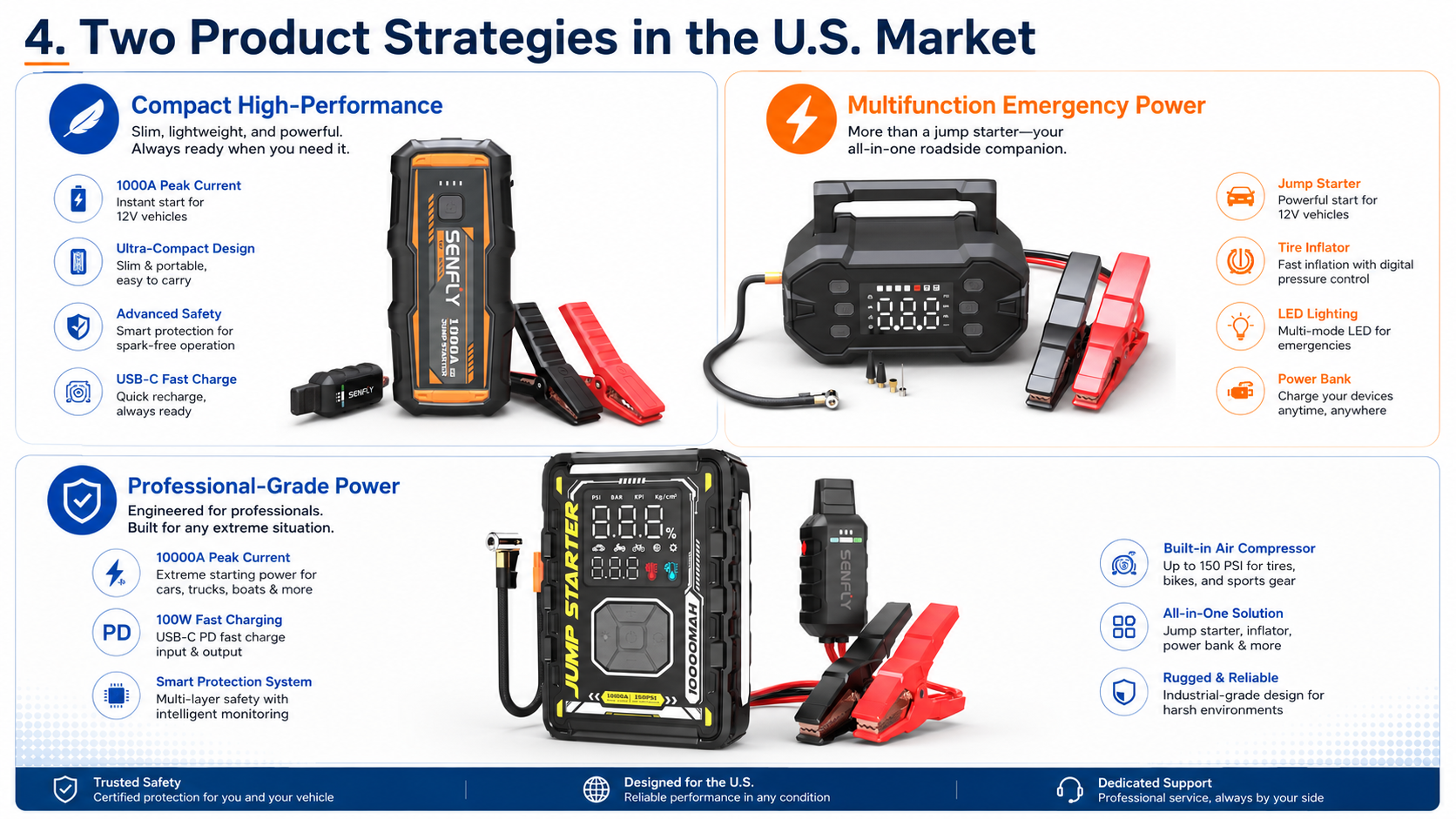
Three viable product strategies are emerging in the U.S. market.
Two parallel strategies dominate the market: compact, high-performance jump starters represented by NOCO, and multifunction emergency products from brands such as DEWALT, VIKING and GOOLOO. A third professional direction serves large vehicles, service channels and repeated-use scenarios.
| Strategy | Primary Strength | Typical Risk | Best-Fit Channel | Design Priority |
|---|---|---|---|---|
| Compact high-performance | Portability, fast setup, strong safety message and simple operation. | May offer limited differentiation if the product story relies only on peak amperage. | E-commerce, automotive retail, glove-box or trunk emergency use. | Reliability, clamp safety, charge retention and a credible engine-compatibility claim. |
| Multifunction roadside | Broader perceived value: start, inflate, light and charge in one device. | Heat, weight, internal packaging and reliability become more difficult to balance. | Households, long-distance drivers, outdoor channels and broad retail. | Inflation speed, thermal management, intuitive storage and integrated user experience. |
| Professional / heavy-duty | Higher ticket value, repeat-use capability and stronger fit for pickups, fleets and tools. | Higher cost, heavier construction and more demanding validation. | Tool chains, repair shops, farms, fleets and automotive specialists. | Cable/clamp durability, repeated starts, temperature performance and equipment outputs. |
A Structural Opportunity for Combination Products
NOCO does not currently make jump starter–inflator combinations the center of its range. This creates room for brands and importers to differentiate through a supplier with a complete multifunction platform. Senfly’s combination portfolio spans entry-level products such as the T67 29.6Wh and higher-capacity configurations such as the T39 74Wh and T25 88.8Wh, with inflator systems ranging from 19-cylinder to 25-cylinder designs and options for intelligent thermal management.
5. Retail Decision Logic and User-Experience Requirements
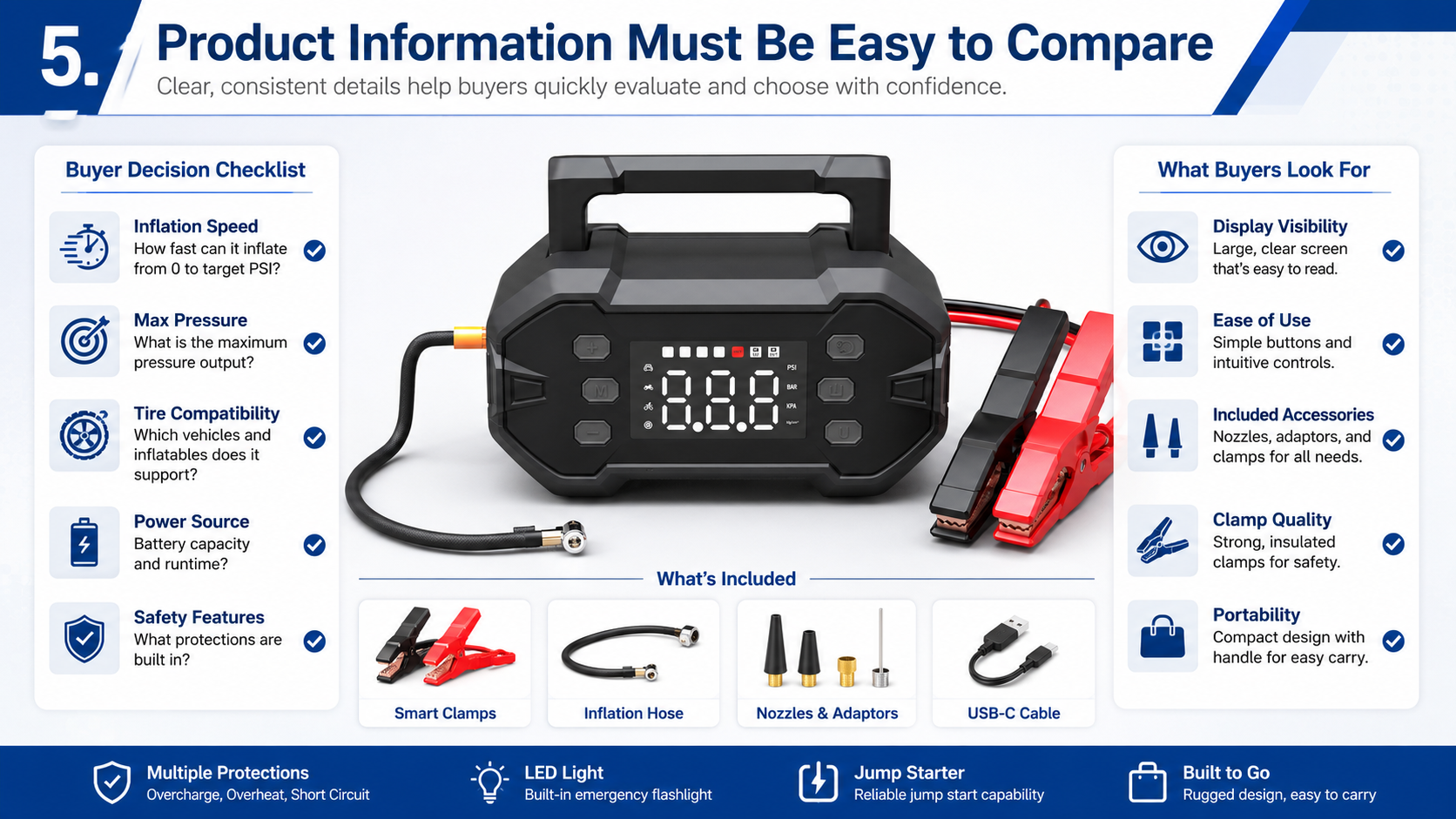
Retail information must translate technical specifications into clear buying decisions.
Most consumers do not compare jump starters as engineers. Retail pages and packaging must therefore translate performance into vehicle type, engine displacement and real usage scenarios.
| Consumer Question | Information the Product Page or Packaging Should Provide |
|---|---|
| Is it suitable for my sedan, SUV or pickup? | State gasoline and diesel engine compatibility and show representative vehicle categories. |
| How many starts can it deliver? | Publish repeated-start results under stated battery, engine and temperature conditions. |
| How fast can it inflate a tire? | Specify tire size, starting pressure, target pressure and test conditions—not only maximum PSI. |
| Can it help with a deeply discharged battery? | Explain forced-start or low-voltage mode, including safety limitations and operating steps. |
| What is included? | Show the charger, carrying case, clamps, hose, adapters and replacement-accessory availability. |
| Can I use it easily at night or in direct sunlight? | Demonstrate display readability, light controls and one-person operation. |
Small Details That Directly Affect Ratings
Consumer feedback cited in the source article shows that buyers value simple operation, compact size, material quality and charge retention. At the same time, details such as short cables can reduce satisfaction. During product definition, purchasing teams should review the following points:
- Clamp-jaw geometry and access to different battery-terminal positions.
- Cable length for large SUVs, pickups and less accessible battery compartments.
- Display visibility in direct sunlight and under low-temperature conditions.
- Secure storage for the air hose, adapters, clamps and charging cable.
- Operation that does not depend on a long manual during an emergency.
- Availability of replacement hoses, clamps, adapters and carrying cases.
6. Safety, Compliance and Supplier Qualification
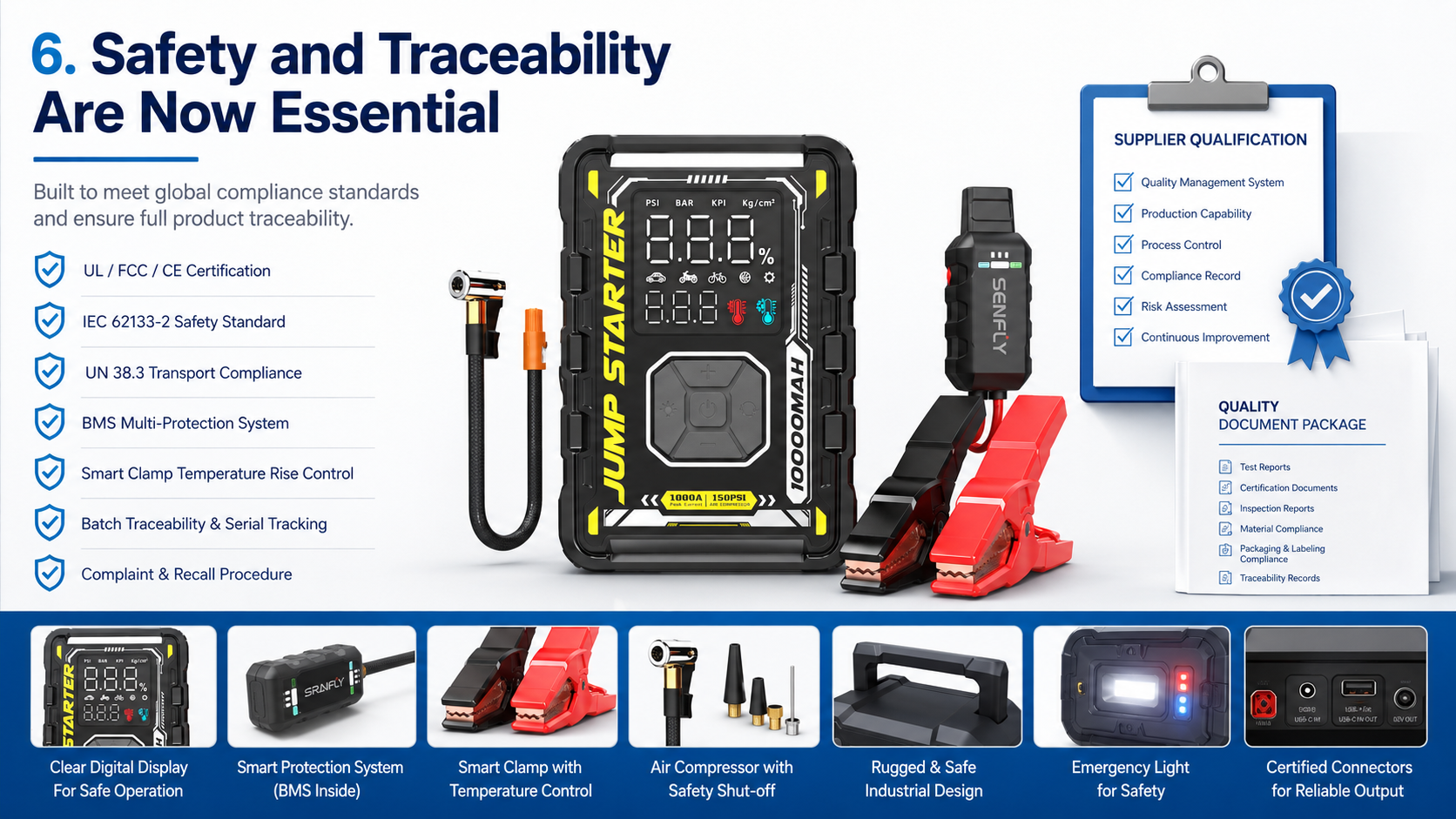
A complete and traceable safety package is becoming a basic condition for U.S. channel cooperation.
Lithium-ion battery recalls and stop-use warnings in the United States continue to influence retailer and importer risk assessment. The examples cited in the source article do not represent all jump starters, but they reinforce the need for stronger cell control, protection validation, abnormal-condition testing and recall readiness.
| Qualification Area | Evidence to Verify | Risk if Missing |
|---|---|---|
| Cell identity and traceability | Cell manufacturer, model, purchase records, batch information and linkage to finished-product serial or batch labels. | Unclear root cause, difficult containment and higher recall exposure. |
| Transportation evidence | UN 38.3 test report and test summary; packaging configuration matched to the shipped battery/product. | Shipment rejection, delayed fulfillment or non-compliant handling. |
| BMS protection | Overcharge, over-discharge, overcurrent, short-circuit and temperature protection verification. | Thermal event, swelling, premature failure or unsafe field behavior. |
| Clamp and starting safety | Reverse-polarity protection, spark protection, clamp temperature-rise test and abnormal connection testing. | User injury, damaged vehicle electronics and product-liability claims. |
| Inflator thermal validation | Temperature-rise, repeated-cycle, continuous-operation and abnormal-blockage testing. | Shutdown, casing damage, reduced life or fire risk. |
| Packaging and logistics | Drop testing, vibration/transport checks, storage conditions and damaged-unit isolation procedures. | Hidden damage and unsafe returns entering normal logistics. |
| Complaint and recall readiness | Complaint escalation, batch containment, field analysis, corrective action and recall procedure. | Slow response, channel loss and uncontrolled brand exposure. |
| Insurance and responsibility | Product-liability coverage and a clearly assigned importer/brand/supplier responsibility structure. | Unfunded claims and commercial disputes. |
Senfly Compliance and Quality-Control Capabilities
Senfly’s core product range is supported by UL, FCC, CE, PSE and RoHS documentation, together with IEC 62133-2 battery-safety reports for multiple models. The manufacturing operation follows IATF 16949, ISO 9001, ISO 14001 and BSCI systems and has completed a Walmart FCCA factory-capability assessment.
Its CNAS-accredited laboratory supports environmental-adaptation testing from -40°C to 150°C and electromagnetic-compatibility testing, including EMC Class B requirements. For brands and purchasing teams, the practical value is a model-level, batch-linked document package that can support channel review, pre-shipment checks and post-sale investigation.
7. Transportation, Returns and Recycling Readiness
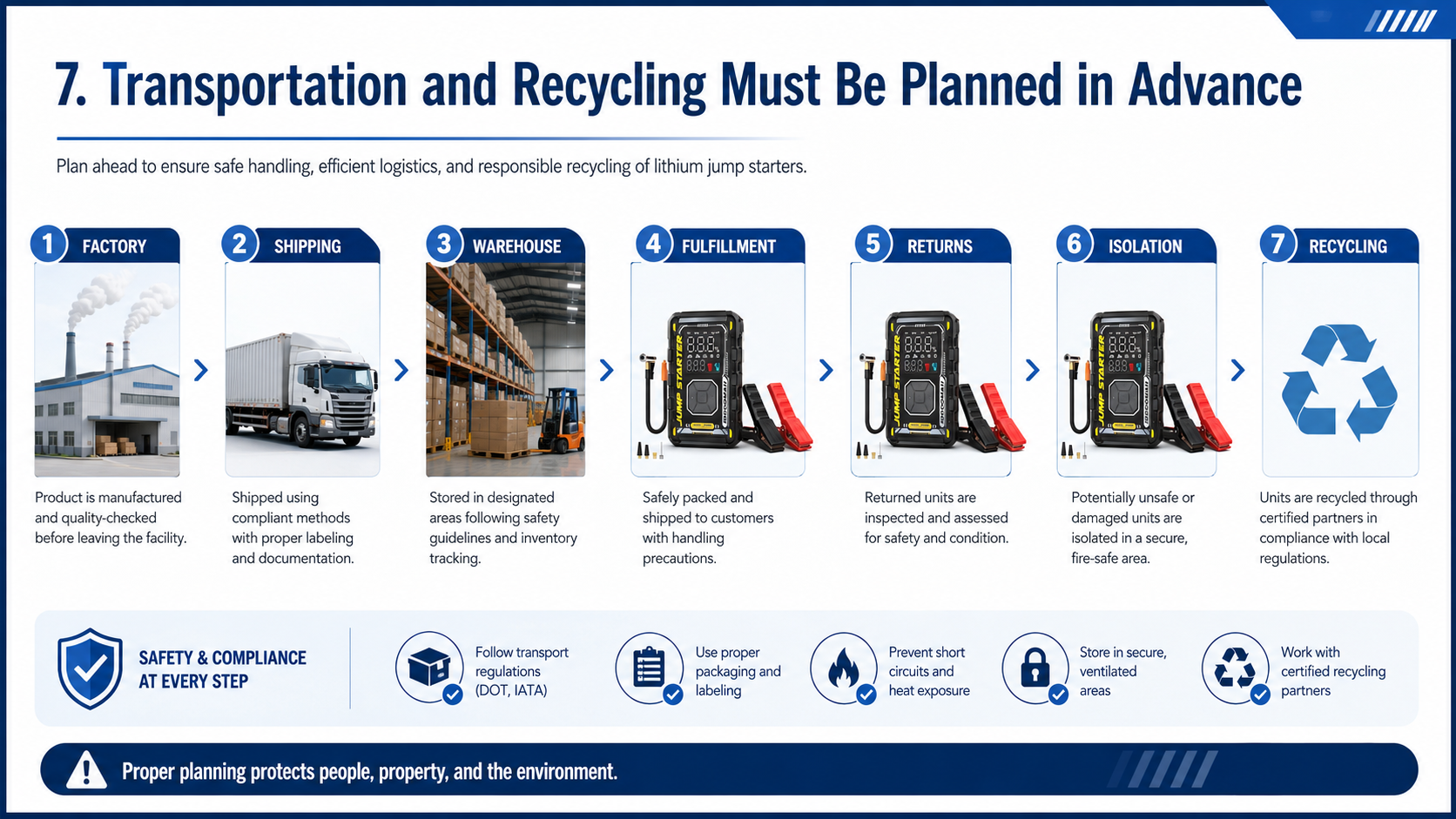
Compliance planning must continue after the product enters the United States.
The U.S. Department of Transportation regulates lithium batteries as hazardous materials. Importers must plan not only international shipping, but also domestic warehousing, truck transportation, e-commerce fulfillment, customer returns and damaged-product handling.
| Lifecycle Stage | Operational Requirement | Primary Owner |
|---|---|---|
| Inbound shipment | Confirm UN 38.3 documentation, battery classification, package marking, packaging configuration and carrier acceptance. | Supplier, freight forwarder and importer. |
| U.S. warehousing | Define storage temperature, inspection, damaged-unit isolation and staff response procedures. | Importer, 3PL or warehouse operator. |
| E-commerce fulfillment | Control package volume, drop risk, labeling and carrier restrictions for lithium-battery products. | Brand, marketplace and fulfillment provider. |
| Customer returns | Screen returned products before re-entry into normal inventory or transport. | Brand and returns center. |
| Swollen or damaged units | Identify, isolate, document and route through an approved hazardous-material or disposal process. | Returns center, compliance owner and approved vendor. |
| Recycling / state requirements | Maintain a state-by-state checklist and define collection, recycling and reporting obligations where applicable. | Brand owner and U.S. compliance counsel/provider. |
8. Recommended Product Portfolio for the U.S. Market
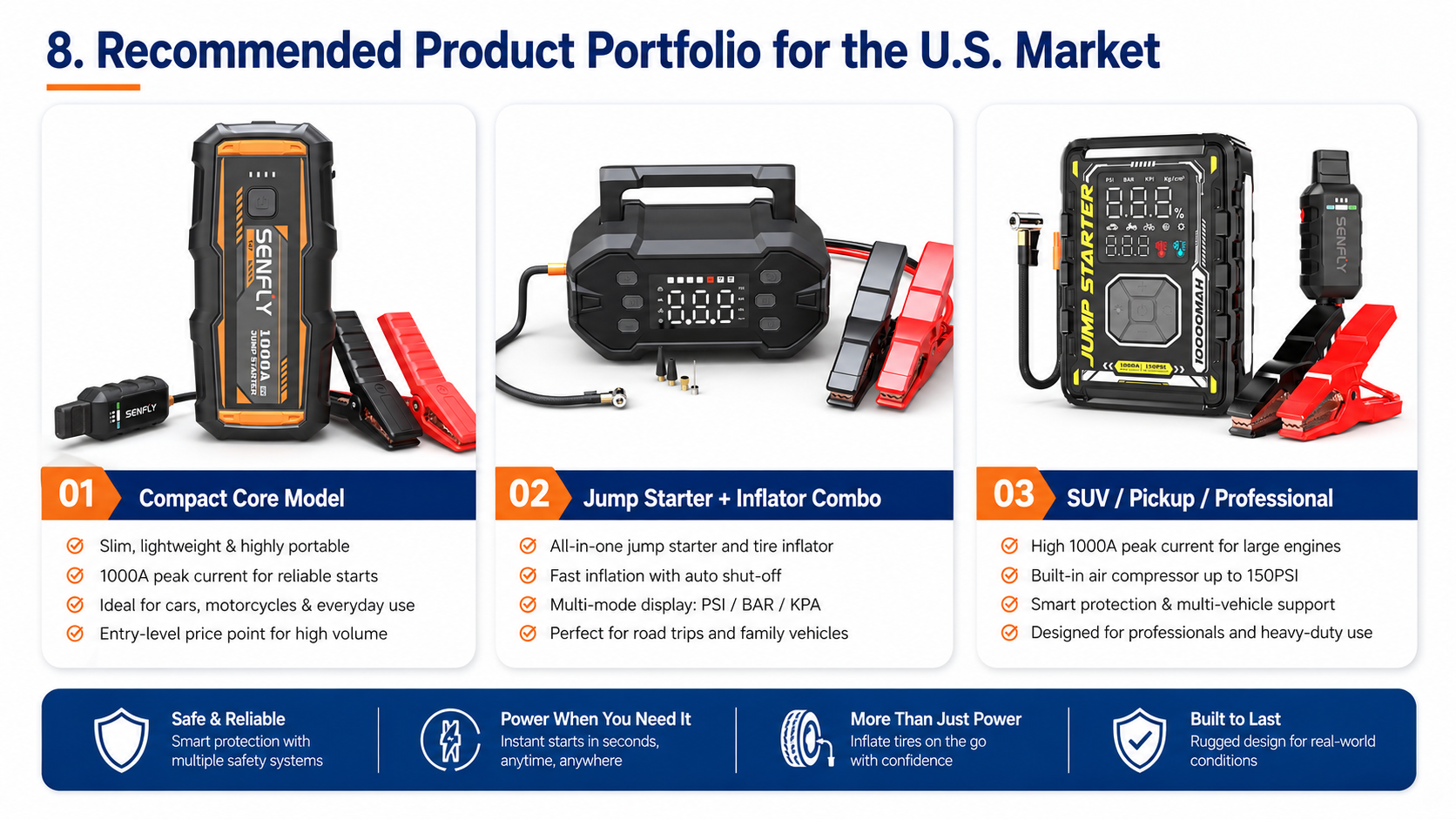
A three-level portfolio covers the major U.S. retail and professional use cases.
A practical U.S. portfolio should provide a clear step-up path. Each level needs a distinct customer, price logic and performance promise. The following structure converts the market analysis into a product-planning framework.
| Portfolio Role | Suggested Retail Position | Target User / Channel | Core Specification Direction | Recommended Senfly Models |
|---|---|---|---|---|
| Compact core model | US$99–US$149 | Everyday emergencies; e-commerce; sedans, crossovers and midsize SUVs. | 1,500A–2,000A market positioning; clear engine compatibility; intelligent clamps; forced-start capability; bidirectional USB-C; digital battery display; hard case; work/SOS light. | T47 series or entry-level T25 combination configuration. |
| Jump starter + inflator | US$149–US$199 | Households, pickup owners, long-distance drivers and outdoor channels. | 3,000A–4,000A market positioning; 150–160 PSI digital inflator; preset pressure/auto shutoff; practical pickup-tire flow; 45W+ USB-C; high-visibility display; separated hose storage; optimized thermal management. | T25 59.2Wh or T39 59.2Wh. T53 for faster-inflation positioning. |
| SUV / pickup / professional | US$199–US$299+ | Tool chains, automotive specialists, repair shops, farms, fleets and professional users. | Large-engine compatibility; higher verifiable starting current; longer/thicker cables; heavy-duty clamps; repeated-start capability; cold/drop/dust resistance; 12V DC or AC equipment output; batch asset labels. | T25 88.8Wh or T11 pure jump starter. |
How the Three Levels Work Together
- The compact model attracts broad-volume buyers and provides a simple entry point.
- The combination model creates visible functional differentiation and supports a higher average selling price.
- The professional model protects brand credibility in pickups, fleets and tool channels where repeatability matters more than compactness.
9. Four Priority Actions for Brands and Purchasing Teams
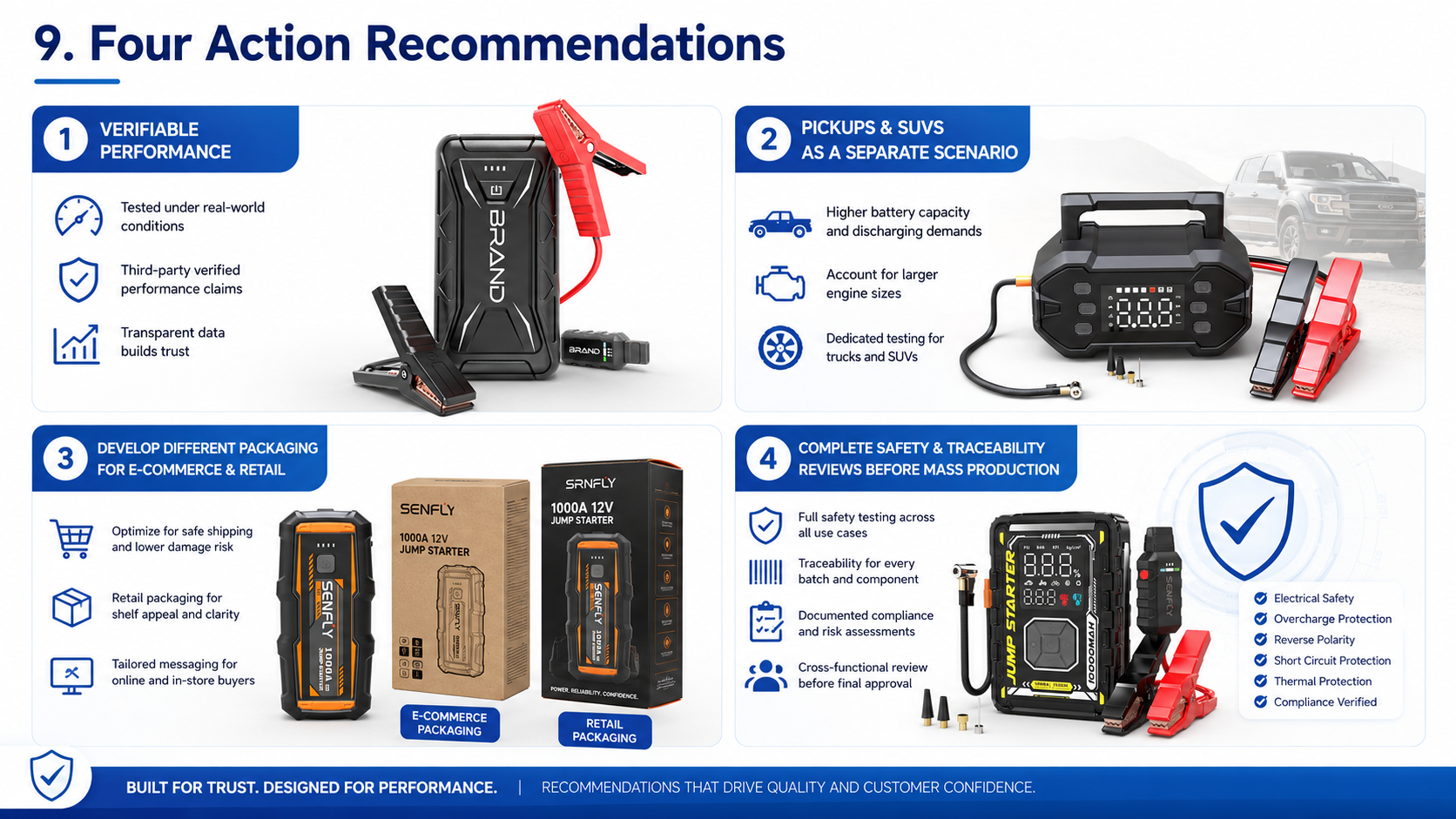
Four actions translate the market outlook into product and sourcing decisions.
| Priority Action | Implementation Focus | Required Output |
|---|---|---|
| 1. Replace peak-amp advertising with verifiable performance | Publish starting current, engine compatibility, low-temperature performance, minimum operating charge and repeated-start results under stated conditions. | A performance claim matrix and test-data package that sales, retail and compliance teams can use consistently. |
| 2. Treat pickups and SUVs as a separate scenario | Re-evaluate cable length, clamp size, inflator flow, casing durability and thermal performance for larger vehicles. | A dedicated large-vehicle validation plan rather than a passenger-car test extrapolation. |
| 3. Develop channel-specific packaging | Use compact, drop-resistant packaging for e-commerce and highly communicative packaging for physical retail. | Separate e-commerce and shelf-retail packaging systems for the same core product where commercially justified. |
| 4. Complete safety and traceability review before mass production | Confirm cell documentation, UN 38.3 summary, critical-component list, protection tests, inflator temperature tests and batch traceability. | A signed pre-production compliance gate and a complete technical file before purchase-order release. |
Conclusion
The U.S. automotive jump starter market still offers stable, long-term demand—but success now depends on proof, positioning and supply-chain readiness rather than peak-amperage claims alone.
Vehicle aging provides a durable demand foundation. Pickups, SUVs, long-distance travel and outdoor use expand the practical scenarios. At the same time, e-commerce competition, lithium-battery safety, retailer responsibility, transportation requirements and state-level recycling obligations are raising the standard for product development and supplier qualification.
For brands, importers and purchasing teams, the next generation of competitive products should combine:
- Reliable and verifiable starting performance.
- Clear vehicle and engine-displacement positioning.
- A balanced multifunction configuration with controlled thermal behavior.
- Packaging designed for the target sales channel.
- Complete, traceable and accessible safety evidence.
About Senfly
Senfly was established in 2011 and is headquartered in Guangzhou, China. The company holds a controlling interest in the Dongguan CAROSS manufacturing facility, which began operations in 2013. The company reports a 13-year record without a major quality incident. Named customers and cooperation partners include Walmart, GEELY, Baseus, mophie, Energizer, Goodyear and Camel Group.
| Company Item | Snapshot |
|---|---|
| Manufacturing and team | 8,000-square-meter Dongguan facility; approximately 110 employees, including more than 50 R&D personnel. |
| Capacity and lead time | Standard monthly capacity of approximately 100,000 units, expandable to 150,000 units during peak periods; standard production lead time of approximately 25 days. |
| Innovation platforms | 82 global patents; polarity-free automatic-recognition clamp technology; Smart Connect protected-clamp system; dynamic battery series-parallel switching technology. |
| Systems and laboratory | IATF 16949, ISO 9001, ISO 14001 and BSCI; Walmart FCCA assessment completed; CNAS-accredited laboratory supporting environmental and EMC verification. |
| Global cooperation | More than 100 partners across over 20 countries and regions; OEM manufacturing, ODM joint development and technology licensing. |


 Hot News