EN
EN

Automotive Jump Starters & Portable Vehicle Power | Africa · South Africa
Load Shedding Fades, Backup Power Habits Stay
An in-depth view of South Africa's 13-million-vehicle bakkie market, zero-tariff re-export potential, NRCS compliance barriers, and real growth in diesel pickup jump starters.
Executive Summary
Assuming that the end of load shedding means the end of South Africa's portable-power opportunity is likely to lead to the wrong conclusion. Three developments are occurring at the same time:
- Grid stability has improved, but backup-power behavior has become permanent. South Africa recorded more than 200 consecutive days without load shedding in 2025, and the grid remained stable in early 2026. Even so, the portable-power market is projected to expand from USD 12.18 million in 2025 to USD 31.23 million in 2034, representing a CAGR of 11.06%. Backup power is shifting from an optional emergency purchase to a standard household preparedness item.
- South Africa is a bakkie market, not a small-passenger-car jump-starter market. Toyota Hilux has remained the country's best-selling vehicle for more than 50 years and sold 36,525 units in 2025, up 11.8%. Diesel bakkies and mining/off-road vehicles such as the Land Cruiser 79, whose sales increased 58.8%, create genuine demand for heavy-duty starting products.
- South Africa combines a zero-tariff import environment with a demanding compliance gateway. Jump starters and lithium batteries enter at 0% import duty, while the AfCFTA framework supports re-export into more than 50 African countries. However, the NRCS Letter of Authority is the gatekeeper for formal channels such as Midas and Autozone.
1. Market Overview
South Africa's jump-starter and portable-power market is being driven by three forces at once: replacement demand from an aging vehicle fleet, consumer-market growth created by permanently established backup-power habits, and a low-tariff import structure dominated by Chinese supply chains.
| Indicator | Market Data |
|---|---|
| Vehicles in operation | More than 13 million; over half are more than 10 years old |
| Total new-vehicle sales in 2025 | 596,818 units, +15.7% YoY |
| Light commercial vehicles (LCV) | 143,637 units, +7.8% YoY, including bakkies |
| Toyota Hilux | 36,525 units, +11.8%; best-selling model for more than 50 consecutive years |
| Ford Ranger | 25,465 units |
| Isuzu D-Max | 21,194 units, +11.7% |
| Toyota Land Cruiser 79 | 5,493 units, +58.8%; supported by mining and off-road demand |
| Chinese bakkie growth | GWM P-Series +34.6%; JAC T-Series +66.2% |
| Portable-power market size | USD 12.18 million in 2025 → USD 31.23 million in 2034, CAGR 11.06% |
| Import duty / VAT | 0% import duty for jump starters and lithium batteries, plus 15% VAT |
| Jump-starter penetration in Africa | Below 8%; almost entirely dependent on imports |
| China's share of South African auto-parts imports | 30%; China is the largest source market |
| Automechanika Johannesburg | 27–29 October; 82% of visitors have purchasing decision authority |
The fundamentals are supported by a fleet of more than 13 million vehicles, an aging vehicle base in which more than half of vehicles are over ten years old, and a mainstream bakkie market dominated by diesel pickups. Portable power continues to expand because three years of load shedding turned backup capability into a normalized consumer habit. South Africa's zero-tariff environment and AfCFTA positioning create a re-export platform, but the NRCS LoA remains the entry ticket to organized retail.
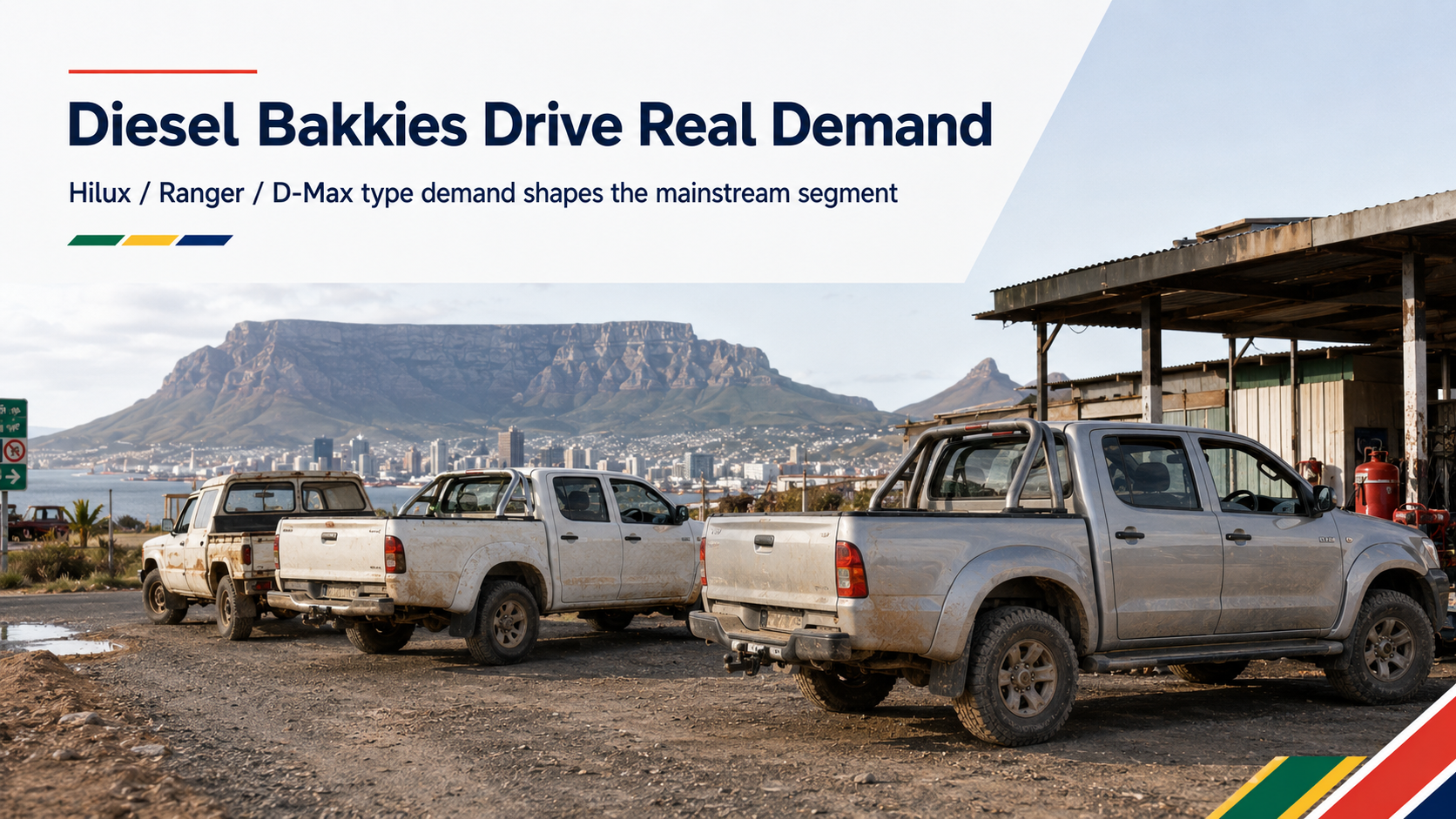
Diesel bakkies are the mainstream use case shaping genuine heavy-duty starting demand.
2. Three Market Perspectives
Perspective 1 · Brand Owners: Competitive Landscape and Differentiation
South Africa currently has almost no local jump-starter manufacturing capacity. The market is heavily import-dependent, with Chinese supply chains playing the leading role. International brands such as NOCO are present on Takealot and in premium auto-accessory channels, but no single brand has established a monopoly. Chinese suppliers are stronger in high-volume, value-oriented segments, while the absence of NRCS LoA support keeps many sellers outside formal retail.
Signal 1: Diesel bakkies create real heavy-duty demand
Unlike markets where 6,000A peak-current claims can become a specification race, South Africa's core demand comes from genuine diesel applications. Hilux 2.4L/2.8L diesel, Ranger 2.0L/3.0L diesel and D-Max 1.9L/3.0L diesel all require higher starting performance than comparable petrol vehicles. The 58.8% increase in Land Cruiser 79 sales, including 4.5L V8 diesel applications, further supports mining and off-road demand. The 2025 LCV segment reached 143,637 units, up 7.8%.
Signal 2: The end of load shedding does not mean the end of backup power
Three years of power disruption changed portable power from an emergency product into a household preparedness item. DeepMarketInsights reports a CAGR of 11.06%, while Grand View provides a longer-term CAGR estimate of 16.2%. Both sources indicate continued growth. The opportunity for Chinese suppliers lies in combining vehicle rescue and household backup functions. LED lighting should be treated as a core feature with a clearly stated lumen rating, rather than as a decorative add-on.
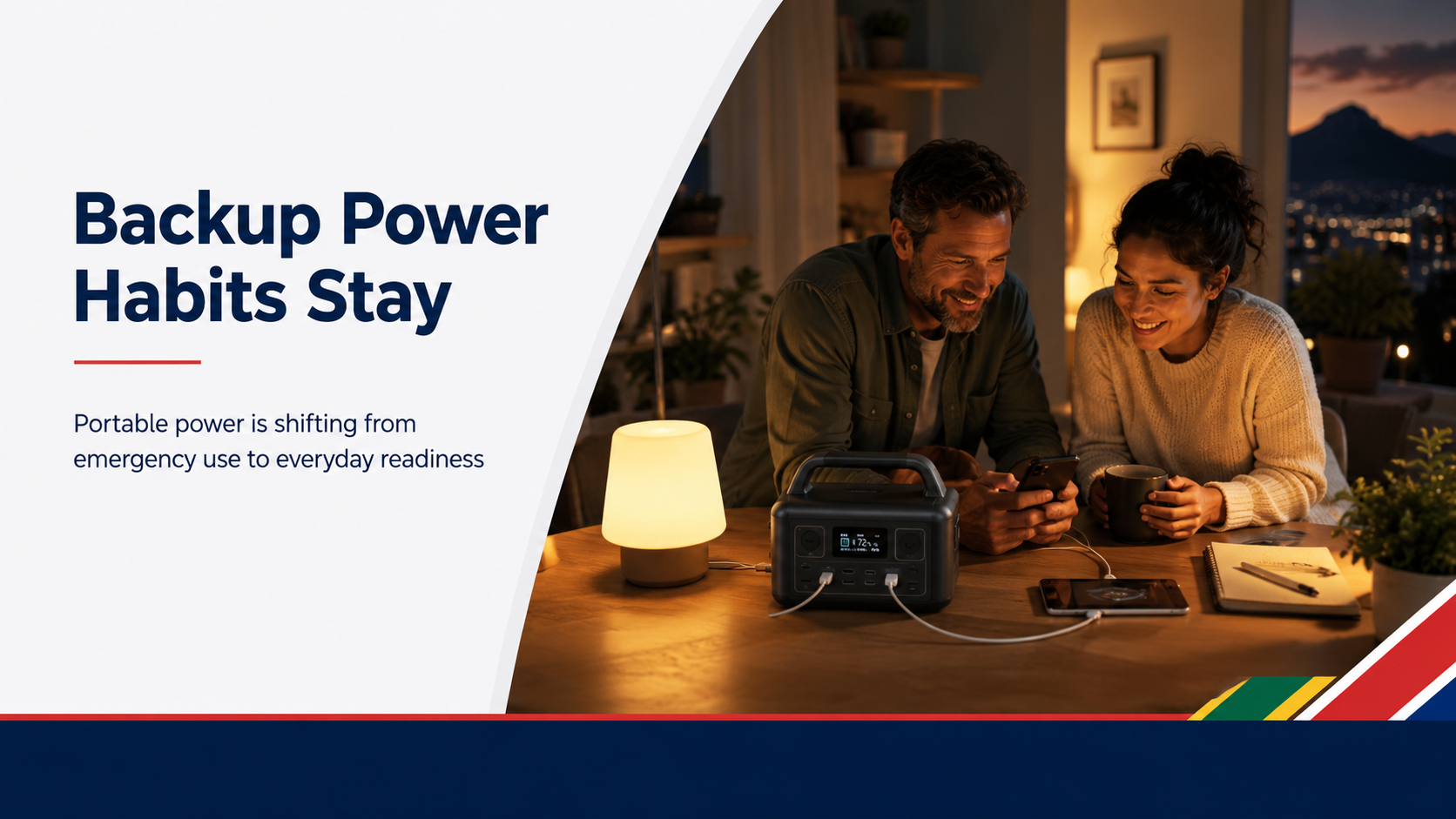
Backup power is moving from emergency-only use toward everyday readiness and household resilience.
Signal 3: Growing Chinese bakkie brands create channel opportunities
GWM P-Series (+34.6%), JAC T-Series (+66.2%) and Foton Tunland (2,329 units) are expanding in South Africa. Chinese jump-starter suppliers can potentially work through these brands' local after-sales networks and service ecosystems, creating a supply-chain coordination advantage not available to many Western brands.
Industry practice reference: Senfly's T-series all-in-one range covers the three major demand types described above. The high-spec T25 combines an 88.8Wh battery and 2,000A peak current with an inflator, LED lighting and dual-USB charging, creating a four-in-one solution for vehicle starting, tyre inflation, emergency lighting and phone charging. The source document notes that NOCO does not currently offer an all-in-one jump starter with a built-in air pump, leaving a differentiation window for combo-product suppliers.
Perspective 2 · Importers: Compliance, Channels and Cost
Compliance is the first barrier to formal retail. The NRCS Letter of Authority is issued by South Africa's National Regulator for Compulsory Specifications. National chains such as Midas, Autozone and Checkers generally reject products without the required LoA. CE certification does not replace the NRCS LoA; both are used in parallel, and the LoA process requires CB/IEC documentation together with testing for South African VC specification differences.
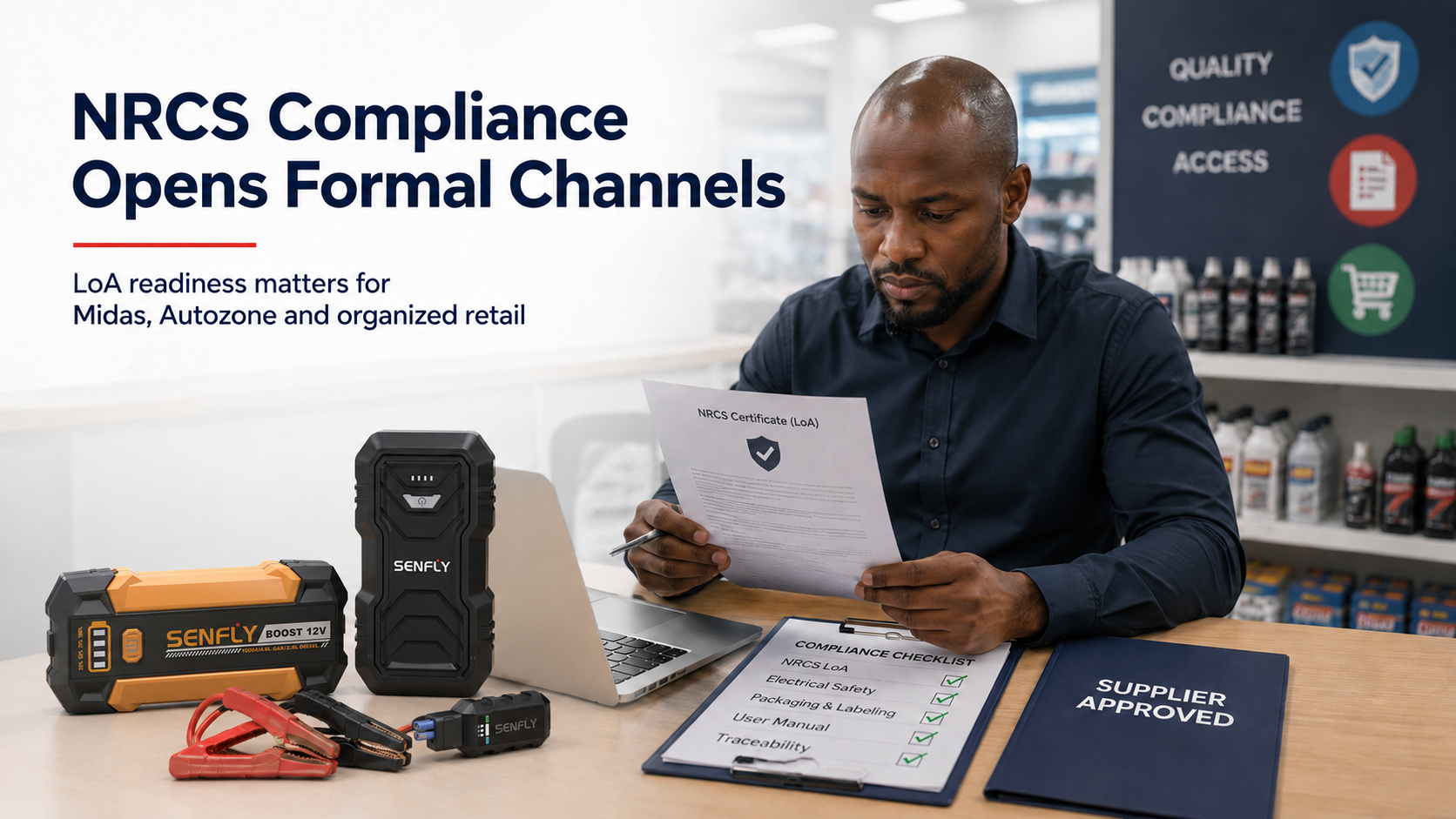
NRCS LoA readiness is central to supplier approval and access to organized retail channels.
| Compliance Item | Requirement | Commercial Risk |
|---|---|---|
| NRCS LoA | Mandatory prerequisite for formal retail channels | Without an LoA, products cannot enter Midas or Autozone and are generally limited to informal markets |
| SABS certification | Preferred by premium channels and government purchasing | Longer lead time, but stronger potential for premium positioning |
| CE + UN38.3 | Required for import clearance | Missing documents can result in cargo detention |
| MSDS | Required for customs clearance of battery products | Missing documentation can result in detention |
| Certificate of origin | Used for preferential tariff declarations | Affects AfCFTA re-export tariff treatment |
| Fumigation certificate | Required for wooden pallets or wooden cases | Non-compliant wood packaging may be rejected; plastic pallets are recommended |
South Africa's 0% import duty is a major cost advantage compared with other African markets. For the same FOB USD 30 jump starter, the landed-cost structure is materially lower than in Nigeria, where the source document cites 20% duty plus 7.5% VAT, or Kenya, where it cites 25% duty plus 16% VAT. Together with staged AfCFTA tariff reductions, South Africa can function as a distribution hub for Zimbabwe, Zambia, Mozambique, Namibia and other African markets.
Sea freight from China to Durban is approximately 22–28 days. With a production cycle of 30–45 days, total planning time is about 8–11 weeks. A 20-foot container can carry approximately 1,800–2,200 compact jump starters or 800–1,000 heavy-duty models.
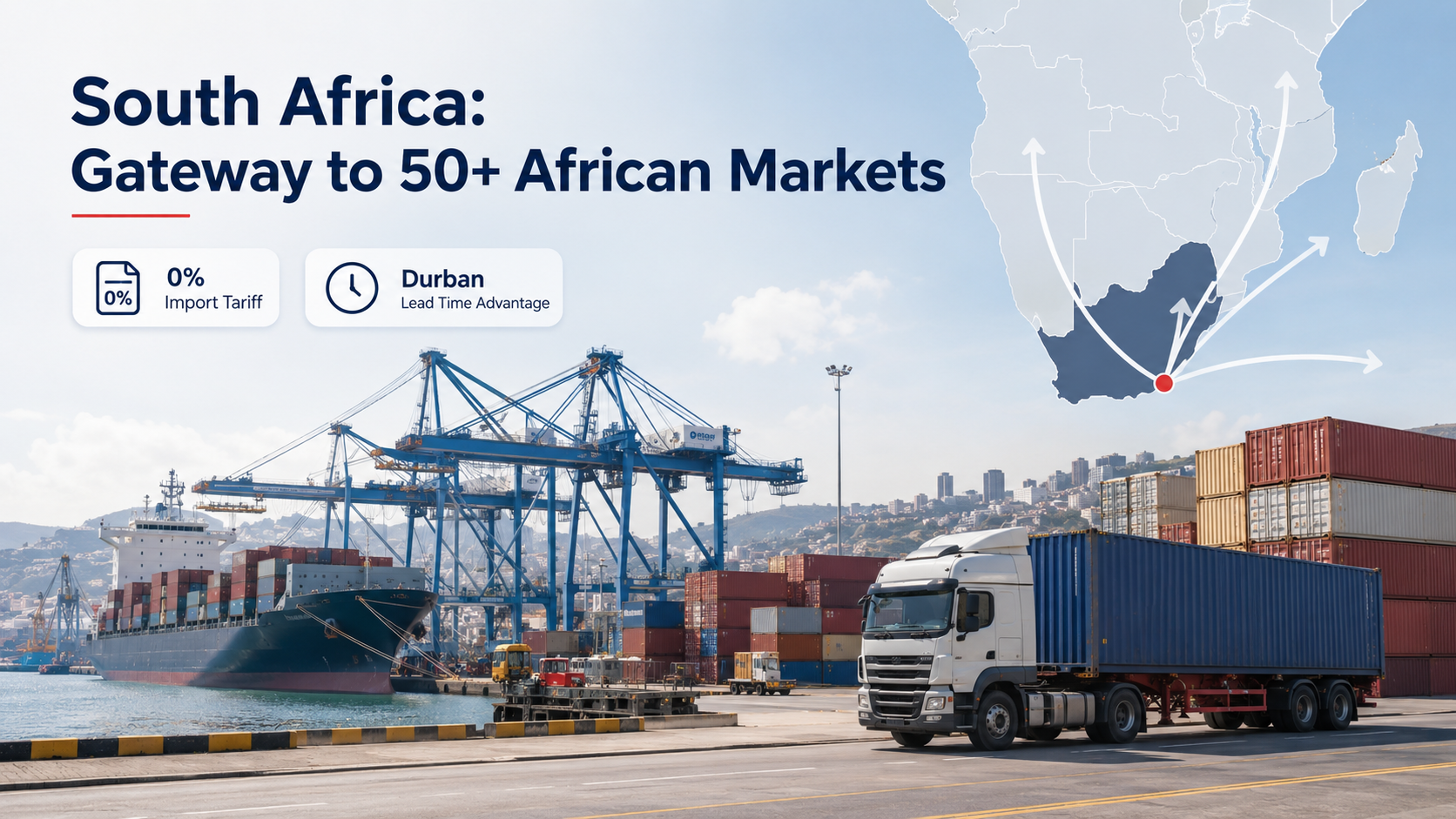
Zero import duty and AfCFTA positioning support South Africa's role as a re-export hub for more than 50 African markets.
South African Import Channel Structure
| Channel | Representative Accounts | Entry Conditions |
|---|---|---|
| Auto-parts chains | Midas, Autozone South Africa | NRCS LoA, technical specifications and wholesale pricing |
| Mass retail | Checkers, Builders Warehouse | NRCS LoA, preference for SABS certification and EDI capability |
| E-commerce | Takealot | NRCS LoA, English listing and local warehousing |
| Auto-parts wholesale market | Johannesburg automotive trading areas | CE documentation and competitive pricing; lower compliance threshold but lower margins |
| Mining / fleet B2B | Mining companies and off-road modification shops | Framework contracts and heavy-duty specifications |
| AfCFTA re-export | Johannesburg distributors serving neighboring countries | NRCS documentation, certificate of origin and re-export paperwork |
South Africa has the highest degree of retail-chain organization in Africa, in contrast with Nigeria's market-led structure. Takealot is the fastest-growing e-commerce window but requires local inventory and NRCS compliance. Mining B2B is a high-ticket vertical channel: the 58.8% growth of Land Cruiser 79 sales directly reflects demand for equipment serving mining and off-road fleets.
Perspective 3 · Purchasing Managers: Product Requirements
South African buyers are moving from a single-dimension focus on “how many amps” toward a multidimensional assessment of compliance, true diesel performance, durability and after-sales readiness.
| Priority | Requirement | Why It Matters |
|---|---|---|
| Disqualifying requirement | Verifiable NRCS LoA | The first purchasing question is increasingly “Do you have an NRCS LoA?” rather than “How many amps?” |
| Core | High-current diesel compatibility | Hilux, Ranger and D-Max are predominantly diesel; “Diesel Compatible” is a key purchase signal |
| Core | Multifunction all-in-one combo | Jump start + inflation + LED + USB can command a 30–50% premium; LED is treated as essential |
| Core | Low-self-discharge cells | Units may remain unused for months; self-discharge directly affects consumer experience |
| Important | Rugged construction | Harsh roads make rubber protection, reinforced clamps and a storage case important quality cues |
| Differentiation | Dedicated 24V product line | Land Cruiser 79 and heavy mining applications require separate 24V solutions |
| Growth | Portable-power bundle | 1,000Wh-class power stations plus solar panels support both emergency and everyday scenarios |
| Operational | English labeling + local warranty | English is sufficient for the commercial environment; local warranty reduces return friction |
| Long-term | EV 12V dedicated model | The source article sees this as a five-to-eight-year opportunity, with near-term NEV growth led by hybrids |
A notable sourcing trend is the gap between real cold-cranking requirements and inflated e-commerce peak-current claims. The source article places real starting-current demand for South African diesel bakkies with 2.4L–4.5L engines broadly in the 500A–1,500A range. Suppliers with CNAS laboratory capability can build trust by distinguishing tested starting current from peak current instead of competing solely through exaggerated headline numbers.
3. Product Configurations and Market Fit
Direction 1: Mainstream Diesel Bakkie — 2,000A-Class All-in-One
This configuration addresses mainstream Hilux 2.8L, Ranger 3.0L and D-Max 3.0L diesel applications. Recommended features include more than 1,000A starting current, reverse-polarity protection, over-temperature protection, Type-C fast-charge input and LED lighting. A clearly visible “Diesel Compatible” statement can affect purchasing decisions. An all-in-one version adds practical daily value through inflation and USB charging, particularly in a market where backup readiness is already a household habit.
Using Senfly T25 high-spec as the source article's example, the 88.8Wh and 2,000A-peak configuration is positioned for engines up to 8.0L petrol and 6.0L diesel. Multi-mode LED lighting — white, SOS, warning and red — is presented as a competitive advantage rather than an optional extra.
Direction 2: Multifunction Jump Starter + Air-Pump Combo
Combo products form a distinct category in sub-Saharan Africa. Poor road conditions and frequent tyre issues raise the perceived value of the inflator function above typical Western-market levels. The suggested configuration is 1,000A–1,500A starting capability, a 150PSI air pump, an LED flashlight with a stated lumen rating, dual USB output and a storage case. According to the source article, consumers accept a 30–50% premium because one product addresses vehicle starting, tyre inflation, phone charging and emergency lighting.
Senfly's range is cited as covering entry to flagship positions. T53 uses a 25mm cylinder and is described as inflating a 19-inch tyre from 0 to 35PSI in four minutes. T39 adds an intelligent temperature-controlled cooling fan and two independent QC18W fast-charge outputs. Importers evaluating combo suppliers should pay close attention to cylinder size, continuous-duty performance and thermal management.
Direction 3: Dedicated 24V Heavy-Duty Unit for Mining and Off-Road
The 58.8% growth of Land Cruiser 79 sales maps directly to demand from mining, infrastructure and off-road use. These users need repeatable starting performance in harsh environments rather than another peak-current number. The recommended architecture is a true 24V platform, not a 12V step-up solution, with high-capacity lithium cells, an integrated protection-control module, reinforced clamps and dust- and drop-resistant housing.
The source article identifies two dedicated Senfly 24V platforms. T40 uses an 8S, 29.6V architecture with an EC8 professional connector that is physically differentiated from 12V EC5 products. T37 uses a 7S, 25.9V, 155.4Wh configuration with PD65W bidirectional fast charging. Both include hardware control logic for automatic conduction above 2.0V and multiple protections for reverse polarity, over-temperature, low battery and loose connections.
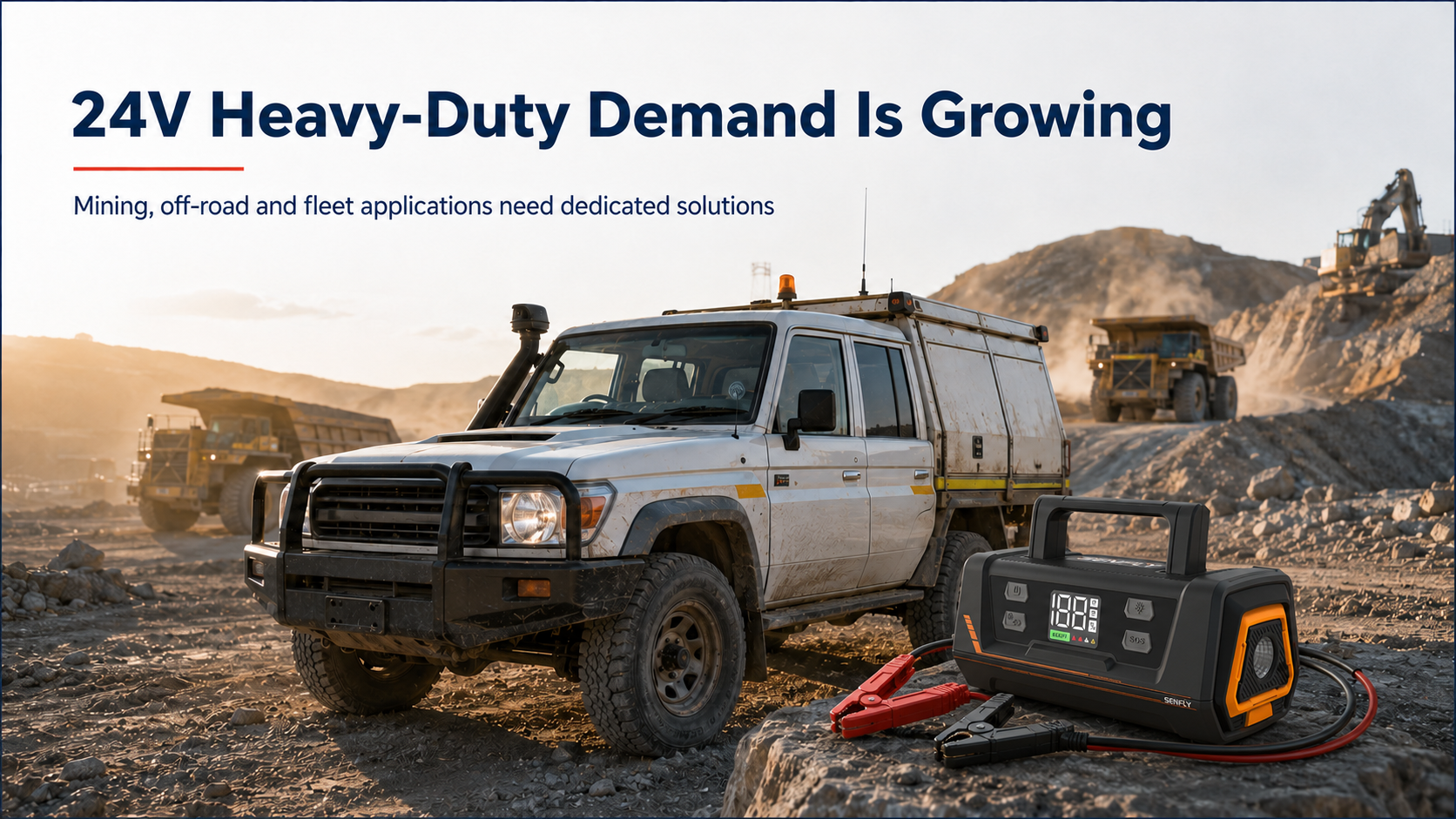
Dedicated 24V architecture, robust clamps and protected housings are central to mining and off-road applications.
4. Supply-Chain Cooperation
For brand owners and importers entering South Africa, a supplier's compliance support and execution capability can determine market timing as much as product price. The following criteria should be included in the supplier evaluation process.
| Evaluation Dimension | Suggested Threshold |
|---|---|
| Product certification | Complete UL, FCC, CE, PSE and RoHS portfolio, with readiness to support NRCS LoA applications |
| Battery safety | Current IEC 62133-2 product-level test report and UN38.3 transport certification |
| Factory systems | IATF 16949 automotive quality management, ISO 9001, ISO 14001 and BSCI |
| Testing capability | CNAS-accredited laboratory covering mechanical, environmental and electrical-safety testing |
| Customization | Private-label printing, packaging customization such as EVA case, soft bag or color box, and clamp-specification adjustments |
| Lead time and capacity | More than 100,000 units per month, standard lead time of 25 days and sample lead time of 7–10 days |
| Cooperation model | OEM manufacturing, ODM co-development and technical licensing |
| Compliance support | Technical files for NRCS LoA and support for South African VC specification-difference testing |
In South Africa's current channel environment, suppliers with complete certification portfolios and CNAS laboratory capability remain limited. Many Chinese exporters are constrained by their ability to support the NRCS LoA process. For buyers targeting Midas, Autozone and Takealot, compliance responsiveness can have greater long-term value than a small unit-price advantage.
The source article describes Senfly Technology as established in 2011, with a controlled Dongguan manufacturing base operating since 2013. The facility covers 12,000 m² and has a 110-person team, including more than 50 R&D personnel. Stated monthly capacity is 100,000 units, expandable to 150,000 units in peak season. The company is described as holding UL, FCC, CE, PSE and RoHS approvals across its product range and 82 global patents, with cooperation experience involving Walmart, GEELY, Baseus and Energizer.
5. Channel Strategy
South Africa's automotive aftermarket differs from many other African markets because chain retail has national scale. Midas and Autozone provide a structured path to volume, while Takealot, mass retail, mining B2B and AfCFTA re-export each require a different proposition.
| Channel | Positioning | Core Strategy |
|---|---|---|
| Midas / Autozone | Mainstream volume route | Enter with complete NRCS LoA documentation, a core combo model and channel-appropriate wholesale pricing |
| Takealot | Fastest-growing retail window | Use English listings, local inventory and review-driven conversion; combo products avoid direct like-for-like comparison with pure jump starters |
| Checkers / Builders Warehouse | Mass-market retail | Pair combo products with seasonal promotions; SABS certification is a positive differentiator |
| Mining / off-road B2B | High-ticket vertical market | Use Land Cruiser 79 growth as a demand indicator; on-site starting demonstrations can be more persuasive than specification sheets |
| AfCFTA re-export | Regional-hub opportunity | Use South Africa's 0% import duty and AfCFTA positioning to serve more than 50 African markets |
6. Market Timing and Key Dates
South Africa is in the Southern Hemisphere. Autumn and winter, from May through August, form the peak period for battery failures because lower temperatures make starting more difficult. The article was prepared in late July, during the later part of the winter peak. The next stocking window runs from September to November, combining spring and summer replenishment with Automechanika Johannesburg on 27–29 October.
Automechanika Johannesburg is described as one of Africa's largest automotive-aftermarket exhibitions. The source article cites an exhibition area of 18,000 m², more than 400 exhibitors from 25 countries and an expected 12,000–14,000 professional visitors. It also states that 82% of visitors hold purchasing decision authority. For brands and importers, the event is a concentrated opportunity to test product response, meet channel buyers and track compliance developments.
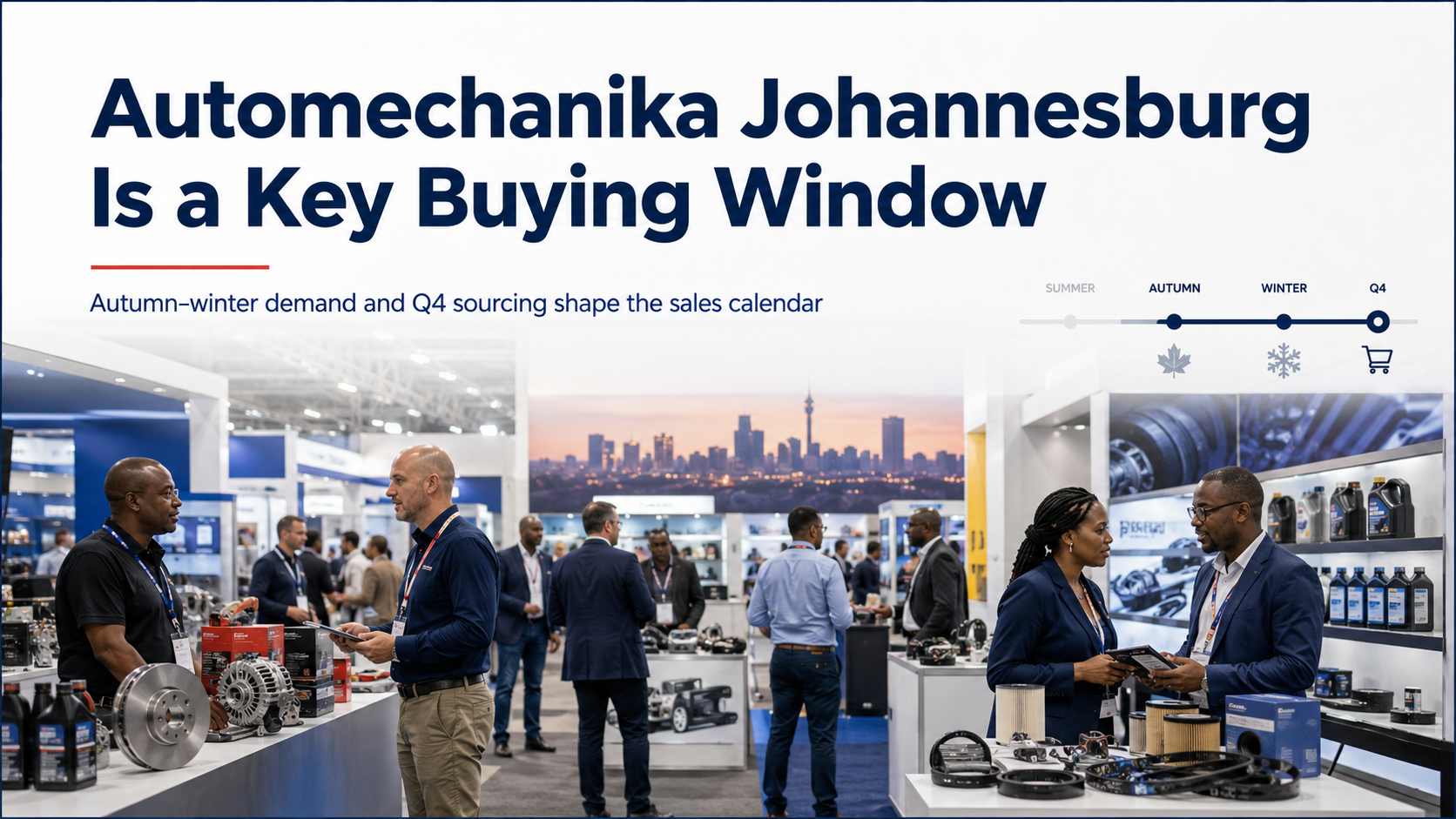
Automechanika Johannesburg is a key channel-development and sourcing window in the second half of the year.
NRCS LoA processing is estimated at 4–8 weeks when existing CB/IEC documentation is available and South African VC differences are added. Because sea freight to Durban takes approximately 22–28 days, the LoA process should begin before inventory production is completed so that certification does not become the scheduling bottleneck.




 Hot News