SENFLY MARKET INSIGHT · INDIA
The real opportunity in the world’s largest two-wheeler-led vehicle market
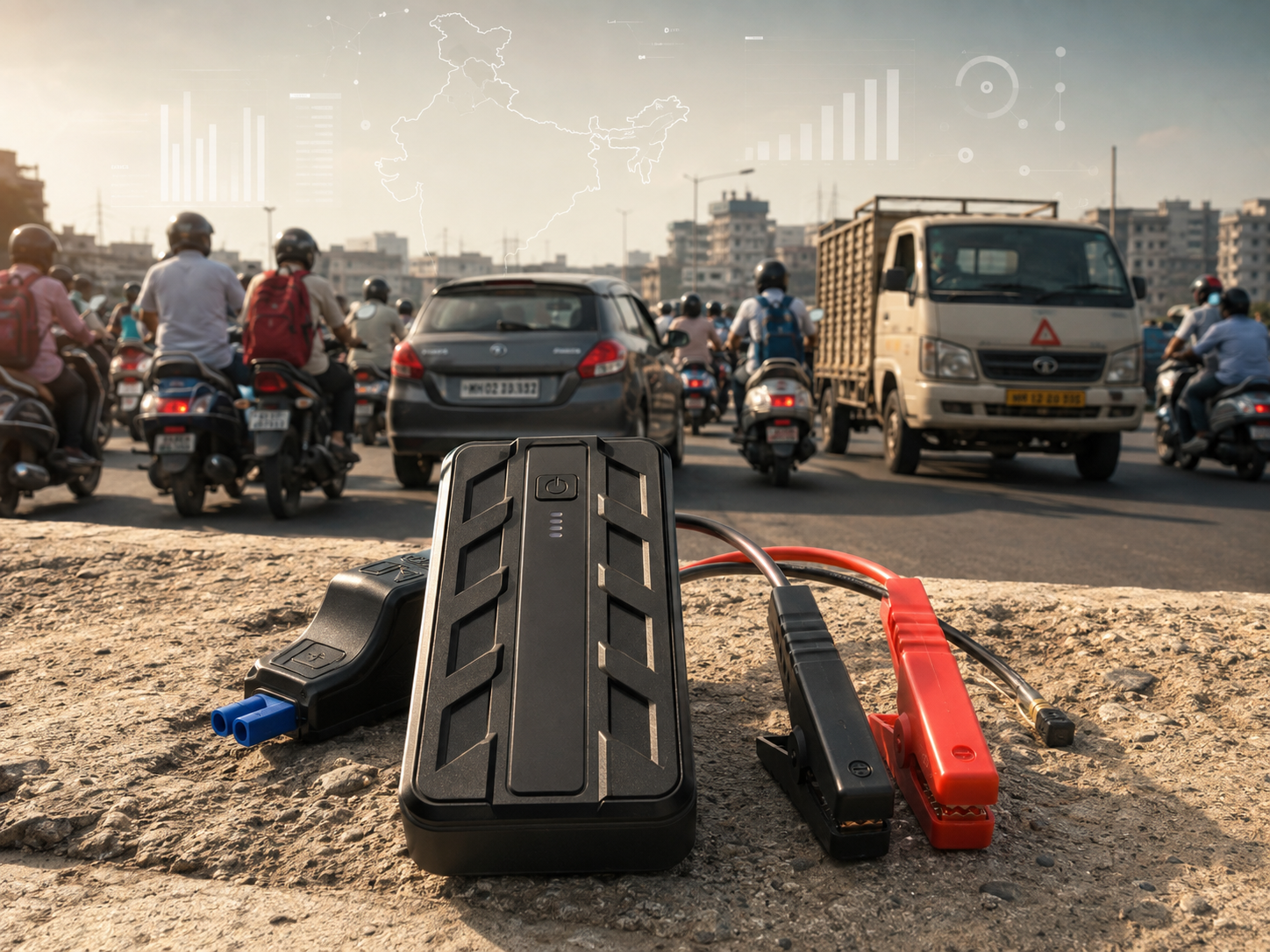
India is the only major global automotive market where two-wheelers are the overwhelming mainstream. Of an estimated 226 million vehicles in operation, about 77%—roughly 175 million—are two-wheelers. Domestic two-wheeler sales reached 19.61 million units in FY2025, up 9.1%. At the same time, the 2026 heat wave has become a direct demand driver for starting products: extreme temperatures accelerate lead-acid battery deterioration and turn battery failure into a recurring roadside problem.
On the compliance side, BIS CRS under IS 16046 remains the hard gate for lithium batteries, while the January 2026 withdrawal of the OTR regulation created a structural easing. For brands, importers and OEM partners, the Indian market is therefore opening inside a “tight on batteries, looser on equipment” regulatory window.
| Indicator | Data | Source cited in the original article |
|---|---|---|
| Total vehicle parc (2023) | 226 million vehicles; the world’s third-largest automotive market after China and the U.S. | CEEW (2025-06) |
| Vehicle parc structure | Two-wheelers about 77% (175 million); passenger vehicles about 13–15%; commercial vehicles about 4.4%. | CEEW / industry estimates |
| 2050 vehicle parc forecast | 494 million vehicles, more than double today’s level; two-wheelers still projected at about 71%. | CEEW (2025-06) |
| FY2025 domestic two-wheeler sales | 19.61 million (+9.1%); electric two-wheelers 1.15 million (+21%). | SIAM / manufacturer disclosures |
| 2025 passenger vehicle sales | About 4.55 million (+6%, a record); SUVs represented about 65% of new passenger vehicles. | FADA / SIAM |
| 2025 total EV sales | 2.30 million, equal to about 8% of new registrations; electric two-wheelers represented 57% of EV sales. | IESA / Vahan |
| Heat and battery life | 46.2°C recorded in April 2026; under-hood temperature can reach 70°C after 30 minutes; 60–65°C can cause permanent lead-acid battery damage; direct-sun parking in northern India can reduce battery life to 2.5–3 years. | VahanBazaar / DriveSpark |
| Jump starter market size (2025) | About USD 9.63 million under a narrow car-jump-starter definition; projected at USD 11.32 million by 2034. | DeepMarketInsights |
| Portable power station market (2025) | USD 30.6 million; projected at USD 79.98 million by 2034, CAGR 11.41%; <500Wh is the largest segment while >1000Wh is the fastest-growing. | DeepMarketInsights |
| Main retail channels | Amazon.in (30+ brands), Flipkart; offline networks including Exide / Amara Raja dealers, Bosch Service and OEM genuine-parts channels. | Amazon / Autopunditz |
| Amazon.in hot-selling price band | INR 3,000–8,000 mainstream; INR 14,000–20,000 premium. | Amazon Bestsellers |
| BIS compliance | Mandatory CRS registration for lithium batteries under IS 16046 = IEC 62133; R-number marking; foreign manufacturers must appoint an India Authorized Representative (AIR). | PCN India Global |
| OTR regulation | On Jan. 16, 2026, S.O. 239(E) withdrew OTR, removing the planned BIS Scheme-X / CoC requirement for machinery and electrical equipment. | Department of Commerce WTO Division |
India is not “another Japan.” Japan is shaped by K-car fitment and disaster-preparedness storage; India is shaped by the 12V two-wheeler starting segment, extreme heat density and multifunction 3-in-1 combo products. Three signals stand out.
About 175 million two-wheelers represent 77% of India’s vehicle parc. FY2025 sales reached 19.61 million units, and Hero plus Honda alone sold 11.73 million. Passenger vehicle sales, at about 4.55 million, were only around one quarter of the two-wheeler volume.
Yet most jump starters on e-commerce platforms are still described as “up to 6L petrol / 3L diesel”—a four-wheel-vehicle message. That leaves an open space for 12V two-wheeler-focused jump starters in the 300–800A band, with a small footprint and improved dust / water resistance. Two-wheeler batteries are smaller, typically 5–12Ah, suffer more from heat, and are replaced more frequently, which can make the practical need for starting support more recurrent than in passenger cars.
At an ambient temperature of around 46°C, under-hood temperature can reach roughly 70°C after 30 minutes. Lead-acid batteries may suffer permanent damage at 60–65°C. Under direct-sun parking conditions in northern India, battery life can fall to only 2.5–3 years. Battery failure is therefore not merely an occasional event; it is increasingly tied to climate conditions.
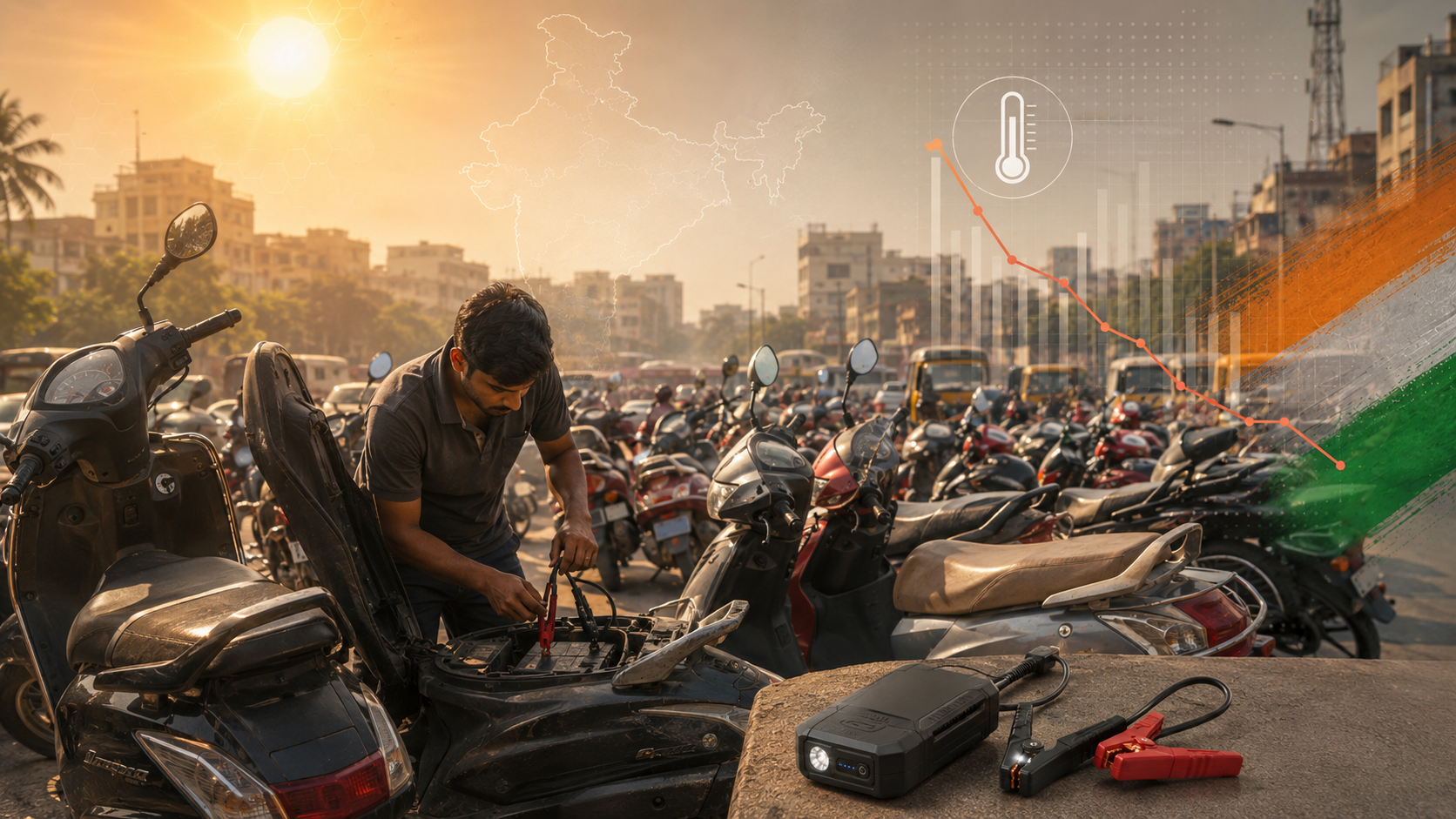
Product positioning should move from “emergency jump starter” to hot-season vehicle essential, with attention to wide-temperature operation, overheat protection and protection against India’s combination of dust and monsoon humidity.
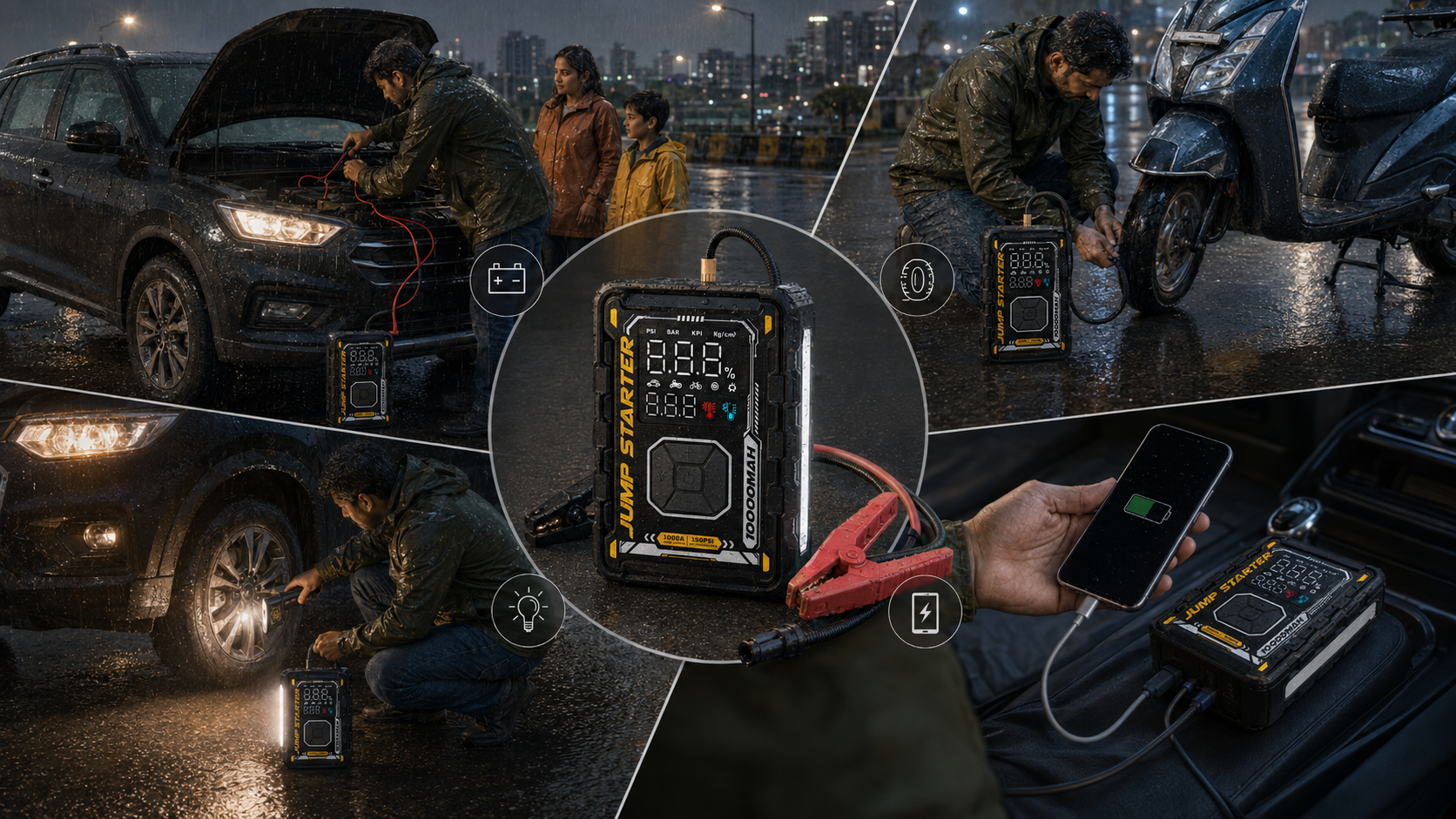
According to the source article’s e-commerce observation, about 40% of hot-selling products include an inflator (150 PSI) and 47% include USB + LED functions. Buyers are not only looking for a jump starter; they want a multifunction roadside emergency toolkit. The high-volume price band is concentrated around INR 3,000–8,000, rather than the premium 4000A flagship narrative.
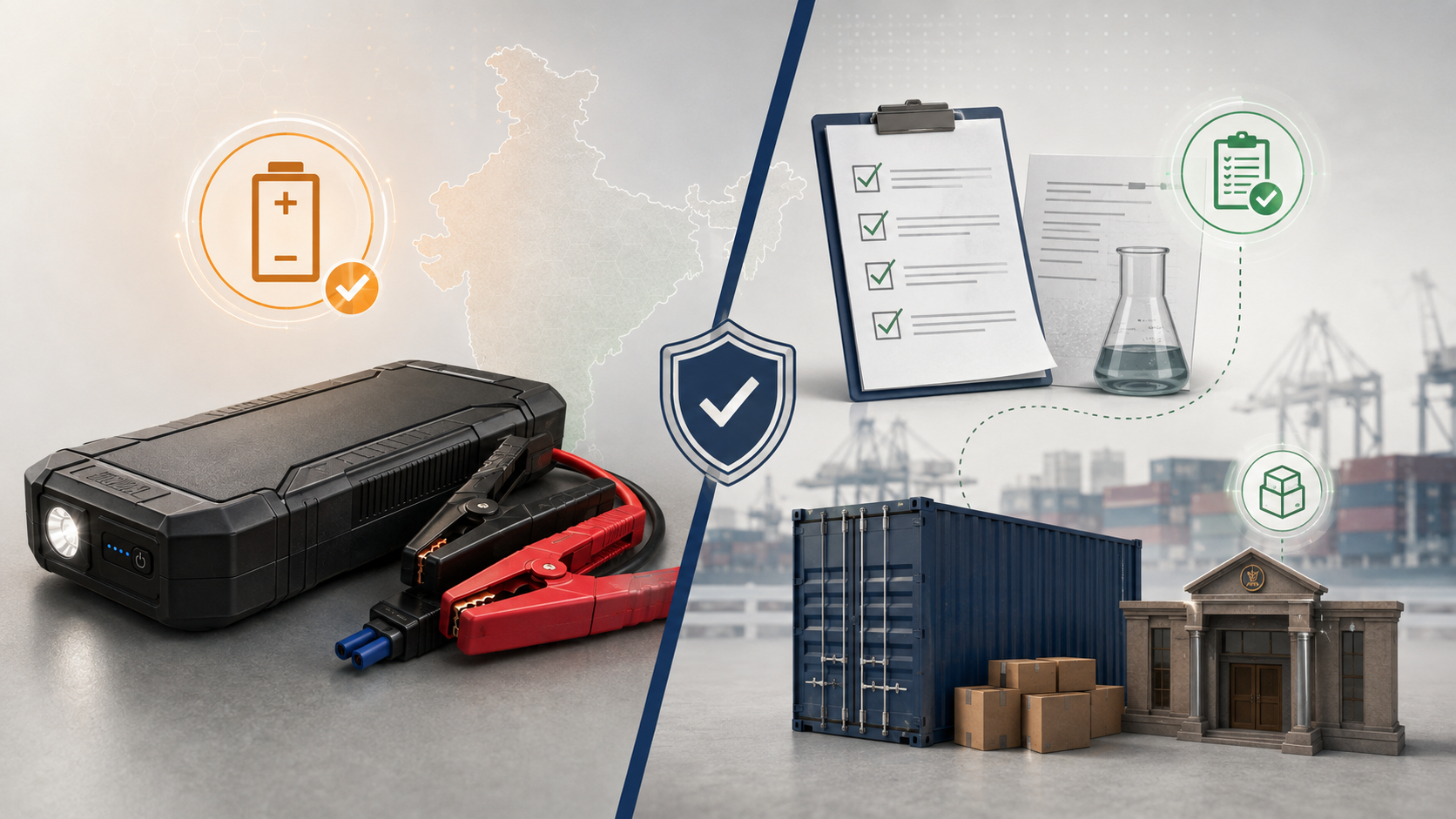
India’s lithium-battery compliance framework is centered on BIS. Sealed secondary lithium batteries for portable applications fall under the compulsory CRS registration program and must pass the full IS 16046 test regime, aligned with IEC 62133, in a BIS-recognized laboratory. Products must obtain and display an R-number before import and sale. Foreign manufacturers must appoint an India Authorized Representative (AIR). This is the hard gate that cannot be bypassed.
However, on January 16, 2026, the Ministry of Heavy Industries issued S.O. 239(E), withdrawing the Omnibus Technical Regulation (OTR) that had been scheduled for implementation on September 1, 2026. The withdrawal took immediate effect. Equipment that had been expected to require additional BIS Scheme-X certification no longer faces that layer of approval.
The result is a “tight and loose” structure: the lithium battery itself still requires IS 16046 compliance, but the extra equipment-level burden has been removed. This structurally lowers the overall compliance burden.
Yes. More than 30 brands on major e-commerce channels are still marketed mainly as “car jump starters,” even though India’s 175 million two-wheelers are the larger installed base. A 12V, 300–800A product with a smaller body and stronger dust / water protection is a clear localization opportunity.
The source article recommends setting BIS testing schedules in Q4, with testing taking several weeks to around two months; first shipments should arrive in Q1 ahead of the March heat-season ramp-up, followed by Q2 replenishment. Ocean freight should be ordered 25–35 days in advance. Q3 can be used for post-monsoon replenishment and Diwali preparation. Because BIS lab capacity becomes tighter in Q4, starting the compliance process in Q3 is preferred.
Models sharing one cell platform but differing in capacity or exterior can use a family application where applicable. The source article estimates this can reduce test cost by roughly 60–70%. Private-label OEM is also workable, and one CRS registration can support multiple brands under the relevant arrangement. A first order of 3,000–5,000 units is suggested to spread certification cost.
The source article also notes that NOCO is almost absent from the top 30 India e-commerce hot sellers, creating greater private-label space for Chinese B2B manufacturers than in many emerging markets.
| Market position | Demand profile | Senfly match |
|---|---|---|
| Two-wheeler focused model (300–800A) | 12V, compact, dust / water resistance, entry price; an e-commerce white space. | T13-A / T55 (300A / 600A segment; T13-A supports small-batch starts). |
| 3-in-1 combo (1000–2000A + 150 PSI inflator) | About 40% of hot sellers include an inflator; covers both two-wheelers and four-wheelers. | T53 (25 mm inflator cylinder, 4–5 minute inflation, optional LiFePO4); T67 (entry combo with cooling fan). |
| High-temperature durability upgrade | 46°C ambient conditions; lead-acid battery life can drop to 2.5–3 years. | T53 LiFePO4 version for improved thermal stability and cycle life; truthful rating across the range. |
| Professional fleet / commercial vehicle heavy duty | About 10 million commercial vehicles; engineering vehicles and roadside service use. | T37 / T40 (24V heavy-duty, heavy clamps and longer cables). |
| Portable power station (<500Wh) | 11.41% CAGR; backup power + camping + emergency electricity. | PB01 (288Wh LiFePO4, bidirectional PD100W, wireless charging, multi-voltage DC output, solar input). |
About peak-current claims: Some products on the market advertise 4000–5000A peak-current figures that are far above real-world starting requirements. In practice, most gasoline engines require only a few hundred amps of cold-cranking current, and 300–800A is already sufficient for typical two-wheeler needs. A truthfully rated product that covers the real requirement—and puts more cost into reliable cells and build quality—is a more rational purchasing choice for India’s price-sensitive, hot and dusty environment.
Senfly is an integrated manufacturer and trading company focused on automotive emergency power. Founded in 2011 and headquartered in Guangzhou, the company operates its own manufacturing base in Dongguan and serves B2B, OEM and ODM customers in more than 20 countries and regions.
The source article states monthly capacity of 100,000 units, expandable to 150,000 units in peak season; average lead time is 25 days and sample lead time is 7–10 days. The factory is certified to IATF 16949, ISO 9001, ISO 14001 and BSCI, and operates a CNAS-accredited laboratory.
Senfly holds 82 global patents covering technologies including smart safety clamps and battery-switching systems. The range extends from entry jump starters to combo units, portable power and 24V heavy-duty models.
The source article states that the range carries UL, FCC, CE, PSE and RoHS certifications, model-level IEC 62133-2 battery safety test reports, and UN38.3 and SDS transport documentation packages to support import clearance and retail onboarding.
Senfly supports OEM manufacturing, ODM joint development and technology licensing, together with product customization, packaging and documentation delivery for importers and brands entering target markets under their own labels.
Senfly is headquartered in Guangzhou and operates as an integrated manufacturer of automotive emergency jump starters, tire inflators, jump-starter-plus-inflator combo products and portable power stations. The company serves B2B, OEM and ODM customers in more than 20 countries and regions and operates its own manufacturing base with a stated monthly capacity of 100,000 units, IATF 16949 certification and a CNAS-accredited laboratory.
For product specifications, certification documents and OEM / ODM cooperation, contact [email protected] or visit www.senfly.com.
Source note: This English version is a direct editorial translation and website adaptation of the uploaded Chinese article. Numeric claims, source attributions, product specifications and company-capability statements are preserved from that source document rather than independently re-verified here.
 Hot News
 EN
EN