Stock both versions when you can tell customers who each one is for and why the upgrade costs more. Picture a shopper looking at two boxes that show the same jump starter. What would make them reach for the pricier one? Give your team an answer they could use at the counter.
If both versions do the job your customers need, start with one. Add the upgrade when a sample shows a benefit that customers will pay for. If you are still checking which version suits the job, wait for the sample before placing the order.
The SENFLY T53 gives buyers a choice of 29.6 Wh, 37 Wh and 59.2 Wh in the same housing. If you are choosing between 37 Wh and 59.2 Wh, ask SENFLY for a quote and sample details for each. See the T53 battery options.
T53 options to compare before you order
| What to compare | 37 Wh | 59.2 Wh |
|---|---|---|
| Rated battery energy | 37 Wh | 59.2 Wh |
| What to check on the sample | Can it handle the job your customer needs? | What more can the customer do between charges under the same conditions? |
| What to confirm on the quote | Battery version, unit label, clamps and what comes in the box | The same items, with any changes marked |
Wh tells you how much energy the battery is rated to store. The 59.2 Wh option is rated for 22.2 Wh more than the 37 Wh option, an increase of 60%. For claims about starts per charge, tyre inflation speed or engine size, use results for the version you plan to sell. Read more about watt-hours.
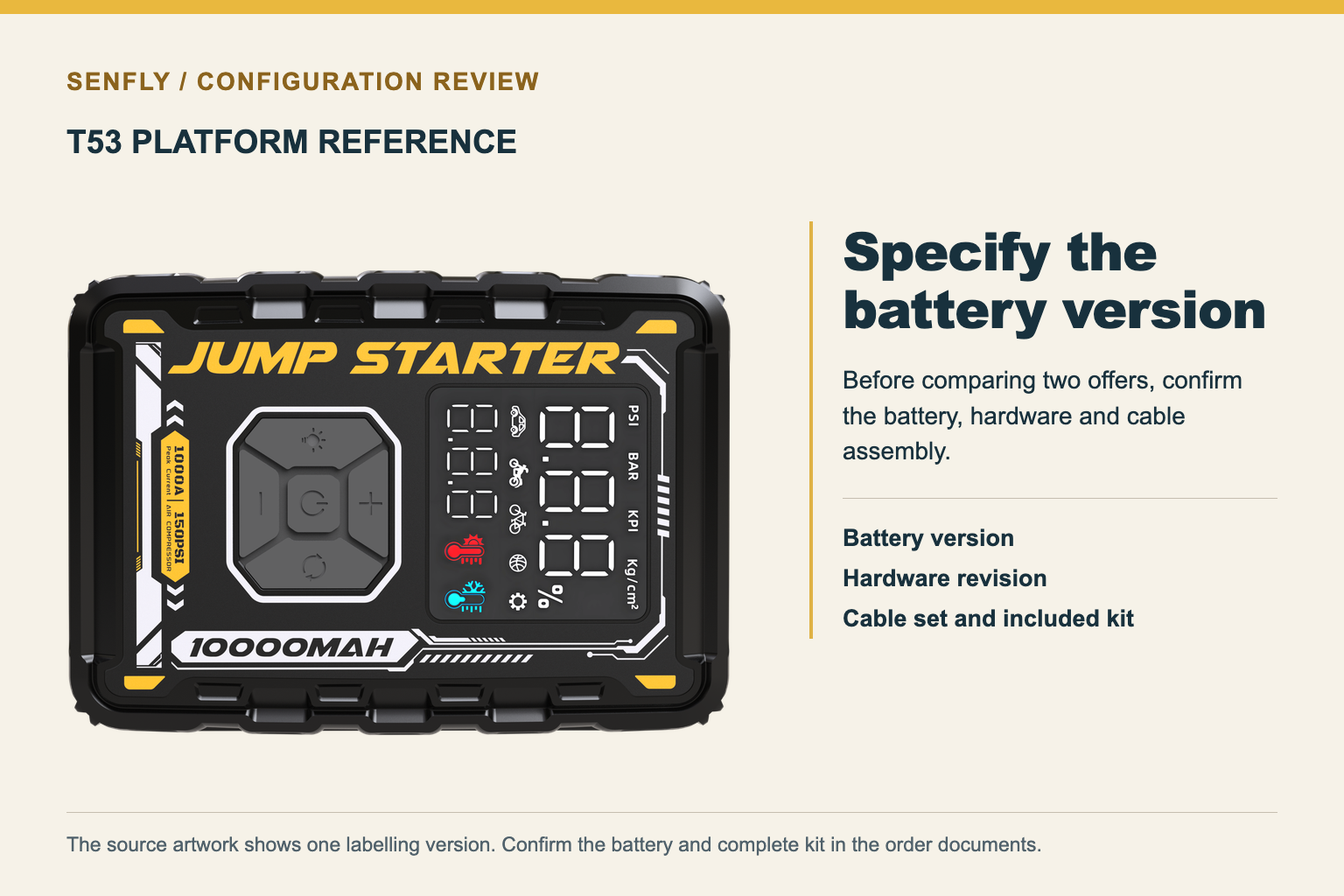
SENFLY T53 housing. Use the label on your sample and the quote to confirm the battery version and accessories.
A shop selling an emergency kit for the family car and a workshop that uses its tools several times a day will ask different questions. For the first, check whether the kit covers the cars the shop serves. For the second, check what each version can do before it needs a recharge.
Agree on one realistic job with your supplier and compare both samples on the same terms. For starting and tyre top-ups, use the same vehicle and battery condition, tyre size, starting and target pressure, temperature and starting charge. Have trained staff follow the vehicle and product instructions, including rest periods between uses.
If customers also want phone backup, compare how much energy they can get from the USB port using the same load. If charging time and easy carrying matter more, time the recharge with the included accessories and weigh the complete kit.
What to buy after you try both samples
| What you find | What to order |
|---|---|
| Each version suits a clear customer need, and your retailer can sell the upgrade at the planned price. | Consider stocking both. Give each a clear use and price. |
| Both do the job, but you have no clear reason customers would pay more. | Start with one. Compare the quotes, kit contents and support. |
| Only the larger version handles the job. | Consider stocking the larger version on its own. |
| You are still checking whether a version suits the job. | Wait on that version and finish the sample check. |
Before ordering, ask whether the two versions can share a minimum order. Get the price, packaging and restock terms for each. That gives you a better idea of what it would cost to keep both on the shelf.
Here is an example you can put into a spreadsheet. Say a buyer switches from the base model to the upgrade, and that sale leaves you $6 more after the costs tied to the sale. If adding the second version costs you $600 upfront, you need 100 such upgrades to cover that extra cost. Use your own figures and account for the cash tied up in the extra stock.
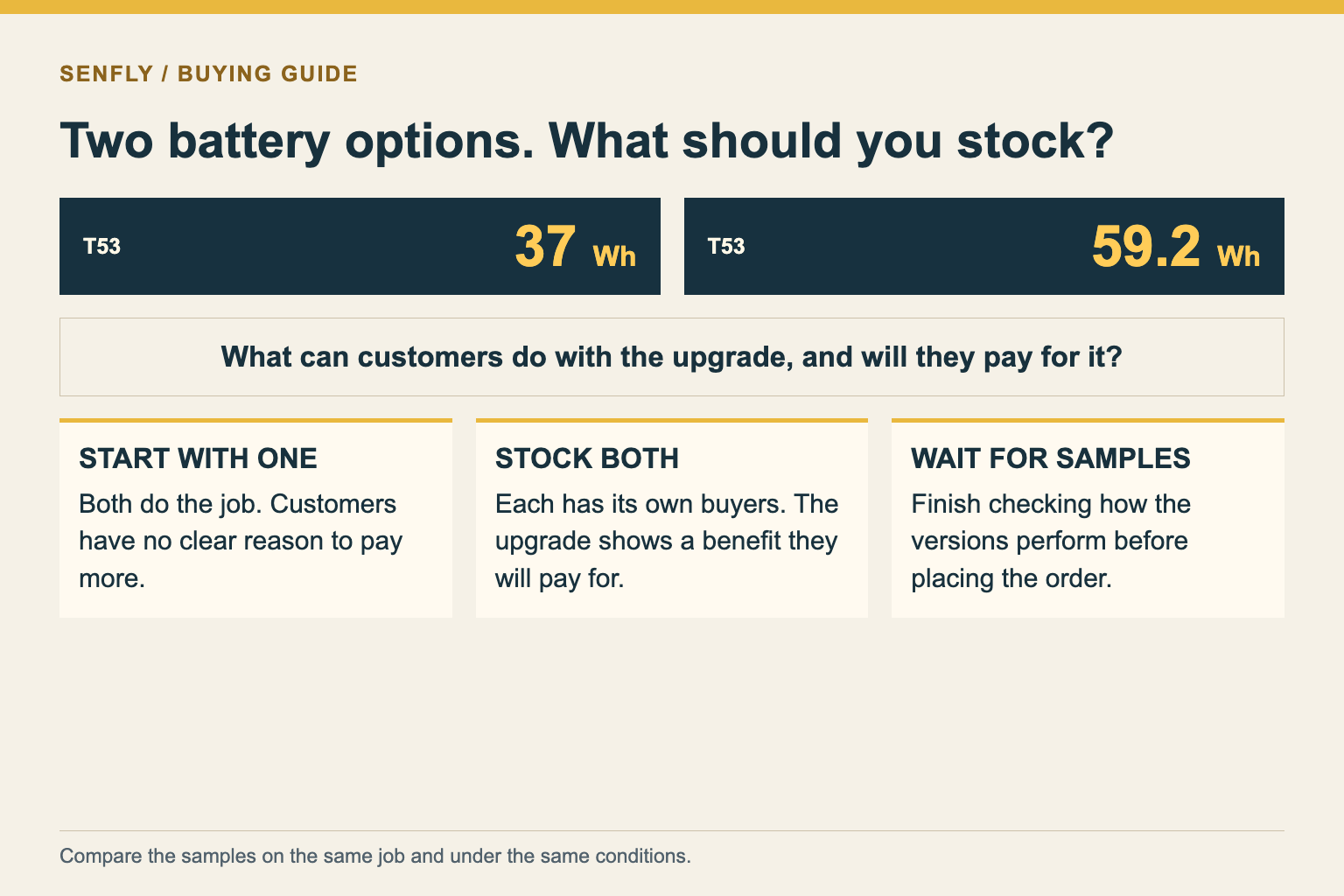
Use the sample results and sales plan to decide whether to stock one, stock both or wait.
If you stock both, give each version its own order code. Put the same code and Wh rating on the quote, sample record, carton and product listing. That lets the warehouse pick the right box and customer service identify a reorder. When describing what the upgrade can do, name the job it was checked on and the conditions used.
Tell us who you sell to, what they need the starter to do, your target selling price and what you want in each kit. If you are comparing the 37 Wh and 59.2 Wh T53 options, request a quote and sample details for both. Discuss your T53 options with SENFLY.
 Hot News
 EN