Before comparing quotes, ask each supplier to provide evidence for the exact jump starter and revision you intend to buy. A useful quote ties vehicle fit, starting performance, safety documentation, the sample kit and after-sales responsibilities to the same configuration. For distributors, retailers, fleets and private-label brands, the following 14 checks make competing quotes easier to compare.
List system voltage, engine type and size, vehicle battery type and any vehicle-maker restrictions. Include the expected number of uses, where units will be stored and recharged, and whether the buyer is stocking a retail shelf or supporting a fleet. Ask for written fit confirmation by vehicle and model. Start with the 12 V jump starter range or the 24 V jump starter range as appropriate; confirm actual compatibility with the supplier. A starter provides short bursts for starting. If the job is to recharge or maintain a vehicle battery, specify a compatible charger instead.
On a request that says “24 V, 300 Ah,” ask which battery the capacity describes. The vehicle battery and the starter’s internal battery are different. Request the internal battery’s chemistry, nominal voltage, capacity and watt-hours separately from the starter’s output, permitted attempts and resting intervals. For a custom electrical requirement, have qualified staff review the written brief before development.
Record peak and starting or cranking current as separate figures when the supplier reports both. For each claim, request the starting state of charge, temperature, load or vehicle, current duration, measurement point and minimum voltage criterion. If suppliers use different methods, leave the claims incomparable until you have evidence under matched conditions. For a volume order, agree on a pass criterion and have qualified personnel run any high-current tests.
Ask for the exact model or revision, report or certificate identifier, issuing body, certificate holder, label and manual. Distinguish a supplier declaration, a test report and third-party certification. UL 2743 is an example of a standard that covers certain portable power packs with a booster function. Confirm what applies to the destination market and channel. Verify any certification claim with its issuer; if the supplier claims UL certification, use UL Product iQ. A label logo or a report for a different build does not prove coverage for the quoted unit.
Ask how the exact model handles connection errors, overheating, unsupported batteries and low charge. Read its manual for stop warnings and any exceptional modes; never assume all protections remain active in every mode. For a retail kit, have someone unfamiliar with it explain the warnings back to you without operating the unit. Leave fault simulation to qualified testers.
Get all three ranges in writing and ask how long a unit may sit before its next inspection or recharge. A fleet buyer should assign a person to record readiness and know when to take a unit out of service. Use the maintenance schedule and temperature limits for the exact model, not a generic rule across brands.
With the sample unpowered, check cable reach to the vehicle’s approved points, clamp access, how labels and warnings read, and how the kit is carried and stored. Photograph any issue and tie it to the vehicle and sample revision. If spare clamps are part of the deal, request the approved assembly part number rather than matching on connector appearance. See our replacement clamp buying guide.
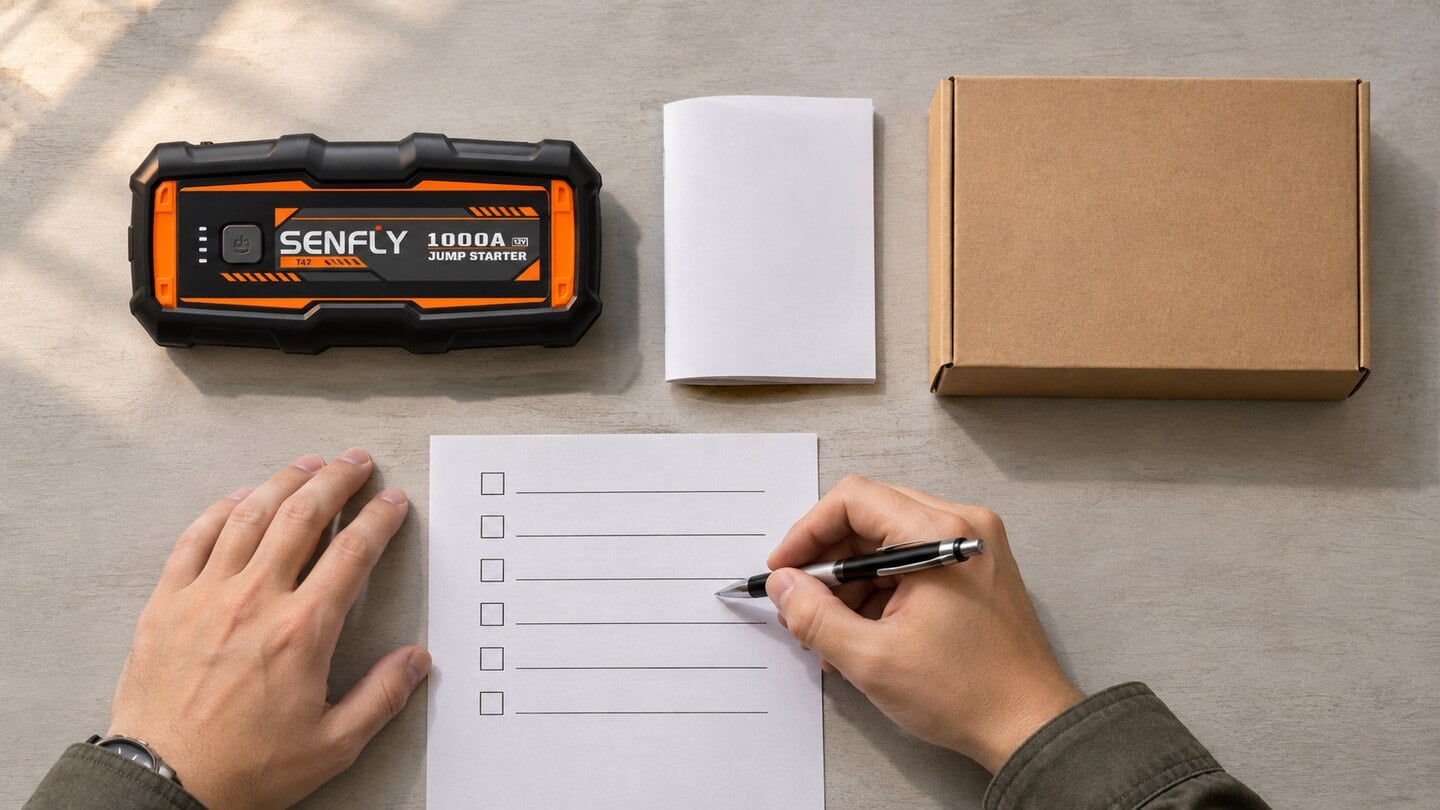
Illustrative sample review with the SENFLY T47. The carton and booklet are props, not a statement of included accessories.
Separate the price of the starter from any approved charger, cable, vehicle adapter, case and spares. If the quote includes a recharge-time claim, ask for the source power and starting charge level. Confirm which accessories are included, which are optional, and which are available as replacements. Compare the cost of a complete usable kit rather than the price of the bare unit.
Ask which entity owns the design, which site assembles the quoted model, who releases finished goods and who maintains records. Name the party responsible for warranty decisions, costs and safety escalation. Match these responsibilities to the legal entities on the quote and purchase order. For larger orders, consider a facility review that covers the actual product and build location.
Record the approved model, revision, kit contents, packaging, labels and manual. Keep photos and an agreed spec with the acceptance criteria. Define which battery, component, firmware or packaging changes need written approval and which need evidence reviewed again. Agree how batch IDs, inspection results and failed checks will be handled before releasing production.
For lithium-powered models, request battery data and the applicable UN 38.3 test summary. Give a qualified dangerous-goods specialist the exact battery configuration, route and shipping mode to check current rules, carrier acceptance, packaging and documentation. IATA’s battery shipping resources cover air transport; your shipper should confirm the requirements for the actual shipment. A UN 38.3 summary is transport evidence, not a product safety certificate.
Look for independent accounts that identify the exact model, vehicle, conditions and support experience. Separate fit, seller, transport and instruction complaints from apparent product faults. Ask what the supplier can verify or fix. Reviews can reveal what to investigate, but they cannot substitute for testing your proposed configuration.
Send the supplier one real, model-specific support question before you commit. Get written terms for covered users, exclusions, proof of purchase, spares, return locations and who pays freight. For a distributor or private-label buyer, agree on who talks to the end customer, investigates the fault and funds the remedy.
Include equipment, kit extras, samples, agreed inspections, freight, dangerous-goods handling, training, returns and spares. Record assumptions separately from quotes. Do not let a cheaper unit price cancel a missing fit confirmation or unavailable documentation. Ask shortlisted suppliers to explain material price differences on the same terms.
Give each unresolved item an owner and leave it marked open until you have the evidence. If you are shortlisting for retail, fleet or private label, send SENFLY your voltage, vehicle list, destination, quantity and kit requirements so we can discuss an appropriate model and sample. Contact SENFLY about your sourcing brief.
 Hot News
 EN